
Celebrating murder is not only politically harmful - it is a fundamental moral wrong
Whatever one’s political views, the assassination of Charlie Kirk is an unjustifiable tragedy
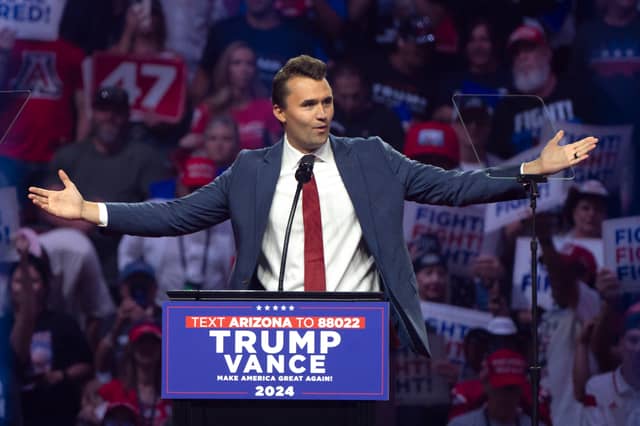


Over the last week, I’ve seen video footage online of a 23-year-old woman, Ukrainian refugee Iryana Zarutska, being stabbed to death by a stranger on a North Carolina train. I’ve also seen a 31-year-old man, Charlie Kirk, shot and killed while debating students at an open-air university campus event in Utah, a life-ending bang ringing out as he replied to a question.
Like many, I’ve struggled to process both events and their subsequent fall-out, particularly with Kirk, a central figure in Trump’s MAGA machine. Teenagers have casually mentioned seeing graphic footage of his killing to parents. Some people have gleefully, sickeningly, celebrated, arguing his politics worthy of the most extreme form of censorship. “He didn’t deserve to be assassinated, but…” statements also conveyed a weary sense of inevitability: political violence is simply expected.
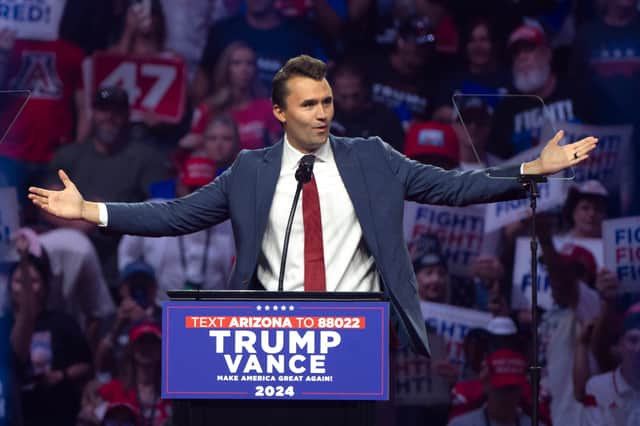
Kirk founded right-wing organisation Turning Point USA, aged 18, building a youth movement galvanising millions of young Americans to embrace Trump for President in both the 2016 and 2024 elections. The core beliefs he advocated are rooted in fundamentalist Christian conservativism, regarding abortion, sex-stereotypical gender norms, and gun-ownership. Kirk promoted these via “Prove Me Wrong” debating events favourable to online provocateurs, where offline events at universities are filmed for online viral content.
Highly-skilled in debate, with unshakeable core convictions, he proved a formidable sparring-partner for left-wing activists or campus liberals who’d come to debate him. Determinedly good-natured during confrontation, he was demonstrably committed to speaking to opponents. Here, I resist stating my own political objections to his views: they’re beside the point. His murder is an unjustifiable tragedy.
His final tweets regarded Iryana Zarutska. He urged her death be “politicised” as politics “allowed a savage monster with 14 priors to be free on the streets to kill her”. Many did, from what I saw online. Soon, though, this was taken over by responses to Kirk’s murder.
There were mournful tributes from political allies. Calls for vengeance and a “war” of “good versus evil” from some fellow travellers. This weekend, many of Kirk’s UK admirers supported the massive Unite The Kingdom rally organised by Tommy Robinson in London.
Speakers like Katie Hopkins, invoking Kirk’s name, raged about an undefined “THEY!” apparently causing all our problems. Into this mix, horrified calls for calm from those with liberal principles right across the political spectrum.
During this, Iryana Zarutska’s image kept circling. CCTV footage of her walking on to the train. Not knowing what was coming. Viewers couldn’t help but urge her to sit somewhere else, not in front of the man who, unprovoked, murdered her. But we were witnessing real-life, not film, not fiction.
Removal of online filters
For those who don’t frequent the world of social media: seeing the clips of Zarutska and Kirk wasn’t a conscious choice. While some positives arguably came from Elon Musk’s takeover of Twitter, now X, the removal of filtering safeguards for such content is absolutely not one of them.
We are simply not built to consume such content, expecting it not to change us. In pre-digital life, in analogue times, still-images of atrocity could be powerful acts of witness, curated for the dailies, rarely explicit. The page, crucially, could be closed. Up-close, filmed, as-if-playing-in-real-time traumatic events you’re powerless to stop? Can any of us say with confidence this is not affecting us – and our children, our culture, our politics - negatively?
Saying this on X/Twitter, led to a minor pile-on. Some insisted we do need to witness this; did I have no compassion? Was I policing people in how to “be enraged”? I saw less reasoning from those sharing footage of Kirk’s death. What was clear, in both cases, was the individual was not the true subject. The intended emotional or political state the poster wished to invoke was. What each tragedy could be made to symbolise the point of sharing.
Then, a shift occurred. Many of Kirk’s supporters urged people not to share graphic footage.
More common became clips of him debating well, or still photos shared of him with his young family. This was how he should be remembered, people urged. Unlike Zarutska, a full subject, not reducible to his final moments.
The motivations of Kirk’s alleged killer remain unclear. Those celebrating the tragic slaying of the young husband and father, however, have come largely from a juvenile online left, incapable of using words to cohere an argument, a type – in my experience - ordinarily far less confident in person than the character they present as behind a screen. Everything online is game, set, match. And if “winning” is all that’s wanted, what’s an opponent’s filmed death but a “Looool” moment? This snarky dehumanisation is consequential, though, suggesting a serious compassion-vacuum for the suffering of others.
For me, the takeaway message of the last week is that political violence is now expected, normalised in our heads; more worryingly it is supported by a core of both left and right-wing agitators as a way of doing things. At the same time: most of us don’t want to harm each other. We desperately want to talk. This can become lost, but has to be remembered.
Those with liberal values, whether left, centrist, or right-leaning can share foundational beliefs – this, too, is often forgotten. Freedom of speech, toleration of other’s opinions even while seeking to change them; these values belong to no “side” and are our best chance against extremism. Not the imagined kind - gender critical feminists or Brexit voters described as “fascist” e.g. - but the real kind, already fomenting, for some time now. It starts with talking to, and refusing to dehumanise opponents. Charlie Kirk, as Iryana Zarutska, was a full human being. Celebrating his murder isn’t only politically harmful, but a fundamental moral wrong.
Comments
Want to join the conversation? Please or to comment on this article.