
Catholic feminist writer calls for the creation of Lay Women Cardinals
Catholic feminist writer Debra Maria Flint has criticised the absence of women at the forthcoming Papal Conclave and called for the creation of lay women cardinals with voting rights at future synods.
She stated: ‘Women are half of the human race and they represent half of all Church members. It is disgraceful that they have no say in the election of the leader of their Church and it is certainly not historical or traditional."
Flint states that although the origin of the cardinalate is disputed; it is generally agreed that it did not exist until at least the 6th century when the term was used to describe the deacons of the seven regions of the city of Rome. In areas outside Rome, however, the title cardinal was given as a mark of honour and was not just applied to ecclesiastics.
Lay cardinals have previously existed in the Roman Catholic Church from the sixteenth to the early twentieth century although all of them were men. However, in 1917 the new Code of Canon Law dispensed with lay cardinals and decreed that from then on only priests or bishops could be given the title of cardinal thus ensuring that all Church governance lay in the hands of clerics.
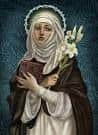

The writer, who has written two books on the roles of women in the Church, believes the early Christian Church to have been inclusive as Jesus had chosen Mary Magdalen to be the first witness of the resurrection and instructed her to go and tell the male disciples that he had risen (Matt 28: 10; Mark 16: 10; John 20:17).
She also points out that bishops were elected by all the people in the early Christian centuries. This is confirmed by Hippolytus, a third century theologian who wrote in the Apostolic Tradition:
‘Let the bishop be ordained after he has been chosen by all the people.’
It is also clear, from scripture and other sources, that women were ordained as deacons in the early church. A female deacon called Phoebe is mentioned by St. Paul in one of his letters (Romans 16:1-3) and a woman deacon is mentioned outside of the New Testament by Pliny the Younger who was a lawyer of ancient Rome. In addition, there are a variety of references to the order of female deacons in the writings of the early church fathers and it is clear from the Canons of the Synod of Epaone (517 A.D.) that the female diaconate was later abolished due to increasing patriarchal trends. Canon 21 of that particular synod abolished the female diaconate in its area.
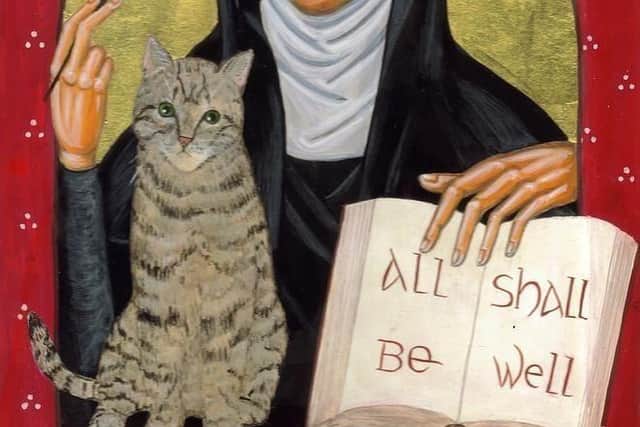
Flint demonstrates that women were highly influential in England and Ireland in the sixth and seventh centuries where they had similar powers to those of a bishop.
She states: "They ruled over double monasteries of women and men. Each of these monasteries was founded by a devout aristocratic woman who presided over two separate communities of monks and priests. These abbesses had complete power of governance and their abbeys also became famous for their learning. St Hilda of Whitby taught theology to five men who later became bishops.
"Moreover, the female abbesses also voted at Church Synods. St Hilda was host to the famous Synod of Whitby which sought to determine the date when Easter should be celebrated in Anglo Saxon England. Her successor, Aelffled, attended the Synod of Nidd and persuaded the synod to restore St Wilfrid to the bishopric. Sadly, these monasteries were destroyed by Viking raids which began in the late eighth century and future abbesses were never endowed with the powers that these women once had."
Following the demise of the early Christian abbesses, Flint argues that there were other women who were very influential in the pre reformation Catholic Church and gives Julian of Norwich and Catherine of Siena as examples. She states:
‘Julian of Norwich wrote ‘The Revelations of Divine Love’ which led to her being regarded as one of the greatest Christian mystics of all time. However, during her own times, she was mainly sought out for her spiritual direction, and many royals and church dignitaries would travel very long distances to receive her advice.
Catherine of Siena was, in effect, the spiritual adviser of Pope Gregory XI and played a key role in his 1376 decision to leave Avignon for Rome after which he sent her to negotiate peace with the Florentine Republic. Can you imagine a Pope having a woman as his spiritual adviser today? I think not. The current hierarchy are happy to admire women in the past for everything they did for the Church but they will not allow modern women any such influence.’
Flint believes that there are many factors that led to the demise of women within Catholicism but the two main ones appear to be the reformation and mandatory celibacy. She said,
‘The reformation undermined women because the monasteries were destroyed and many records of notable spiritual women were lost. In addition, the female religious orders and the vocations of consecrated widow and anchorite were completely wiped out. When some of these vocations were eventually restored the women, once again, did not have the influence they had enjoyed in previous centuries.
Priests were married in the early church and the idea that all priests should be forced to be celibate was one of the issues that led to the East West Schism in 1054. At that time the Church split into Orthodox in the East and Roman Catholic in the West. The Orthodox have never mandated celibacy but the Roman Catholic Church mandated it in 1122 at the First Council of the Lateran. It can be argued that this has led to an all-male culture within the Church which has caused women to be increasingly disregarded. A married man has a far better understanding of women than a celibate one.’
Flint believes that Jesus treated women as equals and that the Roman Catholic Church of today, in the way it fails to include women, has moved away from the traditions of the early church. She advocates the creation of female lay cardinals as a way to resolve this. She states:
‘Women are created by God in the image of God. They also represent about 50 percent of church members and yet they currently have no say in the election of a Pope who will lead the Church. This should be addressed and the best way to currently address it would be to return to the practice of creating lay cardinals and to ensure that some of them are women’.
Rev. Debra Maria Flint is a former Roman Catholic who is now ordained in the Old Catholic tradition. She serves the English and Scottish border areas.