
Andrew Connon: Tattie howkin’ taught us about reality of food

Have we lost sight of the value of the produce we take for granted in our shops, asks Andrew Connon
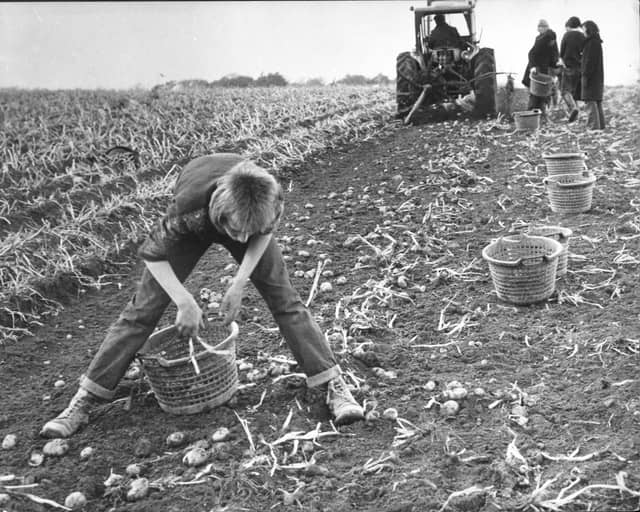
Driving south to Edinburgh this week, past fields of tatties being planted, I was reminded of my youth spent picking tatties during the “tattie holidays”.
For many folk, that sounds like ancient history. But that, in itself, points to something significant – just how far we’ve come from food production being part of people’s everyday lives. And, when you understand where food comes from and what it takes to produce it, you understand why it matters.
Today, food is often treated as something that will always be there. Supermarket shelves are expected to stay full, choice is taken for granted, and price too often becomes a race to the bottom. Recent Easter promotions saw vegetables including carrots, potatoes and swedes being sold for as little as 4p.
This matters. Because, when we stop valuing domestic food production, we put food security at risk.
In an increasingly uncertain world, Scotland cannot rely on fragile global supply chains while allowing its own food-producing capacity to decline.
Climate shocks, global instability and market disruption have shown how quickly international supply can come under pressure. A secure and resilient food supply should be recognised for what it is – a national priority. A point reinforced at our own Scottish Parliament hustings.
Scottish agriculture is being asked to deliver more than ever before: high-quality food, climate action, biodiversity gains, water resilience and thriving rural communities. But, financially, a lot of farmers and crofters are under immense pressure.
For many, it’s been too much. If we allow our own production base to weaken, it’s doesn’t just mean importing more food, it means exporting resilience, losing rural jobs and placing food security in the hands of increasingly volatile global markets.
That’s why our manifesto is calling for practical action from the next Scottish government. We need a measurable national food production target that recognises Scotland’s strengths in beef, lamb, dairy, cereals, potatoes, vegetables and soft fruit.
Our ShelfWatch initiative repeatedly highlights where supermarket shelves are favouring cheaper imports here – and in doing so, undermining support for our producers.
We need fairness in the supply chain. The next Scottish Government must work with the UK government, processors, retailers and NFU Scotland to deliver the Fair Dealing Obligations, to ensure contract transparency, prompt payment, and fairer treatment across the chain.
We also need stronger producer organisations and co-operatives, plus proper support for local abattoirs, processing and storage.
We need the next Scottish Government to ensure that schools, hospitals, care homes and prisons prioritise Scottish food through procurement rules that support local producers and make it easier for SMEs and co-operatives to bid and compete.
And we need a clear commitment to transparency across the food system, so consumers can make informed choices – including a review of labelling regulations.
“Tattie holidays” may be a thing of the past, but purchasing power is not. These are practical steps to protect our ability to produce food – and our industry.
Food production is not just another sector. It is a strategic national asset. And we should treat it that way.
Because the real question is no longer whether Scottish food production matters. It is whether we value it enough to protect it.
And perhaps that brings me back to where I started – those tattie holidays, when food production was something we, as a nation, stood behind.
Andrew Connon is president of NFU Scotland