
Head of leading robotics and AI institute resigns amid grant funding row
CEO accuses university leadership of “turning their back” on grant opportunity



The head of a leading artificial intelligence and robotics research institute has resigned after accusing university executives of undermining his efforts to grow the institution by “turning their back” on a major funding bid.
Stewart Miller, chief executive officer of the National Robotarium in Edinburgh, has accused Heriot-Watt University’s leadership of failing to apply for grant funding from a UK government agency, a decision he described as the “final straw.”
Mr Miller, who is a member of the Scottish Government’s industry leadership group for engineering and advanced manufacturing, said the university’s decision to discard the bid at the “eleventh hour” made it clear that it “no longer respected or valued” his contribution.
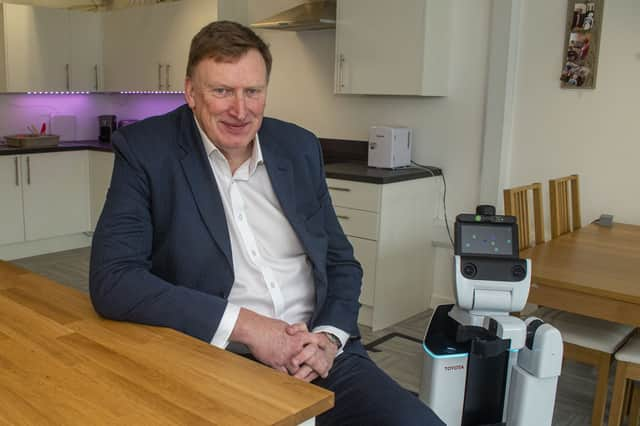
However, the university said it disagreed with Mr Miller’s “characterisation of recent events,” and said that it remained “fully committed” to the continued sucesss of the National Robotarium.
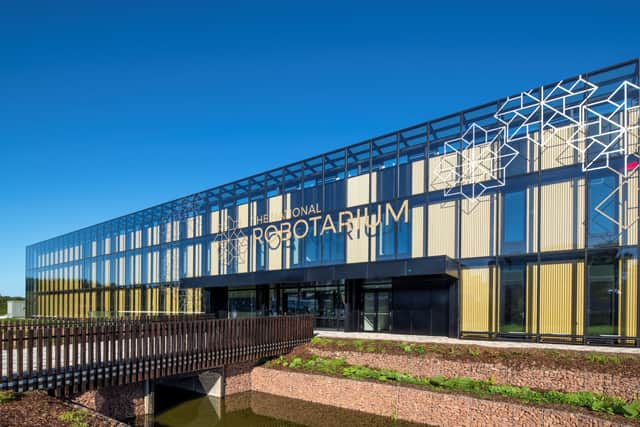
The global research institute helps teach and develop the next generation of roboticists, and delivers incubation and business acceleration support for tech start-ups. Its £22.4 million state of the art facility at Heriot-Watt’s campus includes high-spec laboratories and collaboration space dedicated to the development and testing of robotics and AI solutions.
The venture is part of the Data Driven Innovation initiative, supported by £21m in funding from the UK government and £1.4m from the Scottish government through the Edinburgh and South-East Scotland City Region Deal.
Mr Miller has a background in the aerospace sector, having worked for major firms such as BAE Systems and Leonardo. He took up the role of CEO of the National Robotarium in 2021, with the largest and most advanced research facility for robotics and AI in the UK officially opening the following year.
But in a post on LinkedIn, he made it clear that he could no longer continue. Outlining his decision to resign, Mr Miller, who is also a member of the UK government’s new robotics advisory group, explained: “This is as a direct consequence of Heriot-Watt University senior leadership turning their back on an opportunity to bring £7.5m of investment into the Scottish robotic economy.
“By not applying for Innovate UK grant funding for Robotic Adoption Hubs the HWU Senior leadership undermined all of my efforts over 5 years to establish and grow the National Robotarium to the position of respect and prominence it now has in the UK and in Europe.”
“I had been instrumental in gaining support from [the] UK government for the robotics hub initiative and had positioned the National Robotarium to lead an extremely strong bid on behalf of Scotland, with support from Scottish stakeholders and industry partners.
“For this to be discarded at the eleventh hour was the final straw in a sequence of events over the past six months that have made it clear that HWU no longer respected or valued my contribution as CEO of the National Robotarium.”
Mr Miller, a former chief technology officer with the UK government’s innovation agency, Innovate UK, added: “I want to apologise to everyone that will be impacted by this sudden departure, in particular the team at the National Robotarium and the many Scottish stakeholders that supported the proposal and have been a tremendous support for the past five years.
“The need for adoption support for Scottish and wider UK industry has not gone away, nor the need to support new robotics developers and to encourage careers in robotics I hope to continue working on these topics in the future even if HWU leadership does not value them there are many in Scotland and across the UK who do.”
The centre’s research areas including robotics and autonomous systems, human and robot interaction, and precision laser applications.
In the National Robotarium’s most recent annual report, Mr Miller said it had built “strong foundations” and “solidified Scotland’s influence” on the global robotics stage. Setting out the next steps, he said: “The next phase of our journey is about scale and coordination. Robotics leadership will not be achieved in isolation, but through a connected national effort, aligning skills, infrastructure and investment around shared priorities.”
He added: “The coming decade will define how robotics and artificial intelligence shape our economy, our public services, and our everyday lives. The question is no longer whether robotics will transform society, but whether the UK will play a leading role in that transformation.”
Last June, Mr Miller warned that Scotland risked missing out on the global robotics revolution as other nations surged ahead in a market projected to reach £218 billion by 2030.
“Countries like China, America, and Singapore are racing ahead in robotics adoption and innovation, while the UK ranks just 24th globally for robots per manufacturing worker,” he explained. “But Scotland has exceptional foundations that, with the right approach, could make us a global robotics powerhouse.”
A Heriot-Watt University spokesperson said: "We can confirm that Stewart Miller has submitted his resignation as chief executive officer of the National Robotarium. The university recognises his contribution over the past five years in helping to establish and develop the centre. However, we do not agree with the characterisation of recent events.
“Decisions regarding funding applications and strategic priorities are taken following careful consideration to ensure alignment with requirements and compliance with funding regulations. As this and related matters are subject to an internal review, it would not be appropriate to comment further at this stage.
“Heriot-Watt University remains fully committed to the continued success of the National Robotarium, and to advancing robotics innovation, industry collaboration and skills development across Scotland and the wider UK. We will continue to work closely with partners to build on the strong foundations already in place.”
Comments
Want to join the conversation? Please or to comment on this article.