
Edinburgh trams: Officials urge council to prioritise a new route to Royal Infirmary
The business case underlines the importance of a North-South line in providing fast, efficient public transport for the Capital and its growing population.But a summary of the strategic business case says: “It would be highly unlikely that a tram route of this length (18km) would be built in one go.
The project to build a new Edinburgh North-South tramline should prioritise the southern section of the line from the city centre to the Royal Infirmary, officials have recommended.
A report on the business case for the new line, which will be considered by the city council’s transport committee later this month, says “further work” is required on the plans for the northern leg to Granton, where there has been a strong campaign against the proposal to route trams along the Roseburn Path, a popular walking and cycling corridor.
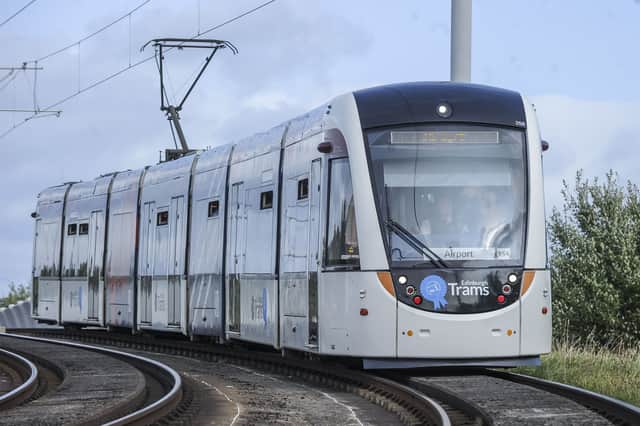

The business case underlines the importance of a North-South line in providing fast, efficient public transport for the Capital and its growing population.
But a summary of the strategic business case says: “It would be highly unlikely that a tram route of this length (18km) would be built in one go.
“Based on forecast passengers and other factors, the Strategic Business Case recommends prioritising the section from city centre to the Royal Infirmary of Edinburgh / Edinburgh BioQuarter using a route via North and South Bridges, Newington, and Cameron Toll.”
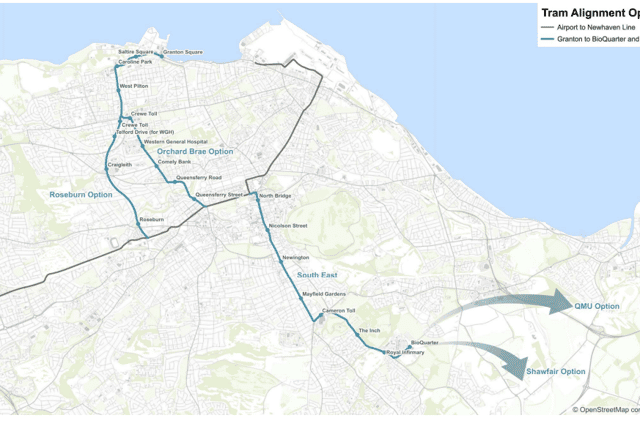
It notes that this would also complement work being done on reopening Edinburgh’s South Suburban Railway using tram trains, which could switch between rail tracks and tramlines.
And the summary says: “While the section from Granton to the city centre is still important to deliver the full north-south route, further work on this section is needed.”
Transport convener Stephen Jenkinson said he still wanted the full line to be built. He said: “I am absolutely convinced we need a grand and bold vision for Edinburgh and the Lothian region when it comes to tram. I believe the Granton to BioQuarter project is strategically important for the city.”
But he acknowledged there were “political” challenges - SNP and Lib Dem councillors strongly oppose using the Roseburn Path and the Conservatives are against the new line, meaning there is no majority for the full scheme as envisaged by Cllr Jenkinson.
He said: “What we are proposing to do as council is focus our efforts on the southern leg.”
The report says: “Trams have high capacity to meet Edinburgh’s and the wider regions’ growth challenges (buses alone cannot fully meet forecast demand); and tram is an efficient use of space which is important for the historic narrow streets in Edinburgh. Tram has already played a key role in city planning and has been successful in attracting development and investment.”
And it points out that some of the most deprived areas of the city would be served by the new line, including Granton, Muirhouse, Drylaw, The Inch, Moredun and Craigmillar/ Greendykes.
“Nearly all of these locations suffer from relatively poor public transport accessibility.The introduction of new tram links (integrated with bus) would transform access to employment, education, health, and open space and leisure facilities from deprived communities and disadvantaged households.”
Cllr Jenkinson estimated work on construction of the new line - “spades in the ground” - could start in about four years’ time. “With a fair wind - and there are always challenges around complex infrastructure projects - if the financing was in place, I think we’re looking towards the end of this decade, probably 2030.”
The cost of a new North-South tramline is expected to be around £2.5 billion - and it is not yet clear who would pay the bill.
The strategic business case says the cost of the southern section of the line, from Princes Street to the BioQuarter, would be around £1.7 billion; the cost of the northern section using the Roseburn Path would be £800m; and the cost of the northern section under the Orchard Brae option would by £1.2 billion; thus giving a total cost of £2.5 billion for the full line using Roseburn Path or £2.9 billion using Orchard Brae.
In an appendix to the main report, council officials look at how the line could be paid for.
While the hope is still that there will be major funding from the Scottish Government, the report says many tram projects elsewhere in the UK have also required a “local contribution”.
It lists a number of options which are “potentially worth further consideration”, including a council tax rise, increased parking charges, Visitor Levy income and developer contributions. The report proposes further modelling of the options.
Transport convener Stephen Jenkinson said: "Edinburgh cannot fund the development of this project on its own. We will always require external funding, whether that's through the Scottish Government or UK Government or a combination."
First Minister John Swinney, in an interview with the Evening News in May, insisted the North-South tram scheme was a "local project" which the council had to take forward.
Comments
Want to join the conversation? Please or to comment on this article.