
Alexander McCall Smith on the return of 44 Scotland Street to The Scotsman
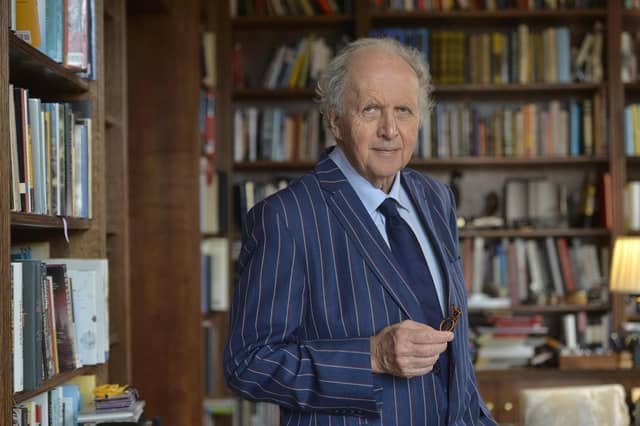

With Bertie’s Theory of Ice Cream, the seventy-something Scottish author continues to delight his fans worldwide
The wait is over as a new series of Alexander McCall Smith’s Scotland Street starts again in The Scotsman on Monday [3 February] and to celebrate the author has taken time out of his busy schedule to answer questions that give us a flavour of Bertie’s Theory of Ice Cream.
Due to appear from Monday to Friday until Wednesday 19 March in print in the newspaper and online the series will also be published collected into one volume in hardback, e-book and audio book form in August.
This is the 18th run of Scotland Street in The Scotsman where it has been running since 2003, making it the longest running serial novel in the world, as it continues to delight readers keen to keep up with the adventures of the community of neighbours in Edinburgh’s New Town.
As well as its Scotsman iteration, Bertie and Co have appeared in hardback, paperback, audio and e-books, with a Scotland Street Cookbook giving readers the chance to reproduce the meals that give sustenance to the New Towners, from Bertie’s Favourite Panforte di Siena to Angus Lordie's famous cheese scones. Numerous BBC Radio plays and adaptations and a Edinburgh Festival Fringe stage show and Scotland Street Festival walks are also
Fans of McCall Smith are in for a bumper year in 2025 as along with Bertie’s Theory of Ice Cream, the indefatigable globetrotting 70-something writer will be publishing several other books.
In February the second novel in the Perfect Passion Company series set in Edinburgh, Looking for You, will be published, followed by The Lost Language of Oysters in June, a new Von Igelfeld novel, set in the world of Academia. Another No.1 Ladies’ Detective Agency book, A Tale of Two Mothers, is due out in September and another untitled standalone novel will be published in October, followed by The Wit and Wisdom of Precious Ramotswe in November and a new poetry collection at some point in the year.
While Scotland Street celebrates a coming of age with its 18th run, Bertie remains his perfect eight year old self, making him an international favourite with McCall Smith’s legions of fans who turn out to see the author when he tours. Currently in South Africa, this year’s travels will see him in Botswana, the United States, various book festivals, possibly India, but most of all at home in Scotland - and always on Scotland Street.
WHAT IS BERTIE’S THEORY OF ICE CREAM?
Bertie’s theory of ice cream is quite complex, as befits a theory propounded by such a
thoughtful young boy. It deals with the role of anticipation in our lives; the sense of achievement when you reach a goal (that is, get the ice cream), and questions of sharing
(should you allow others more than one quick lick of the cone)? There is a lot to think about in ice cream!
WHAT IS YOUR FAVOURITE FLAVOUR OF ICE CREAM? DO YOU INDULGE
OFTEN?
I very rarely have ice cream as I follow a fairly low carb diet. When I do have it, I go for
vanilla. Vanilla is simple and unpretentious. Ice cream snobbery is as bad as wine snobbery.
WHO IS YOUR MOST POPULAR CHARACTER IN SCOTLAND STREET?/IN ALL OF
YOUR WRITING?
There are two characters that have a particularly wide following all over the world. Precious Ramotswe of The No 1 Ladies’ Detective Agency is one of them, and the other is Bertie, from Scotland Street. I am always running into people all over the place who feel they have a particular relationship with Bertie. I have met numerous readers on my tours who have named their son/dog Bertie. There are lots of little Berties, human and canine.
WHO DO YOU LIKE WRITING MOST?
I enjoy writing about all my characters, but I suppose I get a particular pleasure in writing about Bertie and his friend, Ranald Braveheart Macpherson. I also enjoy writing about Olive, that ghastly little girl from Bertie’s class at school.
WHY DID YOU DECIDE THAT BERTIE WOULDN’T AGE, THAT HE WILL ALWAYS BE EIGHT YEARS OLD?
Bertie is still eight (I think). I decided that he wouldn’t age because he is such fun to write
about as a small boy. He is so honest. Others around him are self-seeking, but Bertie is
generous and kind. He is tolerant of his dreadful mother, Irene. It suits him that she has gone up to Aberdeen, although he would never say so openly. The boys in his class are as bad as Olive and Pansy. Larch is a thug, as is Tofu. There is a new character, too, Socrates Dunbar, whom one has to watch. In the middle of all this, there is Bertie – considerate and good-natured.
WHERE DID YOU GET YOUR INSPIRATION FOR THE INITIAL SERIES? AND HOW DO YOU KEEP GOING, KEEPING IT FRESH AND BRINGING IN NEW READERS?
The idea of writing a serial novel came from a conversation I had with Armistead Maupin in San Francisco. He revitalised the serial novel in the twentieth century. The actual setting and characters came to me quite quickly. The characters walked onto the page – it was as if they had always been there, waiting for me.
It keeps going because I find there is never any shortage of things for me to write about. If you invent characters and then leave them to get on with it, you will find that events and issues occur naturally.
DO PEOPLE EVER THINK YOU’VE BASED THE CHARACTERS ON THEM? NEW TOWN RESIDENTS PERHAPS?
Some people do. However, the characters are all entirely fictional except where I introduce real characters, who appear in the books under their own names. It is always fairly clear who these are. So, for example, Ian Rankin has made an appearance – he met Bertie after he, Ian, was accidentally hit in the arm by an arrow fired by the Royal Company of Archers. The Archers ran away, of course, but Bertie had seen them and he led Ian to Archers’ Hall to remonstrate. Tam Dalyell also appeared as himself in one of the early Scotland Street books. Bertie met him in the café at Valvona & Crolla, where Bertie asked Tam what the answer was to the West Lothian question.
IS THE STORYLINE BASED ON THE REAL LIFE COMINGS AND GOINGS THAT YOU HAVE WITNESSED IN THAT AREA OF THE CITY?
To an extent, yes. Real life has an uncanny habit of imitating what happens in literature.
Extraordinary.
WHY IS IT SO POPULAR? IN SCOTLAND AND OVERSEAS? WHAT IS THE APPEAL WORLDWIDE OF THE CHARACTERS AND EVENTS IN AN EDINBURGH STREET?
I think that the popularity of the Scotland Street novels in other countries is somehow
connected with the fact that it is a story that unfolds within a fairly intimate, contained setting.
This is about a world in which people know one another. There are few strangers in the
Scotland Street story, and that is something that appeals in a world that is increasingly
anonymous. Also, this story and the world it describes is fairly old-fashioned, and people
yearn for that. They want courtesy. They want consideration. Edinburgh seems to them to be a city in which such virtues flourish – and I think that this is largely true. Edinburgh is not a vast, threatening city. There is also no violence or aggression in Scotland Street. If you look at contemporary television, there are an awful lot of murders. Is murder really the only story?
WHAT THREE WORDS DESCRIBE THE SCOTLAND STREET SERIES?
Local. Quirky. Gentle.
DO YOU DREAM ABOUT THE CHARACTERS AS IF THEY WERE REAL?
No. However, I sometimes dream plots. I wake up and write them down. Strange.
HOW DOES SCOTLAND STREET FEED INTO YOUR OTHER WRITING?
I think that the various series I write do have some effect on one another. They are written in different voices, but inevitably the act of writing helps to develop style.
WHY DO YOU LIKE WRITING IN THE SCOTSMAN?
I enjoy the immediate contact it gives with a readership. It is also the paper that I have read all my adult life. The Scotsman is a vital part of the national conversation and it is very important to support it. I consider it a great privilege to write in this newspaper.
HOW DOES WRITING IN THE DAILY EPISODIC FORM INFLUENCE THE PLOT OR STRUCTURE, THE WAY YOU WRITE?
Writing in daily episodic form, I think, helps one to be concise. You have a limited amount of space. You must be clear as to what you want to say. There are particular considerations of pacing and plot development that are a good discipline.
WHICH WRITERS INSPIRED YOU TO DO IT IN THIS FORM?
Armistead Maupin in Tales of the City.
CAN YOU EXPLAIN THE THEORY OF DUTCHITUDE AND WHY IT TOUCHES A NERVE?
Not really! Dutchitude is a word that I coined in this book. It means, I suppose, the state of being Dutch.
YOUR READER FEEDBACK MENTIONS KINDNESS, OPTIMISM, HOPE, JOY, LOVE LIGHT… DO YOU THINK WE NEED MORE OF THESE IN THE WORLD? AND WAS IT YOUR AIM TO IMPART THOSE OR IS THAT JUST THE WAY IT TURNED OUT BECAUSE YOU’RE THAT KIND OF PERSON?
The Botswana books, and perhaps the other ones too, might well be described as positive in tone. I would not argue with that description. I did not set out to write books that took that approach – it’s just the way they turned out.
I think that it is important to bear in mind that the world is composed not only of suffering and despair, but that kindness and positivity are also options in the way we approach life. I think it is certainly the case that we need to emphasise these things rather than dwelling on the negative.
As for my personal approach to life, I am interested in philosophy and in the fundamental question of how we are to live our lives. I think that people are increasingly concerned about that. Look at the popularity of mindfulness today. Mindfulness is nothing new, really: the Stoic philosophers have been pointing us in that direction for a very long time indeed.
WHAT FEEDBACK HAS BEEN THE MOST REWARDING, AND SURPRISING?
I have often been touched by letters from readers all over the world who tell me that the books have helped them in some way at times of trouble.
I get many letters from readers who say that Precious Ramotswe helped them get through chemotherapy. I get letters from psychiatrists and therapists who say that they prescribe the books for their depressed patients.
I had a letter from somebody who said that Mma Ramotswe saved her, at the last moment, from taking her own life. The letters we get are often very moving.
WHAT CAN YOU TELL US ABOUT LOOKING FOR YOU: A PERFECT PASSION COMPANY NOVEL, WHICH IS DUE OUT NEXT MONTH?
This is volume two of my new series, The Perfect Passion Company. This is set in an
introductions bureau in Edinburgh. The people who run the bureau introduce their clients to potential partners. It seemed to me that this would be a good vehicle for writing about all sorts of people and their personal issues. I very much enjoy writing it.
WHAT IS YOUR BEST ADVICE ABOUT FINDING THE PERFECT MATCH? IS ONLINE DATING A WASTE OF TIME? ARE PEOPLE RETURNING TO SEEKING ASSISTANCE FROM BUREAUX AND AGENCIES?
Many people still meet online, but I gather that more and more people are finding that
method unsatisfactory. There is still a role for the personal introduction, either through
friends, or through somebody who does that professionally.
In the course of writing this new series, I have done a lot of reading in the psychological and sociological literature on how people meet their partners.
As to advice, it seems that the most stable relationships are between those who see life in much the same way; who share a sense of humour; who are roughly similar to one another in background. Interestingly enough, research shows that most people fall in love with people who live within a few miles of them. So much for the long-distance relationship.
TELL US ABOUT THE OTHER BOOKS COMING OUT THIS YEAR.
A new Botswana novel. A new book in the von Igelfeld series (the Portuguese Irregular Verbs series, volume six). A volume of poetry. One or two others. I write five or more books a year.
HOW DO YOU MANAGE TO BE SO PROLIFIC?
I am very fortunate in being able to write quickly. I write one thousand words an hour.
HOW DO YOU KEEP YOUR WRITING FRESH, FOR YOURSELF WRITING IT, AND FOR READERS?
Writing many different books helps, I think. I also do a lot of touring. And you have to keep your eyes and ears open. You listen to people, and you find they say wonderful, surprising things. And most of all, you allow your imagination to get going. You spend a lot of time fantasising.
YOU WRITE ABOUT MURDER AND CRIME TOO BUT IN A GENTLE WAY. DO YOU ENJOY EXPLORING THE FRINGES OF THE DARKER SIDE OF LIFE?
I don’t do dark very well, I’m afraid! I never write about murder or anything like that. The
only crime series I write, my Swedish series, the Ulf Varg novels, are set in a department of sensitive crimes. These crimes are very small ones – as most crime is, incidentally.
One day I shall write a series of novels about parking offences. It could be called No Place to Park. It would be all about people who park illegally. Set in Edinburgh, it would be about the illegal parking underbelly of Edinburgh.
DO YOU TRAVEL A LOT STILL, FOR EXAMPLE TO BOTSWANA?
I travel a lot for the books. I have just been on tour in Botswana and I am currently in Cape Town, where I have been doing various events.
I shall be in Botswana in April, when I go on safari with readers from all over the world who want to spend time in the world of Mma Ramotswe. That is an annual event. I have also set up a scheme of awards for artists in Botswana, and I shall be going there for that. That is a most enjoyable project: we are giving prizes to emergent artists throughout Botswana.
I go on tour in the United States every year too, and I also attend literary festivals in various places. Later this year I shall probably be in India.
But I like, most of all, to be at home in Edinburgh or in our house in Argyll.
WHAT’S THE QUESTION PEOPLE ASK YOU MOST?
They frequently ask whether the characters are based on real people. That crops up a lot.
They also ask whether I use a computer or pen and ink. [It’s nearly always a computer but he always has a notebook in his pocket for ideas and snatches of overheard conversations.]
Sometimes readers at events say odd things. I was in the US once on tour and a woman came up to me and said, “You know something? You’re going to be far more successful posthumously.” I did not know what to say, other than ‘Thank you’.
WHERE IS YOUR HAPPY PLACE?
Bruntsfield in Edinburgh – having lunch or coffee with friends. Going to the fish shop.
Taking my grandsons to the bookshop. Also, Argyll. On the hill. Listening to a waterfall.
Rowing my rowing boat. Listening to geese flying in formation overhead.
WHERE IS THE MOST SURPRISING PLACE YOUR BOOKS ARE POPULAR?
They are popular in India and Malaysia. I was surprised to find that my von Igelfeld books
went down well in Bulgaria. The Botswana books are very popular in Sweden.
IF YOU COULD BE ONE OF YOUR CHARACTERS, WHO WOULD IT BE?
Isabel Dalhousie.
[The professional philosopher and amateur sleuth star of his Isabel Dalhousie detective series.]
WHERE DO YOU LIVE MOST OF THE TIME?
Difficult to say.
HOW OLD ARE YOU NOW?
Internally, about 18 (as are most of my friends). In reality, a bit more.
HOW HAS LIVING IN EDINBURGH SHAPED YOU AS A WRITER?
Edinburgh is my greatest influence. The city has shaped my writing to a very great extent. I love its slight reserve. I love its quality of slight indirectness. It is a subtle place. Other cities may be very open, very in your face – not Edinburgh. Oh no.
Bertie’s Theory of Ice Cream – A Scotland Street novel, runs Monday to Friday in The Scotsman from Monday 2 February until Wednesday 19 March, and will be published in book form in August, in hardback (Birlinn, on their Polygon imprint), ebook and audio book.
Comments
Want to join the conversation? Please or to comment on this article.