
'Phoque! Phoque!' Why you should never go surfing with seals, primary school kids and French tourists


Sometimes cross-cultural misunderstandings can be overcome by the universal language of surfing, writes Roger Cox
As I stumble ever closer to the big five-o, my surfing mindset is gradually starting to change. On the one hand, I can feel the lifelong urge to seek out waves for myself – a perpetual background hunger, selfish and shark-like – beginning to wane; on the other hand, I find I’m able to enjoy other people’s surfing more. Case in point: a recent trip “up north” with friends. (And no, I’m not going to say where – those who are already familiar with the place will probably be able to figure it out, and for those yet to visit, I wouldn’t want to deprive you of the thrill of discovery.)
The swell was tiny, yet by pure, dumb luck our mixed group of kids and grown-ups ended up at a place where, for a couple of hours at mid-tide, the waves would hit an oddly-shaped sandbar just-so and peel along it for a ridiculous distance.
At low-tide the place offered nothing but unsurfable shorepound; at high tide it was a waveless lagoon. For a short-but-magical window of time each day, though, it produced a wave that seemed almost to defy physics.
There wasn’t much point in adults trying to surf these miniature waves – they barely had enough power to get a full-sized human moving. For the youngest members of our posse, however, aged nine and 11, it was like getting to surf a kid-sized version of Malibu in California, only with no crowds, zero risk of sunburn and the roar of the Pacific Coast Highway replaced by a vast, silent backdrop of moorland and mountains.
Twenty-something me would have taken one look at this set-up, shrugged, and driven off in search of something bigger; thirty-something me would probably have done the same. And yet here was forty-something me having an absolute blast, pushing a never-surfed-before nine-year-old into one-foot waves on an eight-foot surfboard.
Did she ride further on her first wave than many adults manage in their entire surfing lives? Yes, she did. Did she really manage to get through three complete rounds of the Macarena on another wave before the board finally ran aground in shallow water? At least three, possibly four – I was laughing so hard I lost count.
On our second day at this miraculous Liliputian surf spot, a group of five very cold-looking French tourists waded out to join us wearing nothing but shorts, T-shirts and big smiles. They were full of cheers and applause for the exploits of the junior surf squad, and as we got chatting it soon became clear that one of their number – a guy from Nantes who looked to be in his early twenties and had grown up surfing around Biarritz – was desperate to catch some novelty waves.
“I didn't even know you could surf in Scotland,” he told me.
“When you get home, you should Google ‘Thurso’”, I said.
Having exhausted most of her dance routines by this point, and surfed at least 100 miles in less than an hour, our nine-year-old surf veteran was happy enough to hand over the eight-foot soft-top, and so our French friend (I never did catch his name) grabbed the board and paddled out.
For a few, painful minutes the surf went completely flat, and I was worried he might develop hypothermia before he was able to catch a wave. Just as his violent shivering was starting to generate its own little ripples, however, a couple of promising-looking lumps appeared in the middle-distance. He opted to paddle over the first one (perhaps simply because he needed to generate some body heat), then spun around expertly under the peak of the second, paddled hard and sprung to his feet.
It was by no means a classic wave – knee-high at best – and our accidental surf explorer's weight was always going to work against him. In spite of that, however, he was still able to cruise along for 20 metres or so before he ran out of momentum. As he paddled back out for another go, he wore a grin as wide as the Loire Valley.
For the next ten minutes or so, the micro-waves poured in, and Monsieur Nantes filled his boots. I offered his non-surfing pals a shot on a bodyboard we had back at the beach, just so they could say they too had surfed in Scotland when they got back to France, but they were more interested in cheering on their pal.
Eventually, as the tide pushed further in, the water over the sandbar became too deep and the waves all-but stopped breaking. There was still time for one more surprise though: in a lull between sets, a sudden chorus of “Phoque! Phoque! Phoque!” broke out from the French contingent, with much pointing and waving of arms.
As far as the wide-eyed, open-mouthed primary school-aged kids in our group were concerned, this was way beyond the pale. Of all the words you were never, ever supposed to say, “phoque” was right up there, and yet here was a bunch of adults shouting it as loudly as they could. Had nobody told them? Surely there would be consequences?
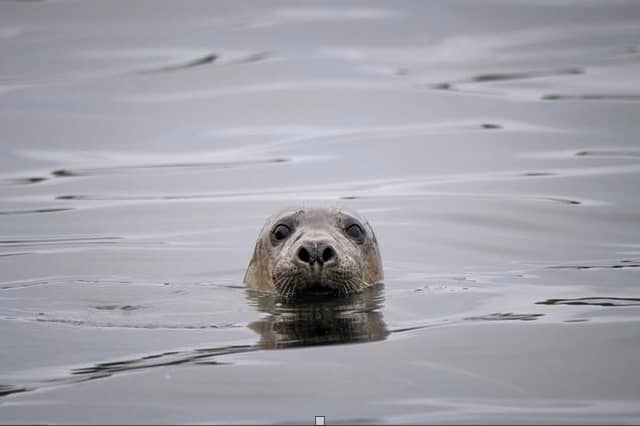
A hasty explanation that “phoque” was French for seal soon had the tourists back in the kids’ good books, and the appearance of a small, inquisitive face bobbing just beyond the surf confirmed that the grown-ups were indeed telling the truth. Kids and tourists returned home with stories to tell, and I felt surprisingly upbeat about a surf trip on which I failed to catch a single wave.
Comments
Want to join the conversation? Please or to comment on this article.