
Outlander is back with a welcome touch of retro inside
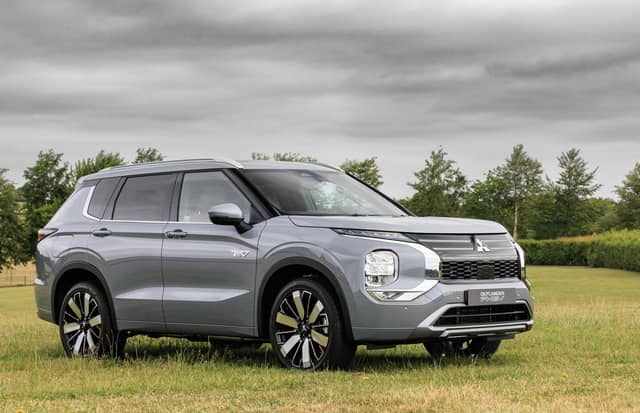

There’s lots to attract buyers to this smooth and sensible Mitsubishi, writes Jim McGill especially for drivers put off by too many touchscreen controls
Mitsubishi is back in the UK after sales stopped back in 2021. We’ve already driven the company’s latest L200 pick-up, now we’ve got our hands on the all-new Outlander, which completes the current 2026 line-up.
Of course, the Outlander name isn’t new. Back in the mid-2010s the previous Outlander was a core model in Mitsubishi’s sales success with its plug-in hybrid technology a huge attraction. Not only did it appeal to those families wanting to pioneer the shift into plug-in hybrid technology and be seen to do their bit for the environment, but from a business-user perspective there were significant tax savings. In the five years since Mitsubishi pulled away from selling cars in the UK, the market has changed significantly, most noticeably with the rise of the Chinese manufacturers. Carmakers like Jaecoo have raised the bar in terms of plug-in hybrid technology, while also managing to be hugely aggressive in terms of pricing. So the returning Outlander faces a stiff comeback.
On the face of it, the 2026 model’s fundamentals are the same as the previous model, in so much as it’s a plug-in hybrid family SUV. Worth highlighting it’s a true Mitsubishi, rather than a rebadged Renault as many of the range is in Europe. But with prices starting at five quid under £47,000 and an all-electric range of up to 53-miles, the question is, is the latest Outlander really ready to take on the plug-in hybrid newbies?
Tell me more about the new Outlander
At its heart is a naturally-aspirated 2.4-litre petrol engine, plus a 22.7kWh battery and two electric motors, one at the front and one at the rear to create all-wheel drive. In total, the combined output is 299bhp, and as I mentioned its official electric-only driving range is 53 miles. Equivalent Chinese rivals from the likes of Jaecoo and Omoda in the same price band regularly deliver around 90-miles of electric driving. Buyers can choose from two trim levels, the Nativa and Diamond, with prices starting from £46,995 and £49,995 respectively. The Nativa has a seven-seat specification, while the Diamond is a five-seater. In many ways the Outlander we’re getting now is a facelifted version of the model which would have been in Mitsubishi dealers a few years ago if the manufacturer hadn’t stopped UK sales in 2021. But we shouldn’t see that as a bad thing. This isn’t an old car. In fact it’s a significant step forward when compared to the previous Outlander that was on sale in the UK, with quite a bit that’s new and interesting, including that third row of seats which previously was only available in the diesel version.
Trim levels
Mitsubishi has kept things, thankfully, very straightforward. One engine and two trim levels, and both are well equipped including all-wheel drive. The Nativa gets a heated steering wheel and heated front seats, rear parking sensors, wireless phone charger, powered tailgate, head-up display, 12.3-inch infotainment screen and it sits on 20in alloys. The Diamond meanwhile adds a leather interior, ventilated and massaging seats, heated rear seats, a hands-free tailgate, built-in rear window blinds and a panoramic roof. But it also loses the third row of seats.
What’s it like inside?
Spacious and roomy, and with an intriguing combination of the old and the new in terms of technology. There’s the 12.3in full colour ‘floating’ touchscreen in the centre of the dashboard which provides comprehensive connectivity, in-car entertainment information and satnav. Apple CarPlay and Android Auto are both standard, as is Bluetooth. A wireless smartphone charger and three USB ports are also supplied. Thankfully, while the touchscreen is simple and easy to use, with clear, sharp graphics, there are also lots of clearly labelled physical buttons and controls for the important things like temperature and volume. There’s almost a retro vibe to the dashboard’s appearance as it flies in the face of many of the latest super-streamlined cabins from manufacturers eager to funnel every control into their car’s touchscreen. But while that may work aesthetically in terms of delivering a smooth, Space Age-type cabin, there should always be a role for buttons and knobs. They remain the safest and most simple way to navigate the basic functions.
The Mitsubishi designers have also introduced a dedicated shortcut button for the driver assistance settings. Hallelujah! Why don’t more manufacturers do this, rather than subject you to numerous tapping and scrolling exercises every time you start the car and have to disengage the annoying bings and bongs. The driver also gets a head-up display.
In terms of creature comforts, the Outlander has big, comfortable seats, both in the front and the second row. Worth mentioning though that while the Nativa is classified as a seven-seater with its third row of seats, in reality they are for either extremely flexible passengers, children or solely for occasional use. An adult wouldn’t want to be travelling any decent distance in them. But the kids would probably love it. They fold neatly into the boot floor — that’s the seats, not the kids — but it is a bit of a fiddle to get them out and store them again. It is, however, a good option to have.
Both versions of the Outlander also benefit from a dedicated premium Yamaha sound system. Not only is the sound quality excellent, but the system can adjust its volume in response to external factors, turning the volume up or down depending on the likes of rain, the car’s speed, or even the air conditioning. Clever. The driving position is comfortable with excellent visibility, especially as you’re sitting high up in what is a proper family SUV. The Nativa gets a synthetic black trim, while the Diamond benefits from a brown leather interior, which definitely looks more upmarket.
And bootspace?
The rear seats split 40:20:40 with the third row in Nativa folding flat, providing up to 1602-litres capacity when the second-row seat (third in Nativa) is folded. When all rear seats are folded down there’s a maximum loadspace length of 1710 mm available. The boot also includes eight cargo hooks.
What’s it like to drive?
Quite normal, really. It’s a family SUV, so it’s not something you’re going to be hurling round corners or drag racing up your nearest private road. The Outlander is a proper, sensible motor which means its handling is reassuring, smooth and easy. Unruffled.
The Outlander has never been an exciting car to drive. It’s not in its DNA. So it should come as no surprise that the 2026 version continues with the sensible-first approach. Dynamic it isn’t. Efficient it most certainly is. And it’s quiet. That’s because the Outlander strives to run on electric as much as it can. The tech is so good you can barely tell, in fact in most cases you can’t, when the PHEV shifts from mode to mode. Only when you accelerate hard does the engine make itself known.
Mitsubishi has certainly nailed the petrol-electric integration; it’s the best part of the driving experience. Sure it’s not as quiet as a full-electric, but boy it’s pretty impressive in terms of quietness. The Outlander has a full-time all-wheel-drive system, powered by the front and rear electric motors. And as in Mitsubishi’s long offroad tradition, it’s not shy about shouting about just how good the Outlander can be when the going gets tough: it has seven driving modes including Eco, Normal, Tarmac, Power, Gravel, Snow and Mud which adjust features such as the accelerator and brake response, traction control and rear-wheel torque. Most of the time you’ll leave the car in Normal.
It’s an SUV which makes you feel safe. It’s a sensible car. There’s nothing flashy about it, it just quietly goes about its job doing everything well while ensuring the occupants are comfortable. Perfect requirements for your family. Steering is nicely weighted too, which makes it easy to navigate around town and for parking.
And performance?
It won’t blow your socks off, but that was never the intention with the plug-in hybrid. The performance is perfectly acceptable for a family SUV. Pumping out 299bhp, 0-62mph is covered in 7.9secs.
Range and charging
With its 22.7kWh battery, the electric driving range is 53-miles. In conjunction with its 2.4-litre four-cylinder petrol engine, Mitsubishi says you should be good for more than 500-miles on a full charge and tank of fuel.
Some might question 53-miles being too low. But in reality, if you’re going to be charging the battery at home overnight, the range should be perfectly acceptable for your daily driving routine, including things like the school runs, shopping, commute to and from the office, and even local trips at the weekend. Charging overnight from your typical home wallbox will take about six-and-a-half hours. If you’re out and about and find a rapid charger, getting back to 80% should take around 30-minutes.
Like the majority of the latest-generation of plug-in hybrids, the petrol engine often just works as a generator to supply electricity to the motors. It doesn’t really act like a traditional petrol engine doing all the hard work itself. The result is an exceptionally smooth driving experience akin to that of the leading Chinese PHEVs from Omoda and Jaecoo where, again, the electric motors do the majority of the work and the petrol unit simply supports them.
As for economy, the official figure is 313mpg which, as is the case with all plug-in hybrids, is completely meaningless and bears no relevance to real world driving. In reality, expect anything between 35-40mpg. But two things should be focused on. The first, is if you charge it at home and do most of your driving on electric, the Outlander will be very cheap to run on a daily basis. But if you choose to rarely plug it in and drive it as a petrol SUV, just remember you’ll be lugging around a load of heavy unused hybrid hardware which will hit you hard at the fuel pumps.
Safety
As you would expect, there’s a comprehensive passive and active safety suite as standard, including lane departure prevention and automatic brake control safety incorporating forward collision mitigation. There’s also rear automatic emergency braking and an electronic parking brake. Traffic jam assist, traffic sign recognition, driver attention alerts, blind spot intervention, emergency lane keeping and forward collision mitigation are all also included as standard.
Warranty
There’s an 8-year or 100,000-mile (whichever comes first) vehicle and battery warranty as standard.
Verdict
There’s no denying Mitsubishi has timed its return with the Outlander well because the PHEV-SUV sector — one it actually helped define — is very popular with families. And there’s much to attract buyers to the Outlander. It’s a practical family SUV, smooth and sensible, and in a market with many new manufacturers fighting for your purchase the return of the established Mitsubishi badge has to be an attraction.
But it is entering a fiercely competitive sector and compared to a number of its main PHEV rivals, its pricing is on the high side. In places the cabin looks slightly old-fashioned. But that, strangely, could well be a significant positive as it will be welcomed by those who have held on to their now tired and trusted older Outlander and need it replacing, as well as buyers put off by the increased level of touchscreen-based controls now so common in modern cars.
Mitsubishi is confident the 2026 Outlander will find its band of buyers. Quite how big that band will be we’ll need to wait and see.
Mitsubishi Outlander PHEV
Price: From £46,995
Engine: 2.4-litre, four-cylinder hybrid with 22.7kWh battery
Transmission: Automatic
Power / Torque: 299bhp / 195Nm
Top Speed / 0-62mph: 106mph / 7.9secs
Fuel consumption: 313mpg (WLTP)
CO2: 20.3g/km
Dimensions (L/W/H in mm): 4720 / 1862 / 1751
On sale: Now