
Half a dozen show-stoppers unveiled in Paris

Jim McGill takes a trip to Europe’s biggest automotive extravaganza and eyes up some of the big new launches and concept cars
For many, Paris in the spring is the big attraction as the French capital eases itself out of the cold winter months into the slow-growing warmth as the buds appear on the trees and the street cafes again flood out on to the pavements. For others, it has to be Paris in October. Why? It’s the Paris Motor Show of course.
Europe’s biggest automotive extravaganza is a mecca for new car launches, unveilings and first public appearances. It is THE place to be. There have been months of build-up to the show, which now is unquestionably one of the most important events in the world of cars. So, with so many important new cars debuting, I thought it would be interesting to check out some of the main headline-grabbing models and give you a first insight into a number of models, some of which will be appearing in your local showrooms over the next few months, others still quite some time away.
Not surprisingly, the French manufacturers always put on a terrific show for their hometown supporters, so there are new models and concepts from Citroen, Peugeot, Renault, Alpine and DS. And there’s also cars you will be able to buy from VW, Smart, Geely, Omoda, Alfa Romeo and Fiat. So let’s delve into the show and pick out half-a-dozen showstoppers.
New Citroen 2CV
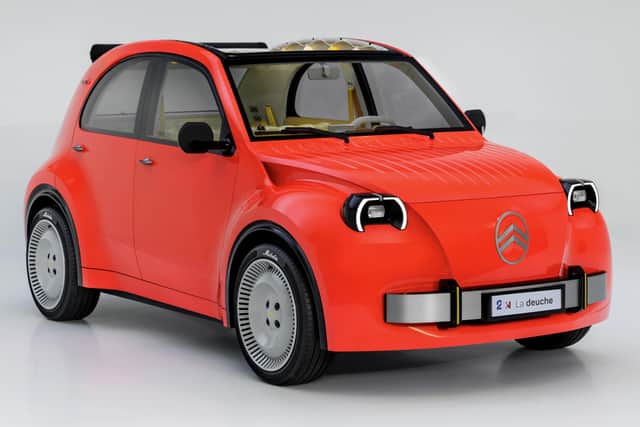
Citroen is promising to go big with its titchy new all-electric 2CV. This eye-catching concept illustrates pretty much what the production version will look like when it arrives towards the end of 2028. Built according to a new set of EU E-car regulations – which are aimed at creating cheaper production costs, and therefore cheaper showroom prices – Citroen says the new 2CV will cost from as little as 15,000 Euros; that’s around £12,700.
Citroen states its new ‘Deux Chevaux’ will be an affordable car designed for Europe’s masses. Measuring just 3.76m in length, this 2CV concept is actually shorter than the original car. To put that in perspective, size wide it’ll sit between the Citroen Ami, which technically is a ‘quadricycle’, and the Citroen e-C3. So it’s not big. It’s even shorter than the new Renault Twingo which I drove recently.
Clearly the design is full retro, but many of the styling decisions have been made with the aim of keeping costs down, rather than simply taking a normal car and stripping it out. Take the near-flat windscreens at the front and rear. Their simplicity saves money on glass costs simply because it’s cheaper to bend glass only in one direction rather than two.
The concept sits on 18in wheels which have plastic covers. The production version will gain steel wheels in the same size. It will also get new narrower tyres which have been designed by Michelin for the new E-regulation class.
Inside — and I’m certainly not sure about the lemon interior — the cabin has been reduced to the bare essentials. The designers have focused on maximising space by including only the technologies that will be needed by drivers. There’s no traditional instrument cluster. Instead there’s a black bar that sits under the windscreen and displays all the car’s important information, basically speed and warnings. The concept also has a very sculptural single-spoke steering wheel. Citroen has yet to reveal any technical specifications. We do know it is aiming to keep kerb weight to one-tonne. Not surprisingly, that will likely mean a compact battery size which will limit range. But the new 2CV will most definitely be a city car.
VW ID. Tiguan
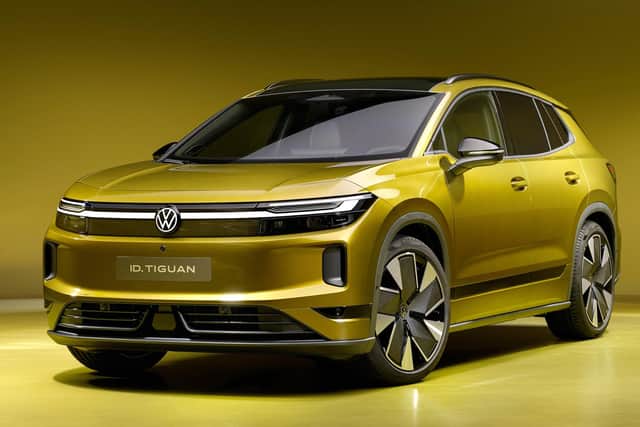
Volkswagen, thankfully, is returning to using established model names for its all-electric range. So this heavily facelifted version of the ID.4 now has the ID. Tiguan badge on it. Given the fact the Tiguan has been VW’s best-selling model since 2017, it made sense to now include the name in the ID. range.
The basic proportions of the ID. 4 have been retained, but there’s no denying the imposing, yet sleek stying of the new model is much more in keeping with traditional VW lines. The Tiguan adopts VW’s new ‘Pure Positive’ design language, already seen on the ID. Polo, which I’ll drive in November, and the ID.3 Neo.
At the front, the new Tiguan gets a significant change with a new full-width LED light strip broken up by an illuminated VW badge. Look closely and you’ll also see a newly-reshaped front bumper with new air curtains at the side. Not only is it an improvement aesthetically, but it has contributed to the drag coefficient falling from 0.27 to 0.26.
Inside you’re greeted by what VW calls its “True Volkswagen philosophy”. I think that’s a gentle way of admitting they got things wrong in the first generation of ID. models. First impressions are they’ve definitely got it right with the ID. Tiguan. There’s a new steering wheel with, hallelujah, a set of I’m-so-happy-to-use physical controls, plus the cabin is dominated by a new 15-inch touchscreen which has already appeared on larger VW models such as the Passat and ICE Tiguan.
As for range, the entry-level ID. Tiguan fitted with the 58kWh battery increases the ID.4’s 265-miles to 279-miles. The larger 77kWh unit – available with a single-motor at the rear, or all-wheel drive – will return up to 372 miles, an increase of 21-miles over the old ID.4. As for charging, the small battery can accept a 105kW charging rate, with the 77kWh managing up to 165kW. Each takes just shy of 30-minutes to go from 10-80 per cent.
Performance? The 58kWh’s 187bhp electric motor is good for a 0-62mph time of 8.5secs, with the 77kWh’s 282bhp motor covering the sprint in 6.6s. The 4WD dual-motor version shaves 0.3s off that. We’ll have to wait till early 2027 to get our hands on the ID. Tiguan, which I have to admit I’m looking forward to because this could well be a game-changer in its sector, and for pricing.
Smart #2
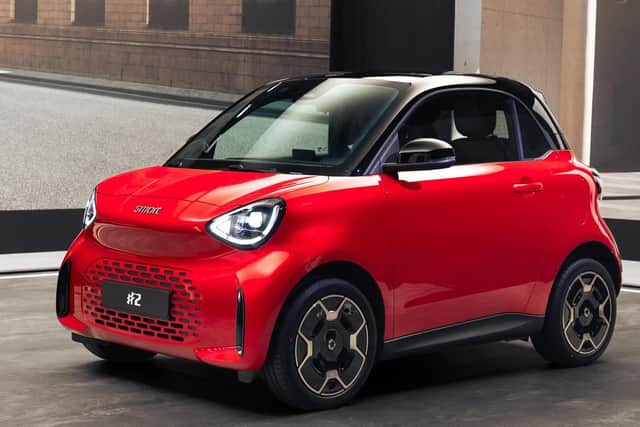
Smart lifted the wraps from its new Smart #2 which is poised to be Europe’s smallest car when it arrives next year measuring just 2.27-metres. Plus, it will cost less than £20,000. The tiny two-seater EV sees the company return to the city car sector after its regeneration by new owners Geely. The Smart #2 essentially, certainly in size, takes you back to the original Smart ForTwo.
Built on an all-new purpose-built architecture engineered by Smart, the #2 has a range of 180-miles and what the company calls “unmatched urban agility”. In fairness, this is borne out by the #2’s 6.65-metre turning circle. It looks pretty sporty and funky too, aided by the fact the back tyres are wider than those at the front. That should also aid handling and stability.
Remember the ‘Tridion Cell’ concept which was a signature part of the ForTwo? Well the new Smart #2 uses a new evolution of it. In essence it’s a reinforced roll cage made from high-strength steel that encases the passenger compartment. It’s this that allows the car to pass the imfamous collision-avoidance Moose test at nearly 50mph.
Inside the quality has leapt significantly from that of the ForTwo, which was always – how shall I put it? – on the basic side. There’s now a premium feel when you step into the cabin. Every model in the range gets a 10.1-inch touchscreen and an 8.8-inch digital driver’s display, while top-spec cars gain a bespoke seven-speaker Sennheiser sound system and a glass sunroof. Bootspace? It’ll take 305-litres of clobber, which surprisingly is just 20-litres less than the larger Renault 5.
As for range? Powered by a 35.8kWh LFP battery, the #2 will be good for 180-miles, Smart says, which is significantly more than the Honda Super-N (126-miles) and Renault Twingo (163-miles). Charging? It’s capable of a very slow 65kW, but because of the small battery you’ll still be able to charge from 10-80 per cent in just 20-minutes. And it’s nippy: 0-62mph takes 11.2secs.
Alfa Romeo Cuorerosso
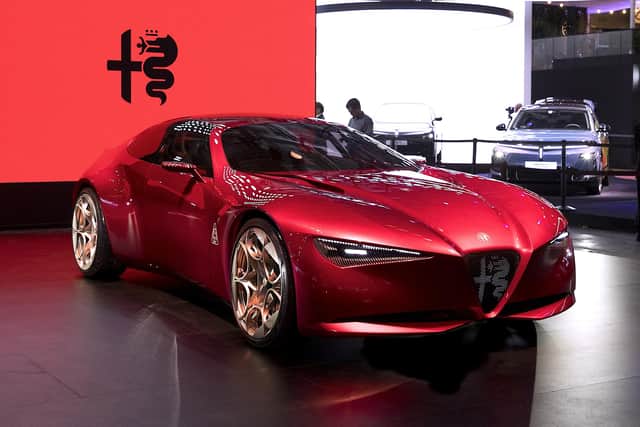
A Motor Show wouldn’t be a Motor Show without a drop-dead gorgeous concept car, and in Paris Alfa Romeo took top marks with its stunning Cuorerosso. And even the name is wonderful: it translates as ‘red heart’. Just so Italian.
Of course it’s a concept car, but the hints that were given as the show indicate that many of its lines and styling are likely to be identifiable in Alfa’s new model due in early 2028.
Painted in ‘Liquid Ink Red’, the Cuorerosso is a 4.7-metre-long, four-seat coupe. Tucked under the bonnet of the concept version is a hybrid version of the Giulia Quadrifoglio’s 2.9-litre twin-turbo V6, paired with Alfa’s Q4 all-wheel drive system. The company though acknowledged that it could also be available as a plug-in hybrid of full-electric.
The coupe has four doors which are hinged at opposite ends and open to reveal a luxurious, inviting cabin. The removal of the central B-pillar will certainly aid access to the rear seats. But this undoubtedly is targeted at being a driver’s car. There’s a yoke-style steering wheel and high centre console, while the driver also views an innovative instrument cluster which can display two different distinct ‘telescopes’ simply with a flick of a switch.
Renault E-Space
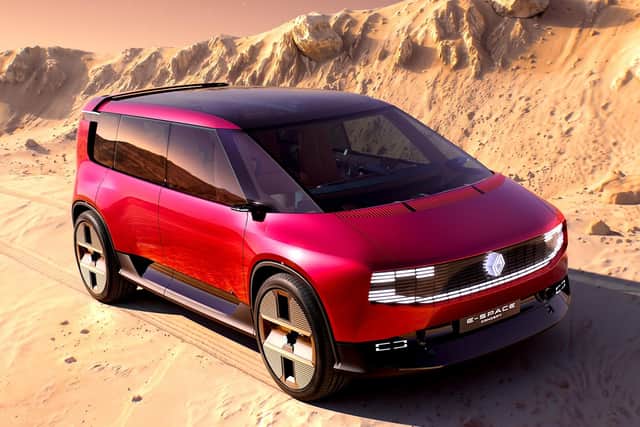
It was 1984 when Renault launched the Espace and became a pivotal player in the then-burgeoning people carrier movement. It was the MPV (multi-purpose vehicle, for those who weren’t around at the time) families craved. Now Renault has unveiled its E-Space concept. But there were strong hints at the show that it could become a production reality.
Renault has already proved its effectiveness of introducing modern electric versions of its former heroes, including the new Renault 5, 4 and Twingo. So why not the electric Espace.
There’s no denying its visual impact. At 4.7 metres long and more than 2.0 metres wide it’s noticeably bigger than the original Espace. Interestingly, the ratio between length and width remains the same. There’s also a heavily raked windscreen reminiscent of France’s TGV trains, and which gives a strong design nod to the original MPV. Renault has stated the concept was designed from the inside out, with the team focusing primarily on interior space and practicality.
Clearly, thanks to its massive windows, the cabin is bright and airy. The E-Space can comfortably accommodate six people across its three rows of seats, and those in the middle row can access folding tables mounted on the backs of the front seats. Alternatively they can spin round and face the occupants of the third row of chairs … similar to travelling by train. Cleverly, the second row of seats can also be transformed to form a table for those in the rear.
The fascia is dominated by a new ‘OpenR Panorama’ screen, which at 1.13-metres wide spans the entire width of the dashboard. This new tech will make its production debut in the next-gen Scenic and Rafale, both of which are due around 2030. The driver meanwhile gets their own smaller infotainment screen, suspended from the dashboard and providing controls for music and satnav.
Of course there are no technical details at the moment, but I assume the next Espace will sit on Renault’s all-new RGEV Medium 2.0 platform. Designed as an ‘electric first’ platform, it can also house petrol-aided Range-Extender (REx) powerplants. That combination could be crucial as it would take range over the magical 500-mile mark.
Omoda 4
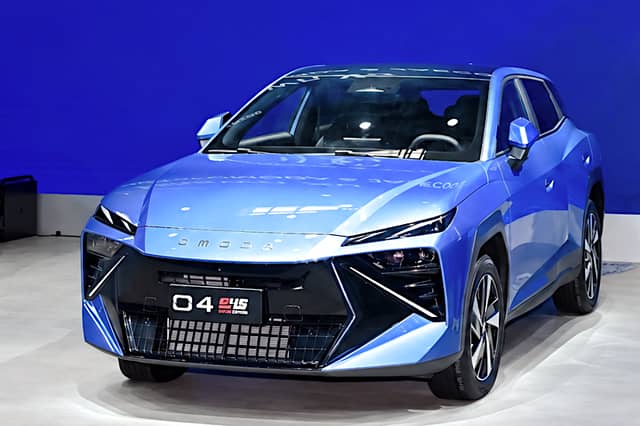
The Omoda brand continues to expand and Paris saw the first appearance of its striking new 4 crossover. Set to go head-to-head with the likes of the Renault Captur, Nissan Juke and Skoda Kamiq, the new entry-level Omoda 4 – which will be available as a full-hybrid or pure-electric – will sit below the brand’s 5, 7 and 9 models. Prices should start below £25,000.
The Omoda 4 hybrid will be the first to arrive in the UK, mating a 1.5-litre petrol engine with an electric motor to produce 221bhp. Expect it to return around 55mpg, or even better. The electric version is likely to get a 61kWh battery and have a range of around 248-miles. This will carry a price premium over the hybrid, expected to be closer to £27,000, and will rival the Renault 4 and Ford Puma Gen-E.
Stylistically the Omoda 4 takes a noticeably different approach to others in the stable with its proud, bold, sharper and more sporty lines. This angular styling is continued inside where there’s an eye-catching sports car-style control panel in the centre console. As you would expect of any Chinese car, the digital cockpit is pretty much bereft of physical controls.
Comments
Want to join the conversation? Please or to comment on this article.