
How cruel disease has devastated the life of a Scottish woman despite high profile breakthrough in battle against deadly genetic condition
Danielle Alexander has always had eating and weight problems since the day she was born … but was only diagnosed with an exceptionally rare form of mitochondrial disease when she was 33.
It’s meant a very tough and painful life for the 36-year-old from Dundee with medics wrongly convinced for years she had a major eating disorder – even misdiagnosing she was suffering from anorexia nervosa - which led to three lengthy hospital stays in her teens and early 20s.
Mitochondrial disease is a complex condition but, essentially, mitochondrial are like little battery packs inside every cell in the body converting food into energy and if they don’t work properly they can have a major impact on people’s main organs and health. The condition is incurable and often terminal.
Danielle was also born with a hole in her heart which was repaired by surgeons when she was two and without that operation it’s unlikely she would have survived.

She’s always had problems eating and putting on weight, only weighing 29kg, around 4.5 stones, when she was 16.
When she’d eat she’d instantly feel full and was then often sick which even led to projectile vomiting as a baby and young child.
Things became so bad she was tube fed through her nose intermittently from a few weeks old until she was about five and then battled through her school years, eating very little and struggling to put on any kind of weight.
She was often admitted to hospital and in her late teens a doctor diagnosed gastroparesis, a medical disorder of ineffective neuromuscular contractions of the stomach, resulting in food and liquid remaining in the stomach for far too long.
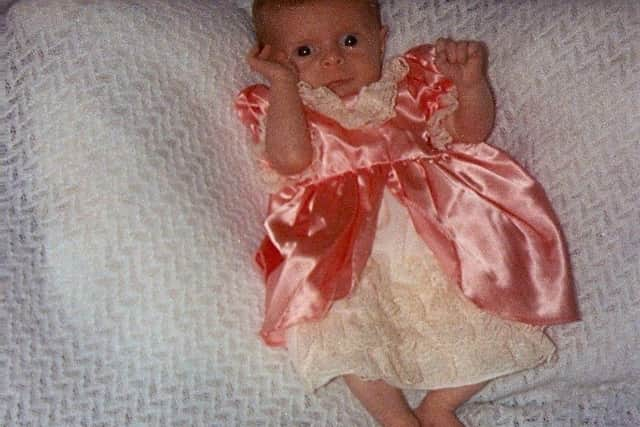
Danielle was always small and was prescribed growth hormone injections which she had from the age of six to 17, adding around 20cms to her height so she eventually grew to just over 5ft.
She saw doctors, psychologists and even psychiatrists over the years to try to get to the root cause of the problem.
When she was 16, Child and Adolescent Mental Health Service (CAMHS) suspected an eating disorder which involved stays of many months in specialist eating disorder units.
“This led to many soul-destroying years where my already vulnerable physical and mental health plummeted further,” said Danielle. “I endured long admissions to eating clinics far from home, force-feeding and seemingly constant battles with medical and mental health professionals.
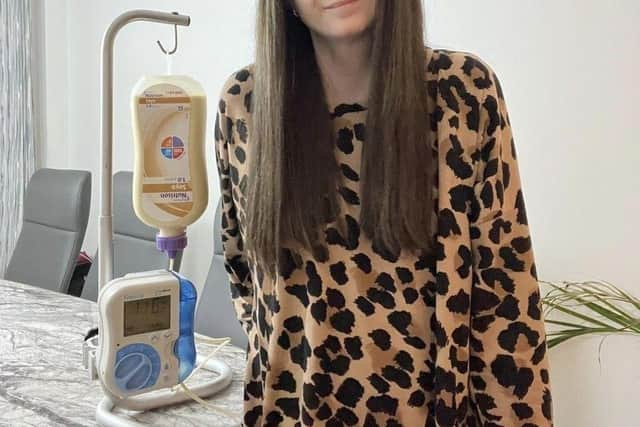
“I felt trapped in the wrong service and repeatedly asked for a PEG feeding tube direct into my stomach so nutrients could go straight into my body, believing this to be my best option for a reasonable quality of life.”
In 2011 Danielle watched a TV documentary called Real Life Thumbelina featuring a four-year-old girl called Amelie Gledhill from Elland in West Yorkshire who has a rare form of dwarfism, Russell-Silver Syndrome, that severely affected her growth and mobility.
The condition also affected her appetite and, although she tried to eat, Amelie needed feeding through a tube in her stomach 20 hours a day to ensure she got enough nutrition.
Danielle shared many of these symptoms and realised she also needed feeding through a tube.
“My stomach would feel full after a couple of mouthfuls, not enough to keep me well or my weight up,” she said. “I was sick and underweight a lot of the time. I was desperate to gain weight and feel well again.”
Despite her struggles, Danielle went on to do a degree in psychology at Abertay University in Dundee
In 2018 she also took part in a major pioneering project into DNA which ultimately led to a major breakthrough for her.
This was the 100,000 Genome Project, a UK initiative aiming to sequence 100,000 genomes (complete set of DNA in a human cell) from NHS patients with rare diseases or cancer to advance genomic medicine and improve healthcare by identifying genetic causes of diseases and developing personalised treatments. Research and analysis is still going on.
Scientists at the Wellcome Centre for Mitochondrial Research at Newcastle University contacted Danielle in 2021 as the gene fault had just been discovered and when they looked on the 100,000 Genome Project database Danielle was the only match who had both faulty gene copies. They discovered that she has a mitochondrial disorder involving the NDUFB3 gene which is incredibly rare.
Since then Danielle has tried to spread the message about mitochondrial disease to try to prevent other sufferers undergoing the physical and mental agony she’s faced all her life.
She’s joined the national charity My Mito Mission and has set up her own mission in Dundee to raise awareness about mitochondrial disease in Scotland.
My Mito Mission is a unique charity in that it has a central office in West Yorkshire which provides awareness, support and fundraising but people around the country with mitochondrial disease set up their own Mito Missions, in effect mini charities within the charity, with all the money going back to My Mito Mission to fund awareness, support and research.
Danielle said: “When I was born on July 29, 1988, I was whisked straight off to specialist neonatal care as I was said to have been born in a distressed state. I feel I’ve been in a distressed state ever since until I got my diagnosis.
“There needs to be better awareness of rare, undiagnosed and genetic conditions, especially from health professionals. Patients and families should be involved in all aspects of their care and treatment and there needs to be improved communication between clinicians and patients.”
Danielle has gone through her medical records in great detail and feels there were several opportunities for doctors to have done more tests and kept a far more open mind than thinking she had an eating disorder that was possibly psychologically-driven.
She still has trouble eating any amount of food and for the last 10 years has had nutrients tube fed into her body through a PEG tube overnight.
“I always knew that this is what I needed,” she said. “Finally reaching the correct diagnosis of mitochondrial disease has enabled me to receive specialist care, the correct treatment plan and peace of mind.”
Danielle’s mum, Helen Fraser, supported her over the years but, sadly, had her own serious health issues and pulmonary fibrosis led to her needing a double lung transplant in 2018 and in 2021 she lost her central vision so was virtually blind.
Tragically she suffered bouts of ill health in the autumn of 2024 and died from pneumonia on December 28, 2024, aged just 57.
It means Danielle is now responsible for the care of her 14-year-old sister, Olivia, and brother Liam, 19.
Around one in 5,000 people suffer from Mitochondrial Disease which makes it one of the most common genetic ones. The number of sufferers is similar to cystic fibrosis and motor neurone disease yet mitochondrial disease is barely known.
Mitochondrial disease hit the news headlines recently when it was revealed that pioneering treatment has seen eight healthy babies born using an IVF technique that includes DNA from three people—two parents and a female donor.
The early results are promising with all the babies developing normally and the disease-causing mutations undetectable or present at levels too low to cause harm.
It gives families living with mitochondrial disease some hope but it only works in a small number of cases and for many families living with mitochondrial disease there are still no treatments or cure.
My Mito Mission co-founder and chair Christine Beal said: “This IVF technique is an amazing part of the solution to our vision of a mitochondrial disease-free world. It’s wonderful that where a mother is identified as having faulty mitochondrial DNA, a healthy family is possible through this IVF technique.
“Of course, many children have already been born with the illness, or will still be born with it where it’s not known that parents have the genetic fault. That’s why we need to keep working hard to ensure treatments and cures are developed which will help all those impacted.”
Mitochondrial dysfunction is now known to be a factor in some of the most common and well-known medical conditions and diseases such as autism, cancer, obesity, hepatitis, dementia, diabetes, epilepsy, fibromyalgia, heart disease, motor neurone disease, MS, Parkinson’s, sepsis and stroke.
This is why research into mitochondrial disease is so critical as it can help in the treatment and research for many other conditions.
For more information or to support the work of My Mito Mission go to https://www.mymitomission.uk
To support Danielle’s My Mito Mission go to https://www.mymitomission.uk/danielles-mito-mission-dundee