
20,000 meals and counting: A 400-year-old Scottish farm's solution to food poverty



Helen Stewart was troubled seeing wild venison go to waste and families around her not having access to high-protein foods.
A farmer has delivered the equivalent of 20,000 meals to families in need over the past year by redirecting venison from culled wild deer into the food system — an initiative to tackle food poverty and bolster food security.
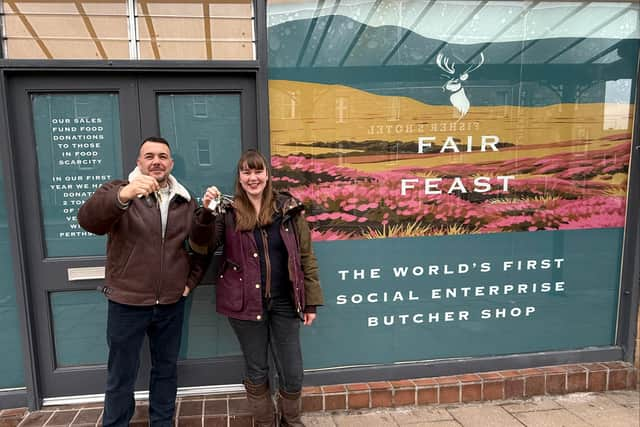
Now, with the opening of a social enterprise butcher’s shop in Pitlochry, the project aims to scale up its impact at a time when charities say demand for food aid in the UK remains at record levels.
Fair Feast, founded by farmer and social entrepreneur Helen Stewart, has in its first year supplied around two tonnes of locally sourced venison to food banks and community larders across Highland Perthshire.


The meat, which might otherwise have gone to waste, has been processed into everyday goods such as sausages, mince and burgers, making it accessible to families experiencing food poverty.
The expansion onto Pitlochry’s high street is intended to bring greater stability to supply, allowing surplus and short-dated produce to be redirected more efficiently throughout the year.
The initiative also increases the redistribution and reach of wild venison in the food chain, a move campaigners have been calling on the Scottish Government to improve for years with research showing a significant increase in deer in the last three decades.
In 2025, the Trussell Trust published data showing almost 240,000 emergency food parcels were provided by food banks to people in Scotland alone – equivalent to one parcel every two minutes. Alarmingly, more than 140,000 of these were for families with at least one child.
The year before, the charity distributed a record of more than 3.1 million emergency food parcels across the UK, including over one million parcels for children.
“Food banks are at an all-time high for demand,” Ms Stewart said.
“Sometimes we are dropping off 100 packs of venison, and it feels like a drop in the ocean.
“But when we have food surpluses and people who are hungry, it really becomes a matter of redistribution.”

Fair Feast came about after Ms Stewart took over her family’s 400-year-old farm in Perthshire. The farmer said she was confronted with a significant overpopulation of red deer: around 650 animals on land capable of sustaining fewer than 50.
Many conservationists argue controlled culling of deer is essential to protect fragile habitats, including peatland and young trees. Deer numbers, while unknown to the exact figure, are believed to have doubled in Scotland since the 1990s and are sitting at about one million, according to environmental groups. Despite increased culls, the resulting venison is often underutilised.
Ms Stewart said witnessing so much high-quality meat go to waste while people in her area faced food shortages resulting nutritional deficiencies was deeply troubling, particularly given that protein-rich foods are especially sought after by food banks.
Often considered “too gamey” or perceived as niche, Fair Feast, which is supported by the UnLtd, a foundation for social entrepreneurs, comes up with ways of processing venison into familiar, family-friendly products. The meat is also hung for a shorter amount of time which helps give it a more mild flavour.
Food security concerns have hit headlines recently due to the Iran War pushing up prices. Farming groups, including National Farmers Union Scotland, warned farm businesses across the UK are facing increasing pressure due to volatility in fuel and fertiliser markets, with implications for food production, supply chains and ultimately consumers.
Ms Stewart said she hopes the expansion of Fair Feast will be some sort of blueprint for other communities across Scotland and beyond.
“If we can donate tens of thousands of meals from just one farm, imagine what could happen if that was rolled out across Scotland,” she said.
Keep up with news from across Scotland by signing up to our free newsletter here.
Comments
Want to join the conversation? Please or to comment on this article.