
Hay’s Way: The mystery of one of Jura’s less known caves
Questions still linger on what happened in the cave.



“Found it!” Tom shouted.
I had my head deep inside a narrow cave, but it wasn’t the one we had been looking for.
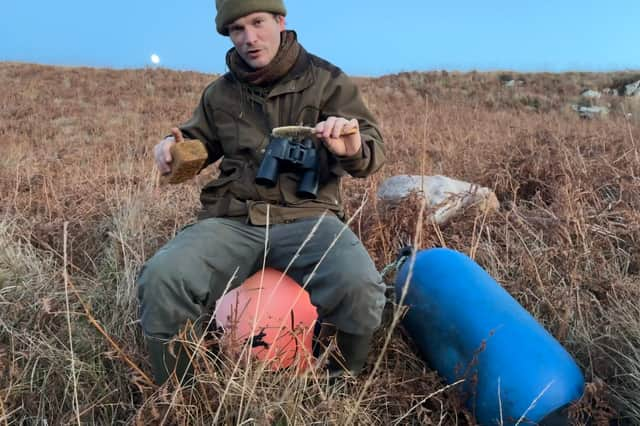
Tom Askew, islander and intrepid cave hunter, had taken me on an expedition to the north-east coast of Jura in search of a curious cavern he had recently discovered with his friend and fellow cave hunter, Ellie Saxon.
I staggered backwards out of the rocky tunnel, landing on a bed of damp moss before scrambling to my feet and following the sound of his voice.
We were in a race against the winter daylight. It was early afternoon and the sun was already beginning to set. We still had at least an hour’s walk across the unforgiving, tussocky moorland to get back to the road.
Reaching the cave-studded coastline was like something out of Jumanji. Not quite the sort of scene I had expected to stumble upon on a remote island off Scotland’s west coast, particularly at this time of year.
It had been one of those crisp winter days, with bright sunshine cutting through the cold as we made our way across the island’s rolling, golden moorland towards the sea. The wind, coming in from the north, had a particularly icy edge, nipping at my cheeks.
But as we dropped below the horizon and picked our way down bronze, bracken-covered banks towards the shoreline, the landscape began to change. The biting air gave way to something altogether more temperate. A dense canopy of woodland offered shelter and, by the time I reached Tom at the mouth of a cavernous cave, the atmosphere had become enchanting.
It was rather like stepping through the wardrobe in The Lion, the Witch and the Wardrobe — except that, instead of emerging into Narnia’s snow-covered wilderness, I found myself in something resembling a jungle.
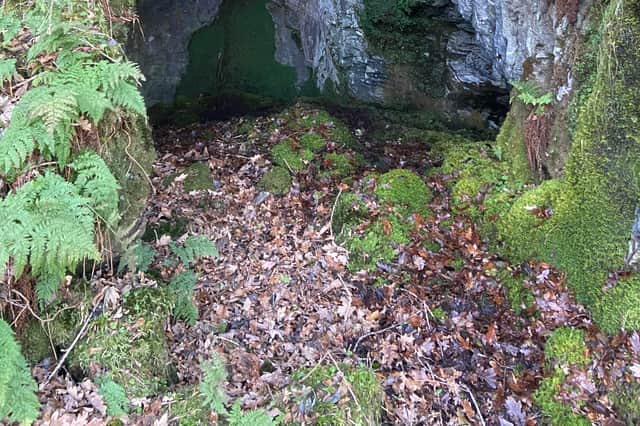
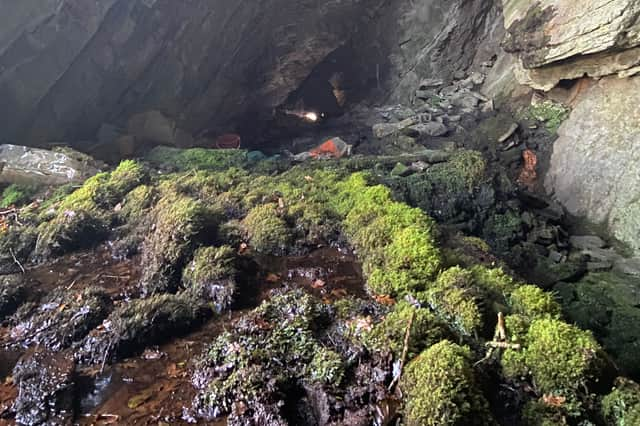
Water dripped from the ancient oak tree that protruded from one corner of the rocky arch above me. Its branches were adorned with fluorescent-green ferns, multiplying in layers around the entrance to the damp cavern, its entrance layered with fallen autumnal oak leaves from above like a leafy door mat. Further inside, the air grew heavy, almost humid. The sound of water droplets echoed throughout the chamber as they fell. It was an incongruous little world, hidden from the elements and seemingly untouched by the wintry season outside.
Our search had begun at the very end of the Long Road, Jura’s only road, which stretches some 27 miles up the island. Beyond a sign prohibiting vehicles, the tarmac gives way to a rough track leading towards Barnhill, a remote house with an outsized place in literary history. It was here that George Orwell retreated to write Nineteen Eighty-Four, his chillingly prescient dystopian novel, securing Jura an enduring place on the literary map.
But Orwell was not the writer on my mind that day. I was following the trail of a rather less celebrated literary figure — although one well known on Jura and within archaeological circles — the British archaeologist John Mercer.
During the 1960s and 1970s, Mercer, working alongside his partner Susan Searight, carried out pioneering excavations across the island. Their work helped establish Jura as one of the most important sites for understanding the Scottish Mesolithic, the period following the last Ice Age.
Living largely off-grid at Lealt, on Jura’s remote east coast, Mercer systematically surveyed raised beaches and coastal bays, uncovering tens of thousands of stone tools and helping to construct an early chronological framework for human occupation in western Scotland.
One of his more intriguing investigations took place on the island’s west coast, in King’s Cave. Excavated in the 1970s, it revealed a remarkable sequence of human activity spanning thousands of years, from the late Mesolithic to the post-medieval period.
Among Mercer’s discoveries on the island was a particularly unusual record of the short-tailed field vole. Layers of small mammal remains allowed Mercer to trace changes in the animal’s physical characteristics over time, offering a glimpse of how Jura’s isolated wildlife had adapted to life on the island, distinct from populations on the mainland.
But the cave we were searching for was less known. A hidden landmark seemingly forgotten by time.
Tom and Ellie had come across it earlier in the year and subsequently christened it Mercer’s Cave, after finding a piece of wood, apparently from a whisky barrel, bearing the name Mercer.
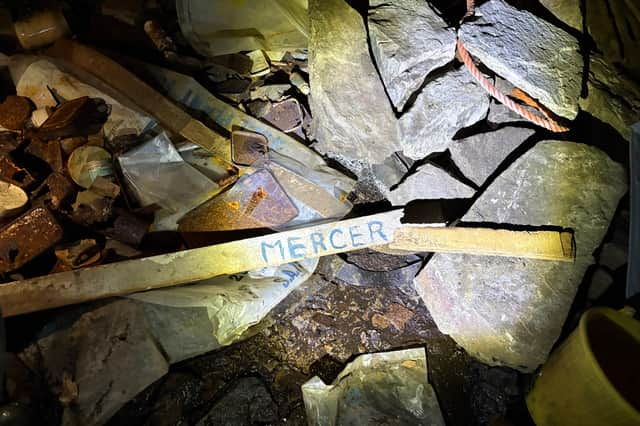
The connection is tantalising. We have little doubt that the name refers to the archaeologist, and good reason to believe he himself had visited and excavated the cave. Whether it was ever formally investigated by him remains another question.
Standing inside, it was easy to let the imagination run away with itself. Indeed, some of what we found was more unsettling than enchanting.
Rusting pharmaceutical paraphernalia lay scattered about. There were small glass vials, some still containing liquid and sealed with corks, along with ropes and plastic containers. Nearby were tins of all-purpose cream, their faded labels seemingly bearing an old Boots logo. In the middle of the cavern, a rough trench appeared to have been dug into the ground.
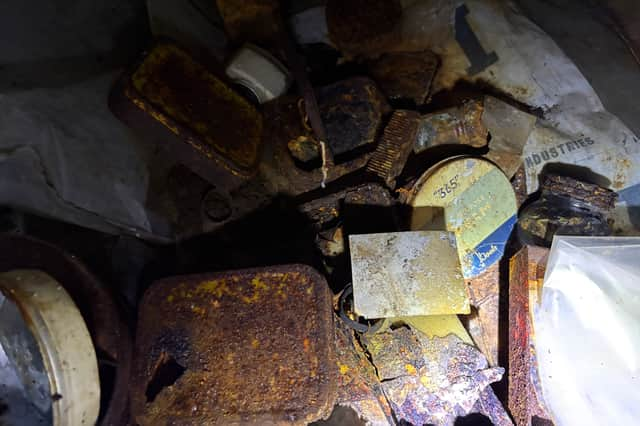
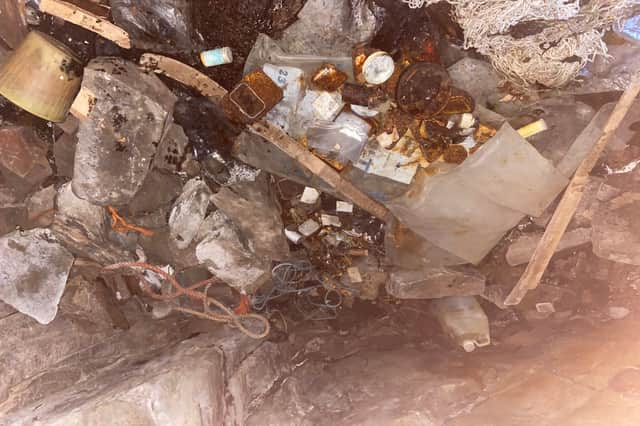
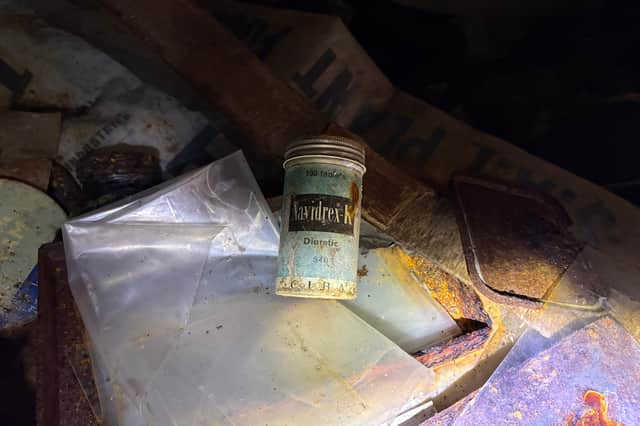
Who had been here, and what had they been doing? The objects clearly belonged to another time, although their purpose was far from clear. Bottles of diuretic tablets were particularly puzzling. The scene gave the impression of a makeshift base, perhaps used by someone working in the area or seeking refuge in the cave. It was as though they had intended to return, but never did.
Even Tom’s dog, Nedwin McFreezly, seemed unconvinced. Normally an enthusiastic explorer, he hovered wide-eyed and anxiously at the entrance, refusing to venture inside.
It was difficult not to wonder whether he sensed something we did not.
Comments
Want to join the conversation? Please or to comment on this article.