
Hay’s Way: My first time gralloching a deer on the hill

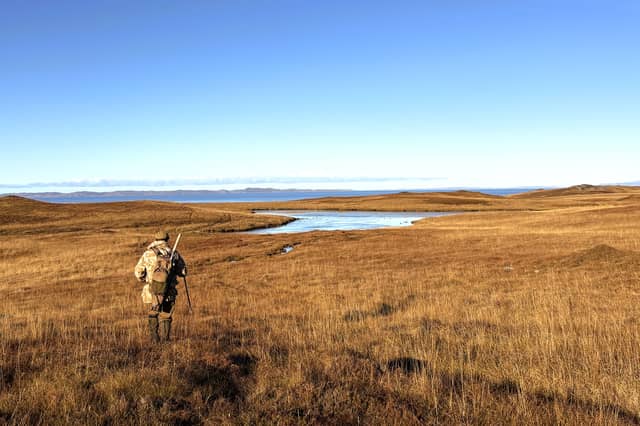

A day out in the shadows of a Jura stalker
Sliding my bare right hand beneath the stomach of a dead hind, her belly freshly opened with a knife in my left, was not how I had imagined warming up on a winter morning in the Scottish islands.
Yet there I was, on a hillside on Jura, stepping headfirst into the rather visceral realities of deer management and venison preparation. I had joined two stalkers during this year’s hind season and, following the shooting of an animal, had been offered the chance to have a go at gralloching - the practice of removing a deer's internal organs after it has been killed.
I spent the day on Ruantallain Estate with seasoned stalkers Craig Rozga and Guy Morlock, learning about their work and the part it plays in the ecology of the island. If I was going to try my hand at the gory yet almost ceremonial practice of gralloching after a deer’s death, there was comfort in having their expertise and patience with me.
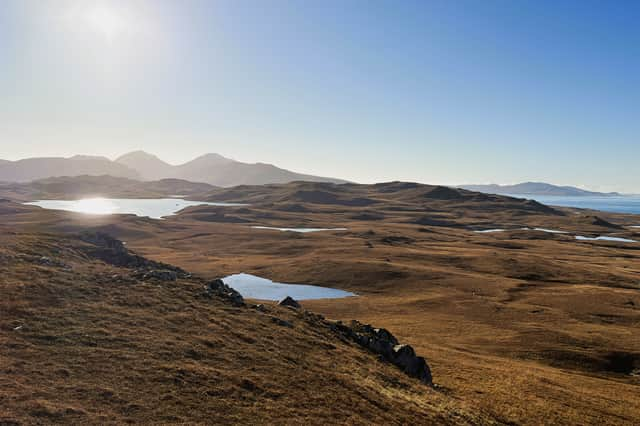
A few minutes before this moment, I had been crawling through the heather behind Craig, carrying his rifle as we edged towards a herd of hinds grazing on a stretch of ground below the ridge. We were trying to get close enough for a proper look without disturbing them.
“We've been rumbled,” Craig whispered.
He pointed towards a hind staring directly at us. Through my binoculars, I could see her gaze fixed on our position, several hundred metres away. Even at that distance, there was no mistaking that she had spotted us. Her coat blended almost perfectly into the muted colours of the hillside, but her eyes had given us away.
To her right stood an older hind. She was the one the stalkers were interested in.
During the traditional stag season, which ended last month, I had watched deer taken from the hill because they were old, in poor condition or carrying switches — antlers that have developed into a single spike and can pose a danger during the rut. The hind season offered a different perspective on the same work. It demonstrated that an equal level of scrutiny applies to females, too.
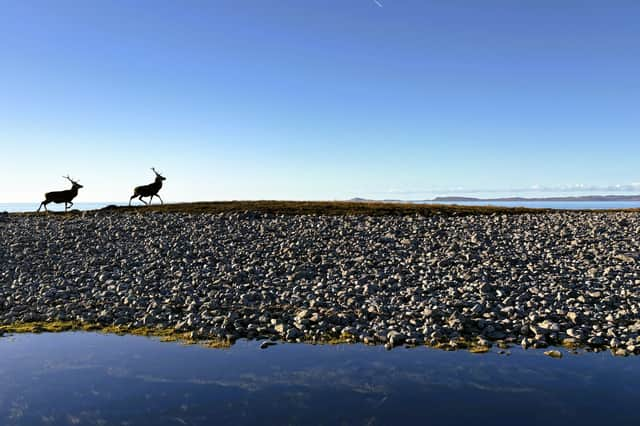
Stalking for many is not simply a numbers game, nor a matter of shooting animals to satisfy management targets. It is about reading the herd, understanding the condition of individual animals and making a judgement about which one should be taken.
That distinction became clear with the first hind of the day.
At first glance, I had not noticed anything particularly unusual about the animal ahead of us. The stalkers, however, clocked her poor condition straight away based on her coat and size. They pointed to her rough, tangled hair saying she was in visibly poor condition, unlikely to survive the winter ahead.
The decision to take her was made not despite her vulnerability, but rather because of it, because ending her suffering there and then, they said, was better than to leave her to the slow decline of starvation over the coming months. On touching her warm body after she’d been shot, you could feel she was little more than a bag of bones and rough, hollow hair.
I found the moment affected me more than I had anticipated. There was a natural shock that can come with seeing an animal killed, but also the uncomfortable sadness of understanding why. Red deer can look impossibly elegant against the rugged landscape of Scotland's west coast. There was something particularly poignant about seeing such a magnificent creature at her weakest, knowing that her life was about to end.
While Highland Game, the venison dealer, visits Jura once a week to collect carcasses destined for sale, this hind would not be among them because of her condition. But that did not mean she would go to waste.
Her body was left on the hillside, providing food for other animals and returning nutrients to the landscape. In death, it was clear that she would become part of another cycle of life.
Within minutes of the rifle shot breaking the stillness of the day, the first scavengers had begun to arrive. Corvids gathered nearby, while buzzards took up positions on rocks along the ridges. Then, from somewhere beyond the horizon, sea eagles appeared, their enormous wings carrying them towards the hillside. They circled overhead, waiting for their turn at the carcass.
It was a remarkable natural spectacle to observe. The hillside had become a dinner table, and there was plenty to go round for the natural world that, on Jura, feels so close.
Watching Craig and Guy carry out the first gralloch of the day also meant I was somewhat better prepared when my own turn came.
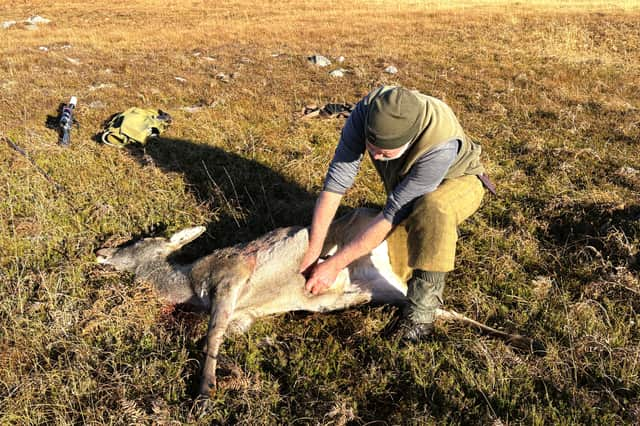
Part of the process involves an incision along the abdomen, allowing the internal organs to be removed. The first to emerge are the lower organs, including the stomach and intestines. The stomach itself is an extraordinary structure, its thick lining offering a glimpse of the engineering involved in digesting the rough vegetation on which deer survive.
One slight tear and the contents spill out, which are mostly great mounds of partially digested vegetation, resembling chunks of freshly cut grass dumped from a lawnmower. It was hardly an appetising sight, but there was something fascinating about seeing the inner workings of an animal that I had spent the morning watching move so effortlessly across the hillside.
The initial incision was the part I found most difficult. There is a psychological barrier to putting a knife into an animal, even when you understand the reasons for doing so. Once that was done, the task became more mechanical, reaching beneath the organs and carefully drawing them out.
The heart and lungs were among the last to be removed, making for a considerably messier operation. The bullet had passed through what the stalkers refer to as the “engine room” — the chest cavity immediately behind the front shoulder, where the heart and lungs sit. It made for a swift death.
There was little room for squeamishness as the work needed doing, and there was a practical purpose to every movement. Plus, the birds were waiting.
Standing back with blood on my hands, catching up with myself on what I’d just done, I appreciated even more the reality of work that is carried out routinely by stalkers across Scotland. Deer management can be discussed in terms of population numbers, ecological balance and targets, but my experience on the Jura hillside that day showed me it is something far more immediate and visceral for these stalkers. Every decision involves an individual animal, and every shot carries a responsibility that extends well beyond the moment the rifle is fired to ensure the deer’s death is not in vain.
Comments
Want to join the conversation? Please or to comment on this article.