
Eerie cry of seabird decimated by rat infestation to return to Scottish island



The return of a species believed to use the stars for navigation to a Scottish island.
Its cry once filled the skies and seas of a small Hebridean island.
But the Manx shearwater population on Canna almost went extinct after a rat infestation wiped out the island’s birds.
In a first-of-its-kind project in the UK and Europe, the National Trust for Scotland (NTS), working with the local community, has helped re-establish the seabird on the island for the first time in almost 40 years.
Working with ecologists and volunteers, the NTS translocated 40 chicks from the neighbouring island of Rùm to Canna during the project’s first two years, in an effort to establish a new colony of the amber-listed seabirds.

The chicks have since fledged, returning the prospect of Manx shearwaters once again filling Canna’s skies and cliffs.
The island was once home to 3,000 breeding adults. Winnie MacKinnon, who was born on Canna and whose family has lived there for generations, recalled the species’ distinctive, eerie cries, which echoed across the night sky above the village as the birds noisily returned from a day feeding at sea.
The skies fell silent in the 1990s, however, after the population was nearly wiped out by a rat infestation. An estimated 10,000 rodents, believed to have arrived accidentally aboard various vessels, wreaked havoc on local bird populations. The rats were eventually eradicated by the NTS in 2005. Now, with robust biosecurity measures in place, the project aims to restore the shearwaters’ once-loud presence.

Closely related to albatrosses, Manx shearwaters spend most of their lives at sea, usually returning to their birth colony each year to nest as breeding adults. They burrow deep underground to raise their chicks and display fascinating stargazing behaviour, thought to be key to their ability to navigate when they fledge and leave their burrows for the first time.
The chicks were carefully moved at a stage when they could observe and imprint the skies above their new island home, Canna, rather than Rùm.
Ecologists involved in the project drew on translocation techniques pioneered in albatross, petrel and shearwater restoration projects in the Southern Hemisphere. The process involves moving birds from thriving colonies to newly created artificial burrows, followed by carefully monitored feeding under strict biosecurity controls.
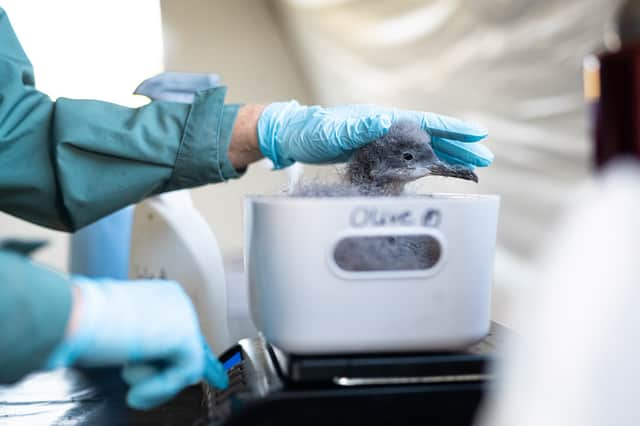
Ellie Owen, senior seabird officer at the NTS, described the Return of the Manx project as “the seabird conservation equivalent of scaling Everest” for those involved.
“From ideas on paper to witnessing our first new generations of Manx shearwaters fledging from Canna, the project has been a real journey so far,” she said.
“We have climbed mountains, searched burrows, blended sardine smoothies, been drenched by storms, got to know each individual seabird and really pushed ourselves, but the effort was worth it to see a project of this magnitude getting off to such a successful start.
“The chicks are likely to return to Canna as breeding adults five to seven years after they fledge, so it is very much a long-term project which requires a lot of dedication and patience, and we are excited and hopeful to see what the future brings.”
Rùm is home to around a quarter of the world’s breeding Manx shearwater population, with at least 120,000 breeding pairs, according to NatureScot.
A feature film, Shearwater, by wildlife filmmakers James Appleton and Trust ambassador Cal Major, is due for release in 2027. It documents the ambitious project and follows the NTS seabird ecologists during its inaugural year.
Comments
Want to join the conversation? Please or to comment on this article.