
Family endured 15 month fight for ASN place as tribunal battles increase

Rhiannon Louden has faced a 15 month battle for a suitable school place for daughter Poppy - with no sign of a resolution yet
The mother of a girl with a rare genetic condition has accused Glasgow City Council of forcing families to endure an exhausting legal battle to secure school placements for their children.
Poppy Louden, who has multiple disabilities and complex needs, was diagnosed with Rhett Syndrome when she was two-and-a-half.
Her parents were certain mainstream education was not going to be an option for their daughter and confident Craighalbert Centre in Cumbernauld, a specialist centre for children with complex neurological conditions, would be the best alternative.
But despite an education tribual ruling that Poppy should attend the school, some 14 months after the original request was made to Glasgow City Council, they are still waiting for a place after the local authority said a month later it would appeal the decision.
Mrs Louden said: “It feels as though the councils are almost hedging their bets that the process will put families off.
“When you keep putting forth these delay tactics and drawing out the process for months and years I think they're hedging their bets that families will give up.
“They know families like ours are stretched thin, and it's really bad that that's what it comes down to.”
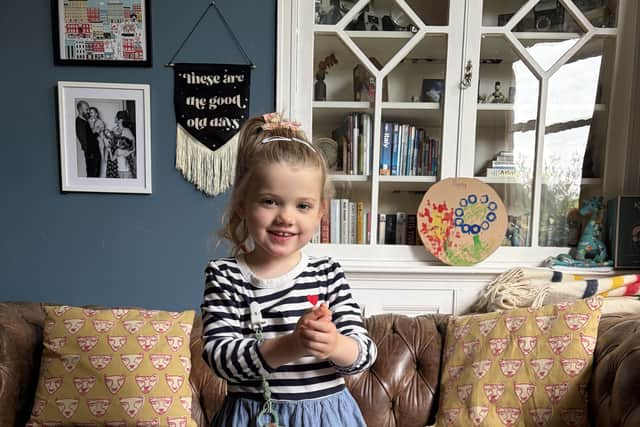

Originally, Glasgow City Council’s educational psychologist suggested Poppy could attend council-run Hazelwood School, with the family deciding they would give it a six-week try.
Mother Rhiannon Louden said it quite quickly became clear that Hazelwood did not have the specific specialist experience for Poppy.
The schoolgirl does not have use of her hands so uses the ACC (augmentative and alternative communication) method.
In August last year, the council offered Poppy a permanent nursery place at Hazelwood but Mrs Louden asked for a placing request to Craighalbert.
Placing requests should receive a response within eight weeks but with a target of two weeks.
They had no response so followed up only to be told the request had been missed.
A series of delays then followed and the family had no answer until January this year - nearly six months after submitting the placing request.
The request was refused so the family moved to take the council to an education tribunal with the support of a solicitor from Govan Law Centre.
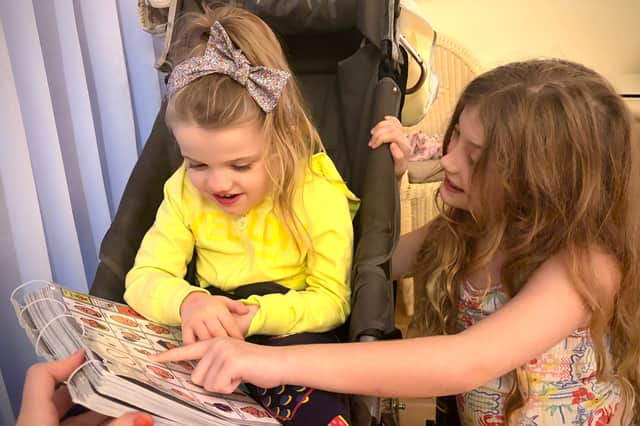
As the situation had dragged on for such a length of time, the family was now looking for a P1 placement.
The tribunal found Poppy’s needs were not being met at Hazelwood in terms of a lack of communication expertise, lack of appropriate therapy support and lack of both planning and monitoring for her wellbeing.
Mrs Louden said: “As just one example, the council’s own expert - a speech and language therapist - suggested Makaton (sign language) as an appropriate communication method for our daughter: a child who has no functional use of her hands.”
Glasgow City Council was directed to procure a place at Craighalbert for Poppy.
The family learned a month later that the council would appeal the tribunal decision.
A Glasgow City Council spokeswoman said she could not comment on the case due to ongoing legal action.
However, she said the local authority is aware of the strain the legal process places on families.
Mrs Loudon said she and her husband had been fortunate to have a network of families around them who could help navigate the system.
Craighalbert also runs seminars with legal experts giving information to families.

“We are a two-parent family,” she said. “We are both educated, working. English is our first language.
“Yet we found this difficult to navigate. It's almost as though they try to sort of hide how to access the support, as though it’s set up to be inaccessible to families.”
Local authorities spend tens of thousands of pounds on tribunals, which Mrs Loudon says “you have to think would just pay for placements for children”.
“It feels very much like a waste of everybody’s time and money,” she added.
Mrs Loudon said she feels that she and her husband have had to push for every element of specialist help.
She said: “Every medical professional, every education professional, will talk about the importance of early intervention.
“So Poppy has missed out - we’re now at month 15 since we asked for her to go to a school that specialises in AAC communication, among other things.”
Alison Philipps, Head of Quality, Partnerships and Innovation at Craighalbert Centre said “nearly all” the school’s families are facing a fight for places.
Currently seven children are waiting for ASN tribunals, which Mrs Philipps described as “unusual”.
“I think what it's indicative of,” she said, “Is the general financial situation with local authorities.
“What is offered within local authority special needs provisions has improved massively over the years, but it remains fairly generalised provision.”
She supports the presumption that children learn in mainstream settings but says it would be “unrealistic” for all local authorities to have highly specialised provision, making schools like Craighalbert, which is grant aided, vital.
She says there is a lack of national data sharing between the NHS and education services that would allow councils to plan ahead for appropriate provision for children with complex needs.
Mrs Philipps also describes the placing request system as “not fit for purpose” with long delays and “becoming increasingly adversarial”.
A recent paper to a Glasgow City Council education committee described how in increase in pupils with ASN has presented several challenges for existing capacities across the ASL estate.
The report reads: “The numbers of children going to tribunal for an ASN placement has seen a significant increase.
“Glasgow has also not been successful in defending tribunals.”
Mrs Philipps added: “It feels like we’ve lost sight of the importance of needs-based and rights-based decisions.”
Pupils from around Scotland come to Craighalbert, which is a specialist centre for children with complex neurological conditions.
Mrs Philipps added: “We don't want to be child catchers.
“We are not looking to admit as many children as we possibly can, we would just like the relatively small number of children who are right for our approach to come to us much more smoothly.
“Yet it feels constantly difficult. There does come a point where fatigue sets in for families so it can seem like delaying tactics to put parents off.”
The Glasgow City Council spokeswoman added: “The council is appealing the decision as our legal and multi-disciplinary professional judgement is that Hazelwood School has the appropriate curriculum and support plan already in place to meet Poppy’s bespoke educational needs now and in the future.”
Comments
Want to join the conversation? Please or to comment on this article.