
Wind industry starts turning tables on critics with blade recycling
Recent dismantling of Scotland's first commercial wind farm shows the way


This week marked another milestone in Scotland’s dominance of UK onshore wind, when ESB, Ireland’s biggest power company, committed to build a new wind farm in the Highlands.
Describing the project as “one of ESB’s strategically most important renewable energy projects”, the company said construction of “Chleansaid” would start later this year on the Dalnessie Estate near Lairg.
The development, which will have 16 turbines and start operating in 2028, adds to Scotland’s 10.7-gigawatt (GW) portfolio of onshore wind farms, according to RenewableUK, an industry body. That accounts for over half of Scotland’s renewables capacity of 18.1GW, and 65 per cent of the UK’s total installed onshore capacity of 16.4GW.
Roughly a quarter century from the moment the turbines start turning at Chleansaid, they will reach the end of their operating life. Then what?
For too long, a narrative has taken hold that old blades simply go to landfill, because, made of fibreglass and resin, they can’t be recycled. That, along with criticism of the concrete foundations poured into peatland to anchor turbine towers, has fuelled the idea that wind power is far from clean. Viral stories of wind turbine “graveyards” — real, in the US — have been critics’ stock-in-trade.
Yet a new narrative is emerging. It is now possible to recycle turbine blades and other turbine parts in a way that we can start to talk realistically about environmental circularity. Spanish renewable group Acciona, for instance, has been turning blades into surf boards in Australia.
There is more serious work happening at scale, too. This year ScottishPower Renewables replaced 26 old turbines at Hagshaw Hill in South Lanarkshire — Scotland’s first commercial wind farm, commissioned in 1985 — with 14 larger ones, in what the industry calls “repowering”. Rather than shut an old wind farm, turbines are replaced with fewer, taller new ones capable of generating more power than the outgoing units.
Almost 100 per cent of the materials taken down at Hagshaw was recycled or reused, according to a report by Mott MacDonald for ScottishPower Renewables. The blades were recycled into construction and engineering materials by Belfast-based Plaswire.
“Everyone is looking at different ways to try and do this,” says Finley Becks-Phelps, UK head of development at Nadara, a rival developer that owns another large portfolio of Scottish onshore wind farms. The company is in the midst of its first UK decommissioning project, at Tow Law in County Durham, drawing on lessons from a similar exercise at its Plouvien wind farm in France last year, where 45 per cent of blade material was recycled into composite for cement, concrete and asphalt.
It is now even possible to manufacture recyclable blades. Siemens Gamesa has worked with Taiwanese firm Swancor to develop a recyclable epoxy blade resin. Half the 100 turbines RWE of Germany installed in June at its Sofia wind farm in the Dogger Bank area of the North Sea carry recyclable blades using this material.
The drive to recycle flows from the confluence of two things: technological innovation and a wave of wind farm decommissioning that’s forcing the wind industry to confront how to deal with obsolete turbines.
Nearly half of continental Europe’s wind farms reach end-of-life by 2030, says Wind Europe; in Scotland, around 250 turbines a year could be decommissioned until 2040, NetZero Scotland estimates.
This new era was on display at an annual onshore wind conference held in Edinburgh this week, organised by RenewableUK and Scottish Renewables, where a record number of stands included some featuring circularity.
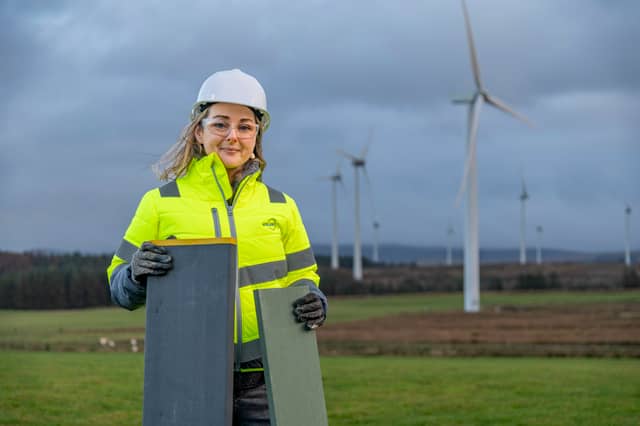
Reblade, exhibiting for the first time, was one. Set up in 2021 by Fiona Lindsay, previously in wind farm development, the company displayed two versions of BladeBoard, a composite board made from shredded turbine blades, developed this year with backing from EDF, the French developer. Reblade is developing it for uses such as fencing and roadside sound barriers, with R&D backed by Scottish Enterprise, which has also extended a convertible loan that could see it become an equity investor in the business.
“This would be great for Scotland,” Lindsay told me, pointing to job-creation potential. “It opens up export opportunities too, creating a product with market demand out of a waste material.”

Another exhibitor was Lochgilphead-based Renewable Parts, which refurbishes a turbine’s “yaw gear” (the bit that keeps it facing into the wind). “Years ago, we’d turn up at customers’ sites and their skips would be full of material. Now many of the parts that fail in a turbine can be reused or remanufactured,” said Stuart Campbell, in the company’s sales team.
Yet challenges remain, chief among them a lack of industrial scale, though initiatives are under way, including the Iberian peninsula’s first blade recycling plant opened last year in Spain by Iberdrola and FCC Ámbito, a waste management company.
The Scottish government made positioning Scotland as a European recycling hub part of a 2023 “Onshore Wind Sector Deal”. I understand a possible site for this has been identified, although nothing has been finalised. Much more will be needed to cope with the coming volume of decommissioned turbines.
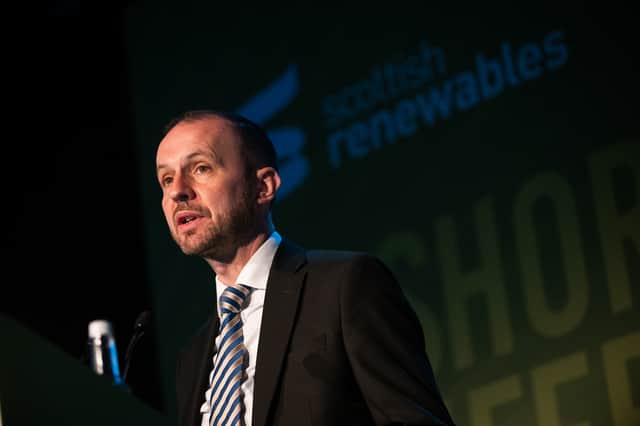
Nor is repowering inevitable, notwithstanding energy minister Stephen Gethins telling the conference Scotland was “now getting ready to lead on repowering”. One issue is uncertainty over grid connections for repowered sites; Nadara, in an April report, said a “lack of a consistent approach to categorising repowering decisions” was creating uncertainty.
“We need [UK] government to lead the way and make repowering a national priority, guaranteeing the increased grid required to unlock the full potential of existing sites,” said Gillian Noble, ScottishPower Renewables’ managing director of onshore.
Nonetheless, the direction of travel is clear. With the right wind, images of landfill are set to be a thing of the past.
Comments
Want to join the conversation? Please or to comment on this article.