
Scotsman Insider emag: revenues fall at over a third of Scotland 500 firms
We carried out analysis on our Scotland 500 ranking and found that more than a third of Scotland's largest firms are now showing declining year-on-year revenue growth.
Business owners and directors have been warning about deteriorating market conditions for well over two years and these figures confirm what we've been hearing on the ground for some time.

It's only now that those concerns are filtering through onto balance sheets.
These firms are the engine room of Scotland's economy. When they stutter, everyone feels it, whether you're an owner, a director or an employee drawing a wage from one of them.One criticism we hear repeatedly, at events and in online forums, is that too many Scottish firms are foreign-owned.
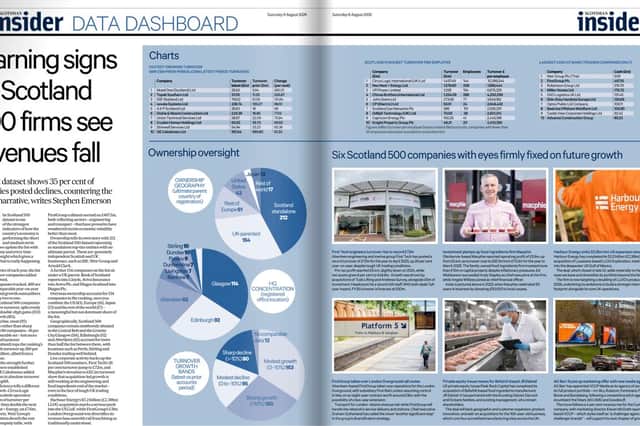
The numbers for the Scotland 500 show overseas ownership accounts for 134 companies on this list once you combine the US (43), Europe (61) and the rest of the world (30), a meaningful share, but not a dominant one.
In this edition, Barclays’ Jamie Grant reflects on 21 years watching Scottish businesses change hands.
His conclusion is that nobody should be losing sleep over who owns a company ,only over whether it's getting the investment to grow.I'd agree. The task isn't to gatekeep ownership but to make Scotland a place foreign capital actually wants to come.
So what's stopping it? Foreign capital detests friction, and where it meets friction, it looks elsewhere.Scotland has no shortage of it.
The planning system is the obvious one.
There are currently serious proposals for 24 hyperscale data centres across the country, developments that would deliver exactly the economic boost these figures show we badly need.
Most are attracting large-scale opposition, and that risks pushing the capital behind them to other countries instead.Then there's policy divergence.
The most visible is income tax, but differences in commercial property law on either side of the border matter too, particularly for companies weighing up offices in multiple UK nations.
Solving for friction is the single best lever we have for flipping the numbers in this edition.When investment comes in, everyone benefits, the indigenous companies already here, the wider supply chain, and a workforce with more money in its pocket.
Comments
Want to join the conversation? Please or to comment on this article.