
How Angus Soft Fruits is pioneering a renaissance in Scottish berry production
John Gray, managing director of Angus Soft Fruits, tells Stephen Emerson how the application of innovative technology, breeding and ambition have helped transform his firm into a £180m global business
The number one selling product line in the largest supermarket chain in Dubai is a Scottish strawberry. Not whisky, not salmon but strawberries, grown on the Angus coast.
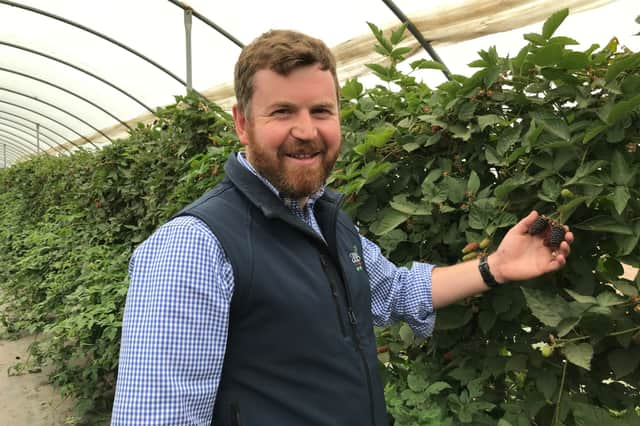

For John Gray, managing director of Angus Soft Fruits, it is a detail that captures something important about how far the business has travelled, and how much further it intends to go.
“Scotland produces more than 10 per cent of the UK berry crop,” he says.
“We’re a significant net exporter of berries within the UK, about 50/50 between Scotland and England. And we export into the Middle East and Southeast Asia. Scottish provenance has real resonance there.”
Angus Soft Fruits was founded as a family business.
The business was founded by Lochy Porter, his father Willie and cousin James Gray.
John came back into the business around 23 years ago, having grown up around fruit production from an early age.
“It was kind of always natural that I’d end up in this job,” he says.
The business he returned to was a relatively small seasonal operation but today it turns over around £180m.
It employs a management team of 100 spread across five countries, operates a packhouse in Evesham with more than 100 staff, and produces fruit 12 months of the year.
This is achieved through growing in Scotland and overseas operations in Spain, Morocco and Chile and glasshouse production in Somerset.
That transformation of the business was not accidental but was built on a series of deliberate technological and strategic bets, starting with the polytunnel.
“My father put the first polytunnels up in Scotland in 1994,” John says.
“They were also the first polytunnels in Scotland to collapse, which happened shortly after. But that really was a step change.”
Scotland had long been recognised as one of the best places in Europe to grow strawberries, the cooler northern climate suits the fruit, but rain was a persistent problem.
The polytunnel removed that variable and combined with the introduction of tabletop substrate production, which lifted strawberries off the ground and eliminated the need for soil rotation, the technology allowed the business to become more intensive, more efficient and dramatically more productive.
Then came breeding with Angus Soft Fruits now operating its own variety development programme, AVA Berries, producing proprietary fruit varieties optimised for appearance, flavour, yield and disease resistance.
The process takes the best part of a decade from initial cross to commercial scale.
The results are now appearing on supermarket shelves across the UK and beyond.
The most exciting development on that front is raspberries.
John said: “Scottish raspberry production has been going down the last few years.
“But we’ve got some new varieties which have hit the market over the last couple of years and we’re now ramping up.
“The main one is AVA Monet, named after the artist. It has the potential to be a renaissance in Scottish raspberry production.”
Blackberries are next in the pipeline, expected to arrive commercially within a couple of years.
The harder challenge, however, is economics.
Over the last five years, production costs have risen by close to 50 per cent, driven primarily by labour, which accounts for approximately half of all production costs, alongside fertiliser, fuel and packaging.
The market, John says, has not kept pace.
“Our biggest challenge is how we recover that through our pricing. The returns we get from the market. It’d be fair to say the market hasn’t kept up because the change has happened so rapidly.”
Automation is part of the longer-term answer, but John is realistic about the timeline.
Picking robots attract considerable attention, but the delicate nature of soft fruit makes harvesting one of the hardest agricultural processes to automate meaningfully.
“It’s, by the nature of the name, soft fruit,” he says.
“You have to be careful picking it and careful placing it. It’s still some years away from being fully commercialised.”
In the meantime, the industry also faces ongoing uncertainty around the Seasonal Agricultural Workers scheme, the visa programme that allows fruit farms to recruit overseas workers for harvest seasons.
It remains subject to annual government renewal, meaning growers cannot plan their labour requirements with any confidence beyond the current year.
Climate change sits in the background of every conversation about Scottish agriculture, but John views Scotland’s position with cautious optimism.
“When you look forward at likely climate change over the next 10 years, Scotland’s very well placed. It’s more volatile elsewhere. Our mild, gentle climate is actually an asset in that context.”
Consumer trends are also moving in the industry’s favour.
Berry consumption has grown sharply over the past two decades as awareness of nutritional benefits has increased.
John sees a further catalyst emerging in the form of GLP-1 weight-loss drugs, which he believes will ultimately drive a shift towards higher-quality, nutrient-dense food as consumers eat less but better,
He said: “Raspberries and blackberries are among the highest-fibre fruits you can eat. Strawberries are high in vitamin C. Blueberries and blackberries are rich in antioxidants and polyphenols.
“Berries have moved from being a luxury 15 or 20 years ago to being an everyday product for a lot of people. But there’s still a way to go.”
The business John is building to capture that opportunity is global in reach but anchored in place.
The Angus coast, mild, maritime, with deep agricultural heritage and a concentration of expertise built over generations, remains the foundation.
The ambition is to sell more of what it grows across more markets than ever before.
“We’ve produced an amazing product,” he says. “We’ve got exciting new varieties coming through. The potential is significant.”
Providing pathways for people to progress
Behind Angus Soft Fruits’ growth into a £180m global operation lies a workforce strategy that John regards as central to everything else the business has achieved.
The company’s management team of 100, spread across five countries, has been built deliberately around what John describes as a strong, positive culture centred on the produce and the shared ambition surrounding it.
“It comes back to culture,” he says. “Training and development is key. People progressing, having pathways and access, that’s important.”
The business works with Management Development Services, a graduate scheme operating across the UK food industry, to maintain a pipeline of new talent into the organisation.
John acknowledges that food and agriculture can struggle to attract ambitious candidates who might look instead to technology, finance or professional services.
“It’s not necessarily seen as the most attractive sector,” he concedes. “But those that are in it see that it’s an amazing business. You’re producing a really healthy product, and the technology and advances going into it are every bit as exciting as other sectors.”
For a business that is planning continued international expansion, and new varieties, the ability to attract and retain specialist talent will be as important as any new polytunnel or breeding programme.
Five bits of berry good practice
1 - Coastal advantage
Angus’ proximity to the coast creates a mild, stable microclimate – cooler in summer and warmer in winter – than inland, giving Angus Soft Fruits a natural edge in producing consistently high-quality berries.
2 - Polytunnel revolution
The introduction of polytunnels, first erected in Scotland by Angus Soft Fruits in 1994, transformed the industry from a rain-dependent seasonal operation into one capable of producing fruit for six months of the Scottish year.
3 - Scotland exports more than it consumes
The country produces more than 10 per cent of the entire UK berry crop and is a net exporter within the UK, with roughly half of all Scottish-grown berries sold in England.
4 - Labour is the defining cost pressure
Approximately 50 per cent of Angus Soft Fruits’ production expenditure is accounted for by the price of labour –almost entirely at harvest time. This fact makes workforce availability and wage inflation the company’s most significant financial risk.
5 - A raspberry renaissance is coming
Comments
Want to join the conversation? Please or to comment on this article.