
People don’t follow algorithms: Why AI must make leadership more human
“The defining leadership decisions come when evidence is incomplete, the stakes are high and waiting carries its own risk”
More than half of mid-market bosses now predict a leadership crisis as technology reshapes the roles where tomorrow's managers learn their trade, according to research by global accountancy network Baker Tilly International.
My own view, shaped by one of the most testing decisions of my career, is that people, not algorithms, will decide who succeeds.
That moment came last year, when I led MHA from partnership to a stock market listing. Our partners had given us a mandate to complete the initial public offering (IPO) at a certain valuation. On the evening the book closed, amid considerable market uncertainty, the valuation came in lower than expected, which is not unusual in a flotation. I had guided the firm towards a change that would fundamentally alter its structure, and the conditions behind it had suddenly shifted.


That night, I approached it as experience had taught me, calmly and rationally, by asking myself three questions. Did I believe in the business? Did our partners believe in the business? And did I still believe in myself as its leader?
The answer to all three was yes.
The valuation was a point-in-time issue, not a reason to abandon a longer-term strategy. The next morning, I spoke to our chief financial officer, the management board and then our equity partners. I told them I would not do a sales job, only explain the conclusion I had reached. By that evening, the vote in favour was unanimous.
The vote showed what becomes possible when people understand the direction, trust the reasoning and feel part of the decision.
The defining leadership decisions come when evidence is incomplete, the stakes are high and waiting carries its own risk.
Data, expert input and governance are essential, yet none of them removes a leader's duty to exercise judgement. Risk should never mean acting blind, but leadership cannot mean waiting until every doubt has disappeared.
The same research, which surveyed 1,500 mid-market executives, found that more than a third of organisations have delayed or cancelled major investments because of policy uncertainty. Our teams in Aberdeen and Edinburgh see the same pressures among the Scottish businesses they advise.
The temptation is to wait for clarity, which I believe is the wrong instinct. Stability cannot be a prerequisite for action when volatility is becoming permanent.
No significant transformation is delivered by one person, and alignment does not mean surrounding yourself with people who always agree with you. Instead, it means a culture where challenge is welcomed, issues surface early and, once a decision is made, everyone understands how it was reached.
Taking people with you is not a communications exercise conducted after a decision, but part of the decision itself. People need a clear account of what is changing, why it matters, what will stay the same and what leaders still do not know.
Leaders must also know what to protect. My message internally was to “stick to the knitting”, continuing to do what we do well rather than being distracted by everything happening around us. Change everything at once and a firm can lose the strengths that made it valuable, from its culture and client relationships to the calibre of its people.
Want more stories like this? Subscribe to our weekly business newsletter here.
I am an advocate of technology and AI despite my vintage. I use it, encourage our teams to use it and see its potential as comparable to an industrial revolution.
Enthusiasm cannot mean abdication, though. AI can be a trusted partner, processing information, modelling possibilities and removing repetitive admin. AI should not become the trusted advisor that makes the decision. Advice comes with accountability, context, ethical reasoning and responsibility for consequences. AI can tell us what could be done. What should be done is still for people to decide.
The greater danger may not be that AI replaces today's leaders, but that we remove the experiences that create tomorrow’s. Many of us learned judgement through groundwork, observation and gradual exposure to responsibility.
As technology takes on more routine tasks, what remains is the human side of work, such as communication, judgement, empathy, curiosity and trust.
Only 24 per cent of leaders in the Baker Tilly research put communication among their greatest strengths, and 22 per cent said the same of leading through uncertainty, yet both rank among the most important qualities for the decade ahead.
Early-career colleagues we interviewed at MHA quickly discovered that technical knowledge alone was not enough. Relationship-building, adaptability and a willingness to ask questions shaped how they learned and progressed. Those capabilities need to be demonstrated, practised and coached, and that responsibility belongs to senior leaders.
People do not expect leaders to be infallible, but they do expect consistency. Trust is built when people can see the reasoning behind a leader’s decisions, recognise the values that shape them and be confident those principles will hold when things get difficult.
Chief executives should ask whether their plans would survive if conditions changed sharply, and whether they are developing successors who can challenge them or followers who depend on them.
For those starting out, the task is different. Technology will make a polished answer easier to produce, but trust is still earned the old-fashioned way, through judgement, reliability and how you treat people. Do not confuse confidence with certainty. Good leaders are willing to say, “I don’t know yet, but this is how I propose we find out.” And do not wait for a job title before you begin to lead.
The tools of leadership will evolve, but one principle has remained constant throughout my career. Unless you have the people behind you, their hearts and minds, you don’t really have a business.
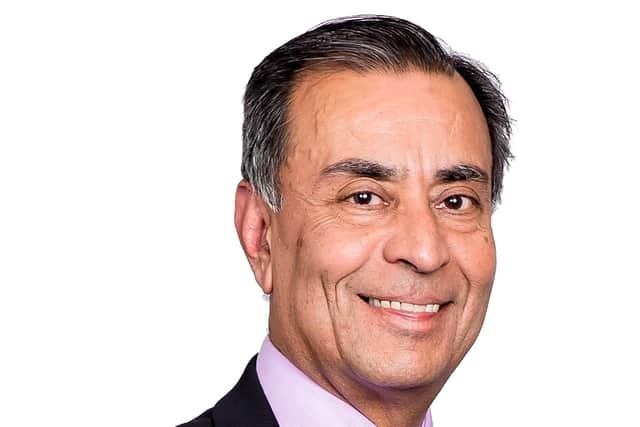
Rakesh Shaunak is chief executive of MHA, the UK member of Baker Tilly International. A chartered accountant, he took the firm public in 2025. MHA’s Scottish offices are in Aberdeen and Edinburgh. For further information on MHA, visit www.mha.co.uk
Comments
Want to join the conversation? Please or to comment on this article.