
Landmark pensions deal picks up prestigious innovation prize


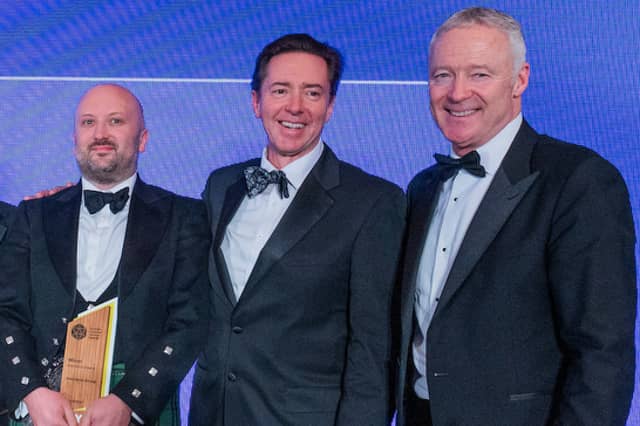
Continuing the series celebrating successes in this year’s Scottish Financial Services Awards, run by Scottish Financial Enterprise, Gareth Edwards profiles the joint winner of the Innovation Award.
A novel deal that has helped one of Scotland’s biggest transport providers look after thousands of pensioners was the joint winner of the Innovation Award at this year’s Scottish Financial Service Awards.
Organised by Scottish Financial Enterprise, the awards looked to recognise the work of the country’s financial services industry over the last year.
And for the Innovation prize they chose a transaction that has been described as ‘redefining the pension endgame landscape’, creating new options for employers seeking to offload legacy pension risk.
The £1.2bn transaction saw Aberdeen Group take on a legacy pension arrangement from Stagecoach, in a deal supporting improved pensions for 22,000 people.
The transaction combined innovative structuring, sophisticated financial modelling and the use of emerging technologies to deliver a pioneering solution with significant advantages for pension scheme members, and is even influencing government policy around future legacy pension ‘endgames’.
For the scheme’s pensioners, many of whom are not affluent, the arrangement secured better protection against inflation, an additional initial uplift of 1.5% to all pensions, potential for further increases linked to the financial performance of the scheme and a scheme sponsor more suited to support a pension scheme over the long term.
Under the arrangement, Aberdeen have taken on responsibility for the scheme’s funding as well as the management of its £1.2bn of assets. They will receive a minority share of any future distributed surplus with the majority earmarked for members, all subject to robust guardrails that ensure the scheme’s financial security.
And for Stagecoach, the transaction simplified its business, enabling focus on what it does best as the UK’s largest bus operator.
Rob Andrew, head of UK pension strategy and solutions for Aberdeen Investments, explained that the deal had actually been borne out of the strategy for Aberdeen’s own legacy pension scheme.
“When the assets of a pension scheme are very big relative to what the trustees expect to have to pay out, the natural thing is to look at an endgame, which normally includes the transfer of assets and liabilities to an insurance company,” he said.
“Until recently that was pretty much the only end game in town. The only other option that people had was to keep the running of it in house, and this is what Aberdeen did.
“We looked at the endgame for our own scheme - the Aberdeen group pension scheme - and we decided that there was a framework that we could put in place that was going to be better for Aberdeen and better for the pensioners than other options at the current time.
“So we did that for our own scheme and we were quite public about it. Then we got a call from the advisers to the Stagecoach scheme saying they think that running their scheme on is likely to represent the best outcome for their members.
“But of course Stagecoach are a bus company, and quite understandably they wanted to simplify their business and not be thinking about this legacy pension exposure.
“So you had trustees that wanted to run on and Stagecoach as a company who basically didn't want to run on. So the question put to us was; could we become the sponsoring employer, replacing Stagecoach and supporting the scheme if it requires future financial support? Because every scheme must have an employer.
“Then we helped develop in much more detail how that could work. It was a framework which hadn’t been used before, certainly not the way we did it. And that’s why it was something of a landmark transaction.”
The transaction supports greater investment in productive assets, which aligns to the UK government’s agenda. Such was the groundbreaking nature of the transaction, that soon after the UK Government and The Pensions Regulator confirmed a review of the relevant legislative framework and rules to ensure future transactions of a similar nature are properly covered and can deliver strong member outcomes whilst maintaining high governance standards.
“We proactively engaged The Pensions Regulator from an early stage to make sure they were satisfied with the deal, because while it complied with existing rules, it was not a route that was envisaged when the rules were originally created,” Rob said.
“The rules around another company taking on a pension liability were created to enable the transfer of pensions risks between employers in the same group. We used the rules to transfer the pension risk between two completely unrelated employers, and so we wanted to make sure the regulator was happy that we had addressed any concerns. Ultimately, if they hadn’t liked the deal, we wouldn’t have gone ahead with it.”
The innovation of the deal also extended to the way it was carried out, with AI work used to allow it to be completed in around three months - an unprecedented speed for a pension risk transfer deal of this scale and complexity.
AI was deployed across governance, analytical and documentation activities, while AI-assisted drafting, review and coding activities reduced the manual workload and sped-up delivery while ensuring robust governance, oversight and decision-making controls.
“We already use AI every single day,” said Rob. “This transacted end-to-end in three months which is extremely fast for something of this nature, and we couldn't have achieved that without AI.
“We had lots of documents to review, for example, and we reviewed them all but used AI to pin-point the areas we should focus on. When it came to drafting our own documentation, again, we used AI to create a lot of initial drafts and then we would edit and supplement those, so it enabled us to move much more quickly.”
And Rob, who collected the trophy on behalf of Aberdeen Group at the awards in Glasgow last month, said he was delighted their work had been recognised.
“It’s really pleasing to see that people had understood what we had done enough for it to be recognized, because we're really proud of it,” he said. “It was great to be part of a transaction that delivered a strong outcome for the scheme members, for Stagecoach and for Aberdeen”.