
Inside Rosyth's leading role in building the hybrid navy of the future
The Fife port is now about much more than the huge frigates it manufactures



On a calm June morning, an uncrewed surface vessel (USV) was anchored off the Danish coast in the Baltic Sea when its radar picked up a Russian corvette heading its way.
The USV tracked the ship’s movements from about 15 kilometres away and spotted a drone launched from it, heading directly towards the Danish vessel.
This may sound like something from a fictional TV drama. But it was real and was recorded by Danish startup Stormborn which makes the USV, called “X-Wave”.
The company, founded by the former head of the autonomous vessel programme at Danish offshore wind group Ørsted, describes its mission as “delivering autonomous maritime systems capable of continuous operation in all sea states – enabling persistent maritime domain awareness and the protection of critical infrastructure and territorial waters”.
The X-Wave is one element of how naval platforms are being reinvented in Scotland for 21st century threats amid a worrying geopolitical backdrop.
In April, former defence secretary John Healey revealed increased Russian military activity in waters off Scotland, centred on the deployment of two submarines from GUGI, an acronym referring to Russia’s Main Directorate for Deep-Sea Research.
That came five months after he outlined how GUGI units – including what the Ministry of Defence (MoD) described as the spy ship Yantar – were vessels directed by Moscow “to conduct hybrid warfare activities against the UK and its allies, specifically around critical undersea infrastructure”.
Russia’s embassy in London has dismissed this as “provocative statements”. Nonetheless, Healey’s revelations explain why, in August, the MoD said Royal Navy operations to monitor Russian activity in the North Atlantic had increased by 25 per cent across the first seven months of this year compared with 2025.
Naval top brass have believed for some time that dealing with such threats is going to involve not simply sending ships out to sea but deploying nimbler assets such as the X-Wave, seamlessly digitally connected to the mother ship. In short, a “hybrid navy”.
The reinvention of naval architecture required to deliver this is central to what is happening at Rosyth Dockyard on the Fife coast opposite Edinburgh. It comes as the UK embarks on its biggest increase in defence spending since the Cold War, underlined by Healey, now Chancellor, committing in this week’s budget to spend 3 per cent of GDP on defence by 2030.
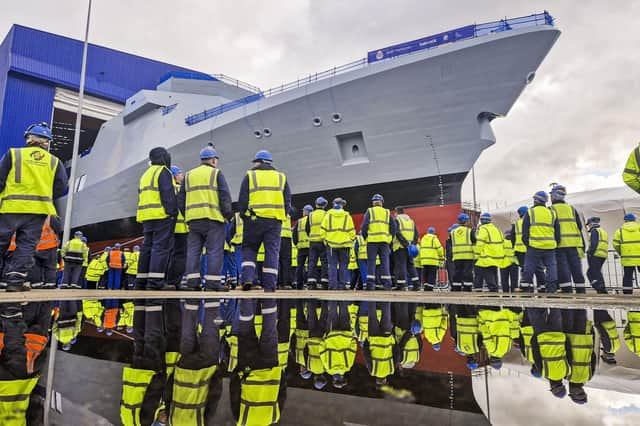
At Rosyth, UK defence contractor Babcock is building a new frigate called the Type-31, under a contract to supply five of them to the Royal Navy. It is the UK version of a frigate platform called Arrowhead 140, itself based on a Danish frigate design.
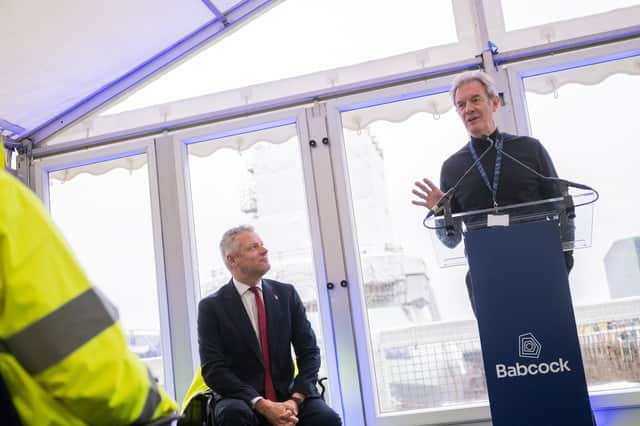
Inside one of the site’s massive covered workshops, welders and technicians were this week working on two hulls, for HMS Formidable and HMS Bulldog, being built side by side at what Sir Nick Hine, chief executive of Babcock’s marine unit, says is “one of the most advanced digital dockyards in Europe”.
Robots do over 80 per cent of the initial welding of plates for the hulls. Two-thirds of the project’s 150 suppliers are Scottish companies.
Yet it’s what is happening away from the metal-bashing that reveals how the hybrid navy is being developed. In an adjacent building, technicians from Stormborn and others demonstrated in a mock-up of a “remote operations centre” how each of their USVs can be operated as part of what Babcock calls “ARMOR Force”.
This concept, first floated by Sir Nick in a speech five years ago when he was Second Sea Lord and Royal Navy vice-admiral, brings together a crewed ship with remotely operated systems in a single platform that can be incorporated into the Arrowhead frigate design. “It’s about building a totally new capability that’s dispersed and disaggregated, taking a lot of critical stuff out of the ship and involving a combination of crewed and uncrewed platforms,” he tells me.
In that speech, Sir Nick said the navy needed to “think differently” and “simplify the ship” to make it more adaptable. This would involve placing technicians from these companies, with specialist technology, in mobile pods – as simple as reconfigured shipping containers – that can be transferred from a ship to an autonomous vessel designed to deploy them at distance from the mother ship.
Stormborn’s USV is one of the first live examples of the concept. Another is a fast uncrewed boat capable of carrying weapons launchers, developed by UK-based Kraken Technology Group, which this summer raised funds valuing the business at $1 billion.
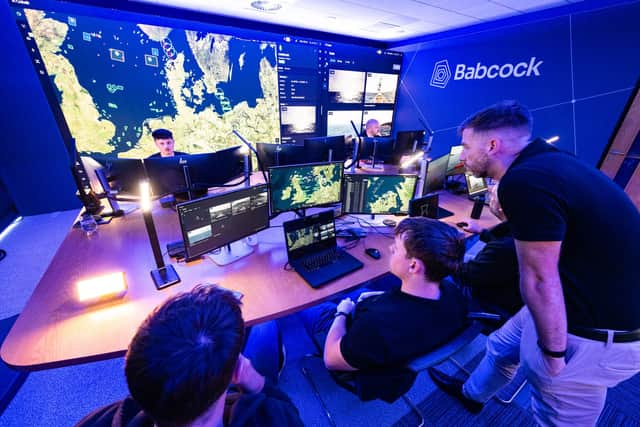
One of Babcock’s shipping containers – which the naval vernacular calls “persistent operational deployment systems”, or PODS – was sitting on a quayside at Rosyth at the time of my visit. Inside, technicians scanned a bank of screens, while outside a Kraken K3 Scout boat (top speed: 55 knots) was on display.
As work continues at the yard, Babcock is under some pressure to deliver the new ships on schedule at a time when the Royal Navy’s existing fleet of seven frigates designed for anti-submarine warfare is ageing.
Then there is the business of securing work beyond that, with hopes of a landmark contract to provide frigates for the Danish navy. This would make up for disappointment when in May Babcock lost out to France’s state-owned Naval Group to supply four warships to the Swedish navy. Babcock can point to earlier overseas successes in licensing Arrowhead to the Polish and Indonesian navies.
“We need to keep building because the biggest danger to Rosyth isn’t necessarily delivering the current platforms late, it’s actually making sure that you’ve got more platforms to build and you don’t lose all of the skills et cetera that you’ve already developed,” Sir Nick said. “We will continue to deliver these platforms as fast as we can.”
Comments
Want to join the conversation? Please or to comment on this article.