
How North Sea expertise could transform defence logistics
ASCO’s move is a sign of how some Scottish businesses with the right capabilities are increasingly looking to expand into defence
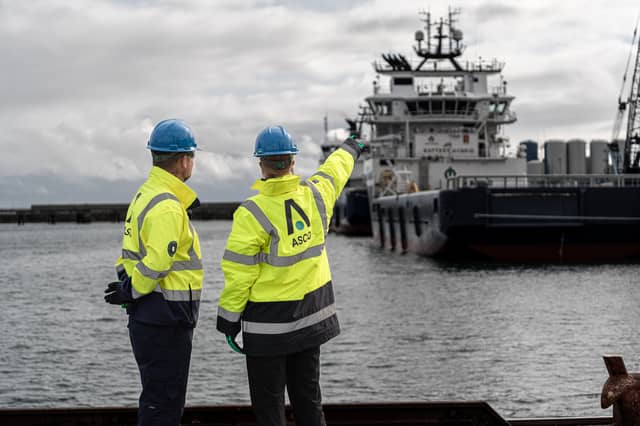


On the outskirts of Aberdeen, near the city’s airport, rows of shelves reach up to the ceiling of a large warehouse in a sprawling business park known as “D2”.
This is where thousands of spare parts for North Sea oil rigs are kept, ready to be dispatched at the click of a button as soon as a message comes in from one of the rig operators, which include Serica Energy and Ithaca. It feels like an out-of-town B&Q, except that what’s kept here is critical to the UK’s energy economy.
I ask Angela Milne, head of materials management and warehousing at ASCO, the Aberdeen company that manages the 125,000 sq ft facility, what’s on the shelves.
“Flanges, nuts, bolts, compressors, heat exchangers, turbines – anything that they need in terms of critical spare parts for their offshore operations,” she says. “If they need any of this offshore we can get it to them within 24 to 48 hours.”
This “just-in-time” management of kit has long underpinned key industries such as automotive and retail. Think Toyota and Amazon.
Yet ASCO believes what happens in this warehouse, and the 50 it runs globally, is just as applicable to defence – specifically how the Ministry of Defence (MoD) handles procurement for building new weapons platforms or how the Royal Navy organises spare parts for its ships.
Last month Milne was in Australia presenting a paper to naval top brass on how so-called materials management could improve the country’s “submarine readiness”. She listed bottlenecks ASCO had encountered in other industries it serves, including renewables, mining, metals, and pulp and paper, that also afflict defence: supplier fragility, ageing assets, documentation requirements, obsolescence and “a low tolerance for unplanned downtime”.

The changing geopolitical landscape makes fixing this particularly urgent, argues Mike Pettigrew, ASCO’s chief executive. “The imminent danger to our nation requires us to completely rethink the way we have traditionally bought stuff, which is designed for the Cold War,” he tells me. “We need to be highly adaptable, highly resilient, because the world is changing very fast.”
The urgency stems from the speed at which battlefield technology is evolving, as Ukraine’s innovative use of drones has shown. It is also driving a rethink of what it means to ensure military procurement and supply chains run as efficiently as possible in the face of growing threats.
Those threats were highlighted again this week when the head of MI5, Sir Ken McCallum, warned the UK had “entered a new era of national security”, requiring a new response that included more “systemic resilience”.
ASCO believes it can be part of the solution. Founded in 1967, the business has built up decades of expertise in logistics and materials management for some of the biggest oil and gas players, including bp.
Owned since 2023 by private equity firm Endless, ASCO employs almost 1,700 people at more than 19 logistics hubs worldwide, on top of its warehouses.
More recently it has been active in offshore wind, operating a warehouse at Peterhead for Ocean Winds’ Moray West wind farm. It also provides quayside management services at Steel River Quay at Teesworks, the UK’s largest industrial zone and energy hub.
Pettigrew and his team are now embarking on a new strategy that was presented to the company’s board of directors last week to become “one of the top UK defence logistics and support providers”.
The aim is to generate more than £100 million from defence-related materials management by 2031, about one eighth of projected group revenues of £800m that year – itself a rise of about 70 per cent from the £470m achieved in 2025.
“In oil and gas there is no warehouse offshore, so the industry learned the hard way that it needed to be really good at making sure all the materials are there when they need them, in the right order. Managing that is part of the skills we bring and are applicable to any complex critical industry,” says Pettigrew, previously at defence contractor Babcock, where he spent over two years heading its warships, marine and technology unit.
Asked where he sees specific opportunities, he says: “For us, I think big platforms like ship programmes and big infrastructure, also where their sustainment is required.”
He says there is a “real difficulty” mobilising such platforms because the system lacks agility – reportedly one factor in the Royal Navy’s problems deploying HMS Dragon quickly to the Middle East recently. “Because of cuts to platforms over the years, we’ve ended up with an armed forces that’s suboptimal for what’s coming. We need to quickly improve.”
ASCO’s move is a sign of how some Scottish businesses with the right capabilities are increasingly looking to expand into defence. In its recent “programme for government” the SNP-led Holyrood administration committed to establishing a “responsible defence industrial growth programme” to maximise the economic opportunities from increased defence spending.
“Scotland is well placed to seize the opportunities arising out of the defence industry, with a highly skilled workforce, world-class colleges and universities and internationally recognised manufacturing,” innovation minister Alyn Smith said yesterday as he confirmed Holyrood would match earlier UK government funding for two new Defence Technical Excellence Colleges for Scotland.
The backdrop is the UK government’s biggest increase in defence spending since the Cold War, set out in documents such as June’s Defence Investment Plan. This includes the appointment of a “national arms director” responsible for reforming how the MoD approaches acquisition to “drive pace and agility into procurement”.
To help its own efforts, ASCO in July hired a logistics expert and 28-year British Army veteran as principal defence advisor. Yet Pettigrew acknowledges that breaking into defence will take time. “It’s a long way in. There are a lot of hurdles,” he says. “But we’ve started the journey.”
Comments
Want to join the conversation? Please or to comment on this article.