
Data Dashboard: a look at the financials and deal activity of Scotland Mid Market 200 companies
Well-run Scottish firms opting for measured growth with calculated and strategic acquisitions.


The latest data dashboard gives a glimpse into the behaviour and performance of Scotland’s mid-market companies which are the productive core of the country’s economy.
Scotland’s Mid-Market 200 companies generate £7.85 billion in combined annual turnover and £1.12 billion in EBITDA with their median EBITDA margin standing at 10.7 per cent.
The typical mid-market business converts just over ten pence in every pound of revenue into operating profit before interest, tax, depreciation and amortisation.
Across a combined workforce of 42,289 employees, that equates to roughly £26,000 of EBITDA per employee.
These figures highlight a segment defined not simply by size, but by operating discipline.
The gap between turnover and margin shows that scale does not automatically deliver capital efficiency.
Some high-revenue operators carry thinner margins due to labour intensity, input costs or asset-heavy models, while specialist or export-led businesses often generate stronger returns on revenue.
Acquisition data reinforces the picture of measured and structured growth.
Over the past three years, 20 acquisitions have been recorded across the Mid-Market 200 with activity concentrated in sectors ripe for consolidation.
Food and drink and wholesale account for six deals, representing 30 per cent of total activity.
Construction, materials and industrial services follow with four transactions, or 20 per cent.
Legal services represent 15 per cent of activity, with pharmacy and healthcare retail and technology services each accounting for 10 per cent.
Consumer, transport and life sciences transactions make up the remainder.
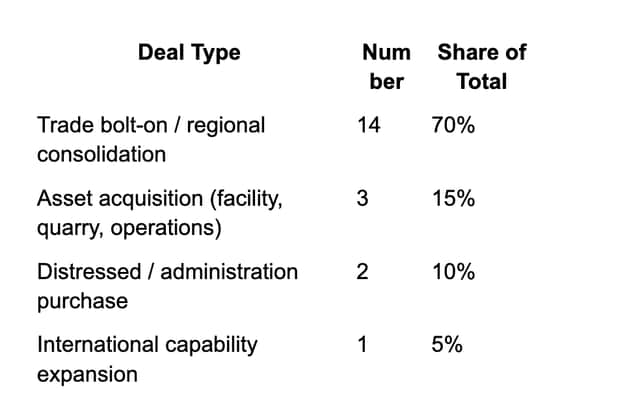
The dominant deal type is the trade bolt-on or regional consolidation, accounting for 70 per cent of transactions.

Distressed purchases from administration account for 10 per cent, while international capability expansion comprises five per cent of activity.
This pattern points to incremental expansion rather than transformational risk.
Companies are strengthening geographic density, broadening product ranges and consolidating fragmented local markets.
Legal firms have pursued regional mergers, pharmacy operators have rolled up branch networks, and food wholesalers have added complementary distribution capability.
Alongside consolidation, there are clear examples of organic and investment-led growth.
Duncan Farms has expanded its Co-op rollout from 23 to 152 Scottish stores, signalling controlled retail scale-up.
Baynes the Family Bakers has lodged plans for a £20 million expansion of its Orwell Bakery facility to support the opening of 69 additional shops.

City Property Glasgow (Investments) has extended a ground lease to facilitate the expansion of the Doubletree by Hilton hotel, while Foresight’s investment in Welding Engineers signals consolidation potential in a fragmented industrial servicing market.
Rabbie’s Trail Burners has secured £2.4 million in finance to modernise and expand its fleet.
Taken together, the data suggests a mid-market that is profitable, employment-intensive and acquisitive but disciplined.
Growth is being delivered through bolt-ons, infrastructure investment and targeted capability expansion rather than speculative large-scale mergers.
GROWTH SIGNALS FROM MID MARKET 200 COMPANIES
Duncan Farms expanded Co-op rollout
Duncan Farms has unveiled a significant expansion of its partnership with the Co-op.
The Turriff firm said the agreement would see Duncan’s Eggs rolled out to 152 stores across Scotland, up from the current 23 branches.
A total of 132 Co-op stores will also begin stocking the brand’s organic free range.
Rachael Duncan, owner of Duncan Farms, said: “We’re excited to be reaching more shoppers who are looking for traceable, nutritious Scottish free range eggs.
Bakers plans £20m expansion to Fife facility
Baynes the Family Bakers has lodged plans for a major expansion of its manufacturing base as part of a strategy to significantly grow its retail footprint.
The Fife bakers submitted proposals for a £20m expansion of its Orwell Bakery production facility in Lochore aimed at supporting the opening of 69 new shops across Scotland.
The family owned business currently operates 71 outlets and says the investment would enable it to increase that number to around 140 sites.
City Property Glasgow (Investments) LLP
City Property Glasgow (Investments) LLP (CPGI) has agreed a new ground lease option paving the way for Doubletree by Hilton’s future expansion in the heart of Glasgow.
The lease change extends the asset’s unexpired term to 150 years, providing the hotel tenant with a significantly longer tenure at its prominent location on the junction of Cambridge Street and Renfrew Street.
With planning permission already in place, the hotel is positioned to add 90 additional rooms, increasing its capacity to 394 keys.
Foresight invests in Welding Engineers
Foresight Group is to invest into Welding Engineers, a Glasgow-based provider of maintenance, repair, fabrication and installation services for industrial doors and shutters.
Founded in the 1960s, the family-owned business has grown into a national operator employing around 180 people across six regional branches throughout the UK, serving customers in sectors including manufacturing, logistics and automotive.
The industrial door servicing market is highly fragmented, and Foresight believes Welding Engineers is well positioned to consolidate regional operators.
Rabbie’s to invest on coach fleet
Rabbie’s Trail Burners is adding to its fleet following £2.4m of finance from Royal Bank of Scotland and Lombard.
The company has built a reputation for its small group , off-the-beaten-track tours, and the new funding will allow Rabbie’s to invest in 22 state-of-the-art EVM coaches, replacing older vehicles and increasing fleet capacity.
Rabbie’s has made significant strides in supporting local communities and sustainability initiatives.
Rabbie’s self-imposed Carbon Tax has already raised over £120,000 for community and environmental projects across its destinations.
Comments
Want to join the conversation? Please or to comment on this article.