
Building a different legacy for Scotland from the Glasgow 2026 Commonwealth Games
“Scotland has committed to becoming a circular economy and we now have the legislation and strategy in place to support that transition”
A question I’m often asked is what a circular economy actually looks like in practice. For a long time, my answer would centre on the strategies and policies aimed at keeping things in use for longer and preventing valuable materials from becoming waste. But increasingly I find myself able to point to real examples of circular thinking in action in Scotland.
That’s one of the reasons I’m so excited about the Glasgow 2026 Commonwealth Games – long even before the opening ceremony, these Games have shown themselves to be a great example of circular thinking at scale.
Working in partnership with Glasgow 2026 to deliver its Circular goals, Zero Waste Scotland has seen these ideas taking shape, and what we’ve found is that circular thinking hasn’t been treated as an add-on, but as a thread running through every decision.


Unlike with many major sporting events, Glasgow hasn’t started with a question of what needs to be built. Instead, organisers looked at the world class venues the city already has and asked how they can be used again.
It sounds like an obvious first step, but it’s a significant shift in thinking.
For a long time, growth and progress has been linked to gaining more – more land, more materials, more buildings. The circular economy asks a different question – how can we create more value from what we already have?
That’s exactly what Glasgow 2026 is demonstrating. Beyond the venues themselves, circular economy principles are embedded throughout the event in decisions most spectators won’t even notice – from reusable commentary boxes and spectator stands, to compostable cutlery made from plant and seaweed-based materials.
There are examples even in the finer details, like the 74 batons travelling across the Commonwealth for the King's Baton Relay being handcrafted from ash trees already fallen in Glasgow's Pollok Park - a small thing in the context of an international sporting event, but a perfect example of seeing value where we might only have seen waste.
Scotland has committed to becoming a circular economy and we now have the legislation and strategy in place to support that transition. The next challenge is turning these ambitions into everyday decisions made by businesses, in government, in our public services, and right across our economy.
Our partnership with Glasgow 2026 is one example of how we’re helping drive that forward. We’re also working with business, industry, and government to develop Roadmaps for the sectors where circular thinking can make the biggest difference. Each looks at where there are opportunities to create more value from the resources we already have, and how we can turn Scotland’s circular ambitions into real action.
Our built environment Roadmap shows what’s possible. Construction and demolition account for around half of Scotland’s waste, with construction materials contributing around a tenth of our greenhouse gas emissions. Rethinking how we design, manage and adapt our buildings could become one of Scotland’s biggest opportunities to cut waste while strengthening our economy.
Yet while our Roadmaps focus on changing systems and behaviours, they’re ultimately about changing mindsets – an essential shift as the environment these sectors operate in continues to change. Materials are becoming more expensive, supply chains are more uncertain, and businesses need to become more resilient in the face of it. A circular economy isn’t just an environmental ambition anymore; it’s an economic lifeline.
We’ve become used to thinking about buildings as things we eventually replace, but in a circular economy we'd see them differently - as valuable assets full of valuable materials that could be adapted, refurbished and given new purpose.
That principle has shaped Glasgow 2026 from the outset. It’s a simple idea that has the potential to shape far more than the future of international sport. It challenges us to see value differently and shows what we can achieve through circular thinking.
I hope that’s the lasting legacy of these Games, because the choices being made in Glasgow aren’t just relevant to sporting events, but to how we design our homes and schools, our hospitals and offices, and how we regenerate our town centres and communities. Across Scotland we’re already putting these ideas into practice through our work with Scotland’s Towns Partnership, helping communities embed circular thinking into the places we live, work, and spend time - making better use of what already exists to strengthen local economies and reduce waste, ultimately making Scotland more resilient in the face of global uncertainty.
Glasgow 2026 doesn’t prove we can do more with less, but that we can achieve more by valuing what we already have - and that’s what the circular economy looks like in practice.
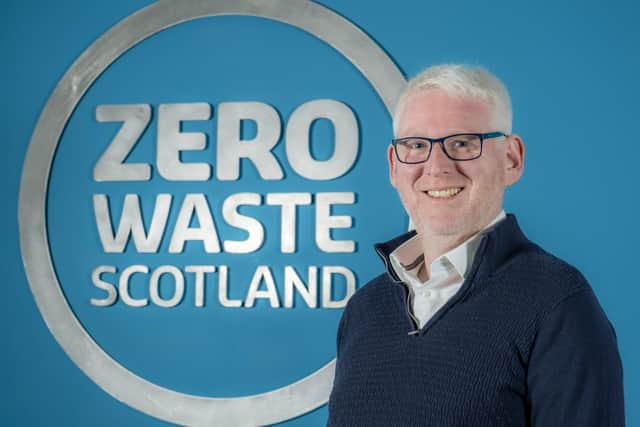
Ciaran McGuigan, chief executive of Zero Waste Scotland – official Circular Economy Partner of the Glasgow 2026 Commonwealth Games
Comments
Want to join the conversation? Please or to comment on this article.