
Sir James MacMillan: Angels Unawares, Sistine Chapel, Vatican City review: 'music of astonishing power'
Inspired by the angelic encounters in the Bible, Sir James MacMillan’s new work features some of his most dramatic writing to date, writes David Kettle
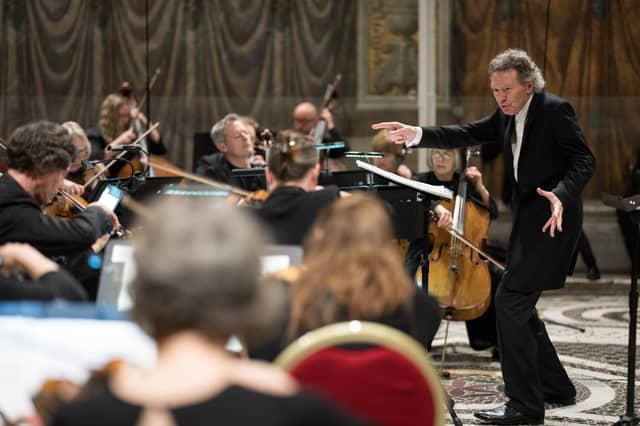

Sir James MacMillan: Angels Unawares, Sistine Chapel, Vatican City ★★★★★
“It feels like quite a statement from me, perhaps even a culminatory statement of where my music has been going over the past few years,” explained Sir James MacMillan just a few days before the unveiling of his new oratorio for soloists, choir and orchestra, Angels Unawares. “The fact that the premiere is happening in the Sistine Chapel is in a sense a kind of hidden proof that it’s probably one of the most significant pieces I’ve produced.”
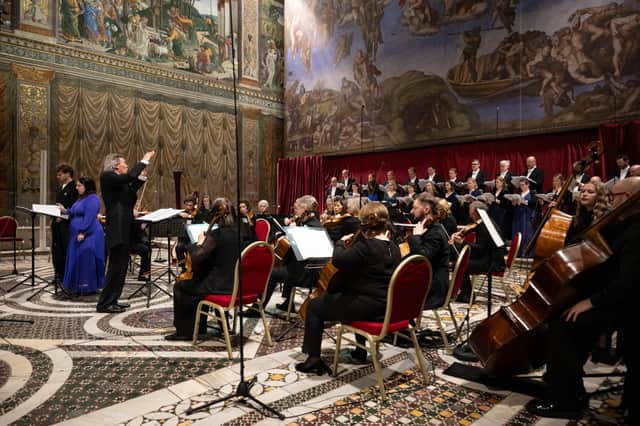
It was a grand occasion all right, with seemingly endless cardinals, VIPs and world leaders past and present in attendance as the Vatican’s inner sanctum was given over to the unveiling of MacMillan’s epic, 12-movement, 70-minute new work - a piece that almost seems to whizz through the entirety of the Bible from the unusual perspective of its angelic encounters.
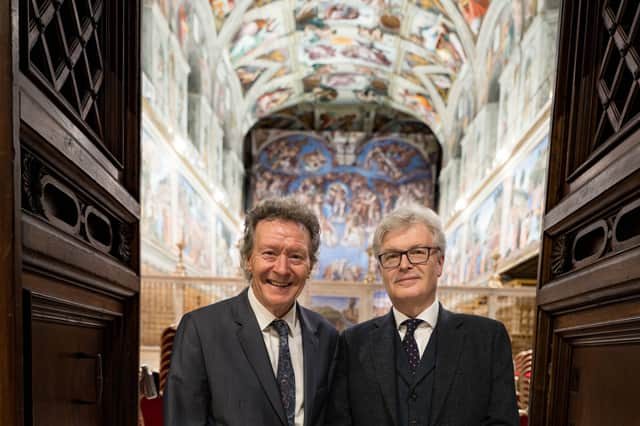
The astonishing setting came courtesy of the efforts of John Studzinski, a far-sighted philanthropist whose Genesis Foundation has long supported MacMillan’s work. “This is actually the eighth piece they’ve commissioned me to write, and the pieces seem to be getting bigger and bigger,” MacMillan smiled when I spoke to him. “Much to my amazement, John arranged for my Stabat Mater to be performed in the Sistine Chapel in 2018. That seemed like a once-in-a-lifetime experience, but now he’s managed to make it work all over again.”
And though the Sistine Chapel premiere wasn’t part of the original plans for Angels Unawares, MacMillan’s score exploited the space’s remarkably resonant acoustics to dramatic effect, from sudden halts leaving long-lasting resonances hanging in the air between the Michelangelo frescoes, to surprising intimacy in some of the work’s most eloquent movements.
But to credit Angels Unawares to MacMillan alone is doing the work a disservice. Its text is by long-serving Dean of Canterbury Robert Willis, who died in 2024, and to whose memory MacMillan dedicated the piece. At one stage, the composer admitted, he worried that Willis’s text was too wordy: it is indeed on the long side, but full of eloquent detail and telling turns of phrase, which clearly inspired MacMillan to produce some of his most diverse and dramatic writing, and some of his most perceptive.
In terms of Angels Unawares representing a culmination, then yes, it seems to draw on everything from the highly decorated vocal melisma of some of his earliest music to the rawer, more abstract vocal sounds of his more recent Symphony No. 5, Le grand Inconnu. Likewise, in style it ranges from exquisite sweetness to brutal energy to a kind of arid emptiness that feels familiar from his Seven Last Words from the Cross. What’s remarkable, though, is how deftly and meaningfully MacMillan deploys his broad vocabulary in conveying the themes and ideas of Angels Unawares, whether they’re theological questions or profoundly human emotions.

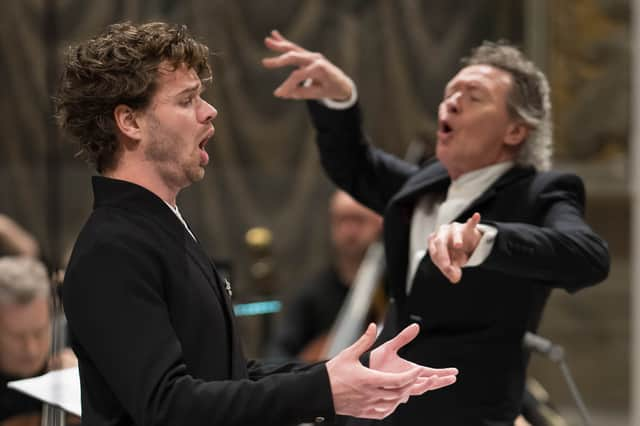
It’s in the latter category that the piece is possibly most remarkable – and, at times, most operatic. Both ‘The Song of Mary of Magdala’ and ‘The Song of Peter’ movements are effectively solo operatic scenes, charting the shifting psychologies of their protagonists – Mary Magdalene at Christ’s empty tomb, and Peter imprisoned after Christ’s resurrection – with insight and focus. Soloists Elizabeth Watts and Matthew McKinney were beautifully matched in brightness of tone, and similarly alive to vividly conveying their characters, in those movements and throughout the larger work.
Equally impressive, though, was MacMillan’s fresh and nimble handling of Angels Unawares’s broader theological questions, which often combined terror and awe to startling effect – in the vertiginous string slides that ably illustrated ‘Jacob and the Ladder Reaching to Heaven’, for example, or the inexorable sense of growth and abundance from a surging river in ‘Ezekiel’s Vision’.
Both the Britten Sinfonia and crack choral ensemble The Sixteen are long-time MacMillan collaborators, and it showed – not only in their pinpoint precision and insight under Harry Christophers’s urgent direction, but also in how well tuned-in they are to MacMillan’s language, and how eager to share it as a result. Did Angels Unawares add up to offering new perspectives on our angelic companions? Perhaps not, but that probably wasn’t its aim. Instead, it offers a reminder of the uncanny mix of wonder and dread in these fleeting encounters between the human and the divine, delivered in music of astonishing power, poignancy and fluency.
A Scottish premiere for Angels Unawares is yet to be announced, but BBC Radio 3 broadcasts the Sistine Chapel’s world-premiere performance on 29 March at 7.30pm, and the UK premiere takes place at London’s Cadogan Hall on 2 June.
The Scotsman’s arts newsletter is now sent twice a week - subscribe today
Want the latest Scottish headlines sent directly to your phone? Sign up to our new WhatsApp channel here
Comments
Want to join the conversation? Please or to comment on this article.