
How Auld Lang Syne became tune for Korean independence anthem explored in new play

The journey of the Scottish classic is now told in a play co-created by Scottish theatre company Wonder Fools and a Korean company
It is the well-known melody to which Robert Burns’ famous lyrics are sung as the clock turns to midnight on Hogmanay.
Now, how Auld Lang Syne became the tune for an unofficial national anthem for the Korean independence movement is to be explored as part of a Fringe show which uncovers “huge coincidences and connections” between the cultures of the two nations.
Told half in Korean with English subtitles, Edinburgh Festival Fringe play Tether charts a relationship between a Korean man and a Glaswegian woman, using their story to portray cultural links between the Republic of Korea and Scotland - including how Korea's independence anthem was set to the tune of Auld Lang Syne.
The play was co-created by renowned Scottish theatre company Wonder Fools and Korean counterparts Theatre SAN, after a meeting at the Edinburgh Fringe two years ago.
Arirang, often considered the unofficial national anthem of Korea and adopted by the Korean Provisional Government working to gain independence from Japan, was believed to have been set to Auld Lang Syne after the tune was brought into the country by Scottish missionaries in the early 20th century.

“The song is seen as almost like a national anthem for Korea, said Wonder Fools co-creator Jack Nurse. “Under the Japanese occupation in the first half of the 20th century, it was the same melody as Auld Lang Syne.
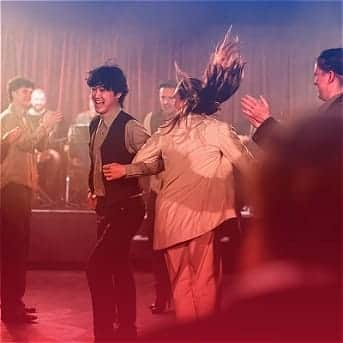
“It was this incredible coincidence and connection between the two countries which was the starting point for Tether. From there, we explored the traditional dance in both countries, ceilidh dance in Scotland and ganggangsullae in Korea.”
The audience is invited to join in a joint ceilidh and Korean dancing style ganggangsullae on the stage at the start of the play.
“Again, there was another coincidence, the same hold used in the Gay Gordons was how you would hold your partner in ganggangsullae,” said Nurse.
“When this first happened in the room, everyone just started celebrating, because it was such an amazing coincidence. From there, we started to create the story.”
Tether is a memory play looking at the course of the life of a Korean man who moves to Scotland in 1910, charting the next three generations of his family across significant historical moments in both countries.
Nurse added: “It’s been a really amazing process of discovery of all of these coincidences and connections between Scotland and Korea that hopefully we’ve fused together both in content and form for the show.”
“There was lot of of Koreans learning about Christianity through Scottish missionaries, so I think it would have become a famous folk song at the time,” said Wonder Fools co-founder Robbie Gordon.
“Theological students might have created their own words to effectively, the existing melody. It’s been really interesting to learn about.”
He pointed to a recent album by renowned K-pop band BTS, called Arirang.
“It was funny because we’d been working on this show for two years and it’s interesting that BTS has chosen to name their album this because it shows this folk music holds such a strong cultural foothold in Korea.”
Nurse said: “Hopefully it’s an experience for the audience that will be funny and moving, but for a Scottish audience, hopefully they’ll learn a lot about Korea, but about Scotland as well.”
Tether is at Summerhall from 6 to 31 August.
Comments
Want to join the conversation? Please or to comment on this article.