
For Banjo Beale 'anything is possible!' as makeover show Designing the Hebrides returns
Abandoned sheets of corrugated iron, five foot crabs and a woven wall, how making do with what you’ve got is the way to work a little magic on small businesses
As the nights draw in it’s time to coorie doon with Banjo Beale and his team in a new BBC series of Designing the Hebrides this month.
“It’s something to warm the cockles as summer ends, a little warm hug,” says Beale.
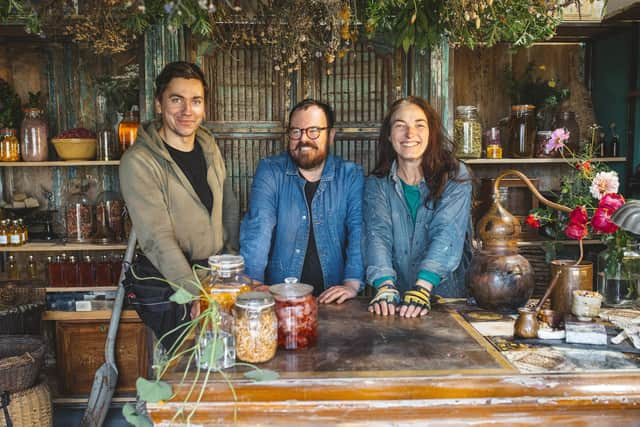
Hopping on and off ferries, the Mull-based interior designer and his team have traversed the islands working their makeover magic on a fresh set of challenges for the second series. There’s a pub on Easdale, an apothecary on Harris, honesty boxes in Mull and South Uist, a wool and craft shop on Iona, a hotel in Tobermory and a croft shop on South Uist, along with all of the people that through them make a living across the Hebrides.


When we speak the Scotland’s Home of the Year judge and host Beale has temporarily swapped his orange fisherman’s beanie for a baseball cap as he’s online from a balmy Bath where he’s working on a Georgian townhouse, but after ten years acclimatising to the Hebrides, he’s feeling the heat - in more ways than one.
“When I don’t have my camera in front of me and a stopwatch and three days to do it in, I tend to drag things out, so now I’m feeling the pressure. And it’s so hot! I gave away all my shorts to the charity shop and I’m always wearing my shacket and hat so I’m not prepared for hot weather.”
Nowadays Beale is at home in inclement weather which is just as well as the new series of Designing the Hebrides was filmed last autumn with the weather as much of a feature as his upcycled salvage treasures, versatile team of joiners and painter, sidekicks partner Rohan and dog Grampa and his ability to work magic on a shoestring budget. What’s notable about this series are the limitations imposed by the islands themselves and how people survive there. Each of the challenges involves a business, and from the start we meet the people involved, all on a tight budget and working two or three jobs to get by.
“It’s really what I like about the show,” says Beale. “Because they’re businesses, you get to learn more about a place and how people live there, so with the apothecary you see the nature around about, or with the craft shop you learn about wool. The people are with you every step of the way so it’s a privilege to get to know them a little bit more.

“Living on an island the season is really short and unreliable so it’s a case of making hay while the sun shines, especially if you’re making a living off tourism,” says Beale. “You have eight months to earn enough to get through winter and it puts pressure on that business, so I was really happy to help.
“Also because I have an advertising background, I can’t help but get my beak into people’s business. So with the apothecary on Harris, I saw an amazing lady with an incredible story and wealth of knowledge, just a wise woman with a beautiful product, but she wasn’t showcasing it in the best way. It’s not just design for me, it’s helping with a business to hopefully make it the very best version and also reflect them. I don’t want to come in and completely change their business, I want them to still recognise themselves in it.”
One of Beale’s signatures is his love of recycling, upcycling and scavenging, and the Hebrides is a place where people by necessity have a make-do and mend philosophy.
“Nobody throws anything out so it means there’s always going to be something there that is useful. It might not necessarily be 100% what you’re looking for but that’s when you have to make do with what you’ve got,” says Beale, who collected corrugated iron panels around Iona to use in the croft shop.
“I loved when my joiner from Harris said they have a saying that ‘if you keep something for seven years you’ll find a use for it’. That’s when the penny dropped for me, it was ah yeah, that’s it. I really loved that.
“Whether I collect stuff in the Hebrides or leave ‘the rock’ and go to the mainland and bring it back, I put it in my hangar shed and save it for when I need it.”
So what does Beale have in his shed at the cheese farm on Mull that he’s not found a use for yet?
“I’ve got a really old horse cart I’d love to use. And this house I’m doing up in Bath is a gorgeous Georgian townhouse and they’ve replaced all the windows so I’m going home to Mull with 30 sash and case windows. I can’t help myself. My plan is to make a big greenhouse or something.”

One of Beale’s shed items is a pair of antique Indian doors that wind up in a new home in the apothecary in Harris.
“I’d had those a long time. My partner Ro gets excited about things and thinks ‘I can’t wait to one day have them in a house of our own’ and then sees that I’ve given them away. Like the gorgeous Sri Lankan tea picking baskets we’d collected a long time ago and he was actually very cranky that I put them at the apothecary, but it’s where they belong. As much as I loved them, they had to go in that space.”
Something Beale will never use elsewhere are the earthenware disposable chai cups he and Rohan collected while travelling in India.
“We’d never use those. That would be grounds for divorce,” he says.
One of the best things about Beale is his enthusiasm for the project and ambitions of his clients, whatever the limitations of budget and timescale. When honesty box owners, lobster fisherman and sandwich shop owner Jamie and Mary from Dervaig on Mull, fear their plans may be too ambitious, Beale comes back with ‘nothing’s too ambitious!’
“Noooo, I think anything’s possible,” he says. “That’s why I do what I do. Everyone tries to dim my shine a little bit, like all these people around me are pragmatic, realistic. But if I’d had my way I really would have a giant crab five foot high. My team is constantly knocking me down a peg and telling me I can’t do what I’m doing, but I think you’ve got to dream. I also understand they’re the long-suffering angel on my shoulder and I’m the devil.

“But I really do listen to people. You become close to them and have invested in them and want it to work because you’re going to leave and they’re going to just be stuck with it and it’s their own hard-earned money.”
His design team, Lisa, Tom and Eoghan, joiners and painter and decorator, may well be the pragmatists, but Beale usually gets his own way.
“An old boss once told me ‘go on the journey with them, so know it will be a no first but eventually you will chip them down and get what you want’,” he laughs. “More often than not, they’ll come around and tell me ‘you were right’ or come up with an idea that is in the same vein, and there we have a solution.”
What has to be borne in mind are the size and close-knit nature of the communities on the Hebrides that Beale is working in and the necessity for a touch of diplomacy. Such as when he suggests getting rid of the bar in the Easdale pub, which has a sentimental attachment for some of the residents.
“God yeah…” he says, remembering. “More than you probably see on screen, that really did get me in a state, the bar and taking it out. Ultimately the bar wasn’t right but the locals were so attached and I certainly don’t want to come in and rip out everything and tell them ‘this is it now’. So it was important to talk to them and understand what the bar meant. I figured out it wasn’t necessarily the bar but the memories attached so it was important to make The Puffer still feel like their pub but also add the owners’ own flair and make it work harder for them as a daytime into night time venue. It turned into a psychological forensic exercise where you have to understand why people want something and how far you can go.
“Because I’ve seen it on Mull, people moving somewhere and changing it because they think they know better. Something like a pub in a small place that’s everything to people, their meeting spot, how they socialise, where all their memories are made - births, marriages, funerals. So I understood how important that challenge was and wanted to get it right, and thankfully they loved it. I go back over to Easdale and have a drink in the pub and everyone loves me, but it was frosty at first.”
Although Beale and Rohan have been on Mull for a decade, they’re still conscious of being incomers while many of their fellow islanders have lived there for generations.
“I’ve been so welcomed but I’m so conscious of being an outsider. In a small community you can see Gaelic speaking diminishing and places changing, people coming and renovating old places that have a lot of history, or ripping out things that have memories associated, and I think part of the reason people love it and live there is because it feels like it’s always been. So I don’t want to come in like a whirlwind and change everything because then it will just be like everything else. I just want to improve it a little bit.”
For Beale the most enjoyable experience this season, with voice over by Ashley Jensen, was the croft shop on South Uist, despite the atrocious weather.
“Surprisingly, because it was the hardest to film and the most bleak. It was just really difficult conditions. Eoghan and Tom had to spend a couple of days getting a base right in the shed first but that meant I got to know DJ and Lindsay and DJ’s mum, and learn about their crofting history and a little bit of Gaelic. The croft is important for their ancestors but also for future generations, because Lindsay was pregnant as well.
“It’s really an isolated spot in South Uist and you get a sense of how much this needed to work because it’s really hard to make a living from crofting but they needed to so they could carry on their tradition and also just feed their family. They didn’t have a lot to spend and we didn’t have much time and were up against the weather. As it was we got stuck there for another two days after we finished because there was a big storm. You don’t ham it up for the cameras; the weather is one of the characters in the show.”
While South Uist supplied the hardest working conditions, it was the makeover at The Western Isles Hotel in Tobermory that was the toughest brief.
“That was the most difficult I’ve ever had - a transitional space that is a spa, with crazy requests like bubble machines, that turns into a moody speakeasy bar at night. I created two spaces that I’d want to use and now me and all my friends go and drink in the bar. It’s funny, because sometimes you wish you had a little cocktail bar to go down to that’s a bit dark and moody and vintage and has cool tables and games and is full of plants, and I’m like, oh hang on…”
While there is a huge variety of transformations for Beale and his team to achieve in the series, there is something all of the projects have in common.
“Everything feels a bit natural and well worn. Natural materials have threaded their way through, whether it’s rustic and reclaimed - there’s always some kind of timber - and plants tell a bit of a story for me, like in The Puffer pub it’s picking the right kind of flowers to dress the space.
“The one which was completely different was the wool shop on Iona because the brief was contemporary Hebridean and that made me realise I can do new in an interesting way. We weaved a wall and Eoghan and Tom were so proud of doing it and happy to use new materials. The craftsmanship of what they did in a short amount of time for not much money was amazing. I was super proud of that one. I think you can have a little bit more fun and do interesting combinations but as long as it feels like it belongs in the place, it reflects what it is they’re either selling or where you are.”
With Designing the Hebrides about to air, and the seventh series of Scotland’s Home of the Year filmed and to be shown later this year before a Christmas special, what’s next for Beale?
“I’m about to launch a new book, A Place in Scotland. I’m always asked ‘what is Scottish style?’ so it was figuring that out, from an outsider coming in. I went on a grand tour of beautiful Scottish places and we’ve got World War 2 control tower, castles, bothies, merchant houses, shops, beautiful hotels like The Fife Arms, places like Lundies House, wild land places, but also regular homes - colourful and quirky. They’re all so diverse but define Scottish style.
“For me Scottish style is a sense of history and a bravery where people mix old and new and bring the landscape inside. There’s humour, like The Fife Arms with the flying stag, a wit and whimsy, and a Trade Winds and neighbours influence, that Scandi Scot aesthetic. In the end I figured out that Scottish style marches to its own beat. It’s not like anywhere else. And the book is a love letter to Scotland from me, because I found my place here.”
Credit: Banjo Beale’s Designing the Hebrides is coming to BBC iPlayer, BBC Scotland and BBC Two in September.
Watch the teaser for the new series here
There will be a special screening and Banjo Q&A in Cottiers (93-95 Hyndland St, Glasgow G11 5PU, cottiers.com) on Tuesday 10 September.
Designing the Hebrides: Preview Screening | Shows and tours (bbc.co.uk)
A Place in Scotland by Banjo Beale is published by Quadrille Publishing Ltd, hardback £35, from October 3.
Comments
Want to join the conversation? Please or to comment on this article.