
Film reviews: After the Hunt | Roofman | Good Fortune | Black Phone
Julia Roberts is fabulously inscrutable as a professor caught up in a #MeToo scandal in Luca Guadagnino’s provocative drama, writes Alistair Harkness


After the Hunt (15) ★★★★☆
Roofman (15) ★★★★☆
Good Fortune (15) ★★★★☆
Black Phone 2 (18) ★★☆☆☆
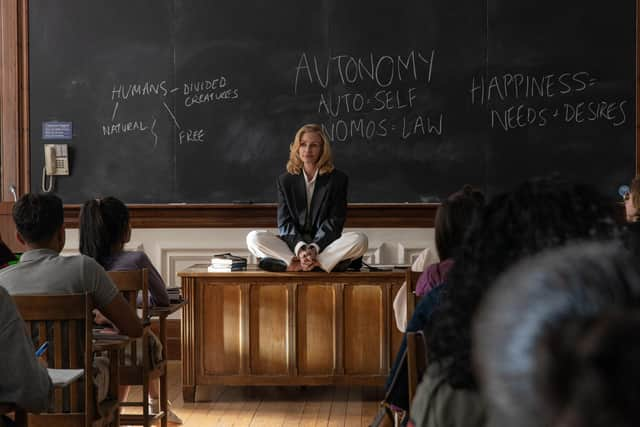
After last year’s Challengers/Queer double-whammy, the prolific Luca Guadagnino returns with After the Hunt, an elegantly provocative #MeToo drama about a Yale philosophy professor (Julia Roberts) who finds her loyalties tested when her star pupil accuses her most trusted colleague of sexual assault.
That description alone might be enough to raise the hackles of anyone anticipating another read-it-both-ways, he said/she said drama, especially because Guadagnino has cannily cast The Bear’s Ayo Edebiri as the accuser and Andrew Garfield as the accused, two hugely appealing actors whose respective charisma instinctively elicits audience sympathy.
Guadagnino, however, is less interested in the transgression itself than he is the whole cultural fall-out surrounding it, particularly the function of art and academia in a world where “the business of optics” is in danger of nullifying it with overly literal analyses of the work and the people who make it. To this end, Guadagnino goads his own audience by paying overt homage to Woody Allen throughout and gives Roberts a great scene – reminiscent of the one Cate Blanchett had in Tár – where her up-for-tenure professor, Alma, berates a desperate-to-be-offended student for misunderstanding a symbolic character’s purpose in a seminar.

But the film is also a careful-what-you-wish-for cautionary tale, hammered home by the ticking clock motif that opens the film and the playful five-years-later epilogue that reinforces the extent to which the system remains very much rigged in favour of the elites, regardless of how much real life impinges on their ivory towers. In between, there’s a lot to unpack (some of it engaging, some of it enraging), though there’s much pleasure too to be had watching each of the characters’ hypocritical natures gradually laid bare, with Garfield stretching himself as the raffish professor shocked to discover that he’s not untouchable after all, and Roberts’ Alma fabulously inscrutable as she tries to figure out which of her acolytes poses the biggest threat to her career.
Channing Tatum’s charm offensive in Roofman goes a long way to helping Blue Valentine director Derek Cianfrance turn what could have been a cutesy, true-life crime caper into a much more affecting romantic dramedy about bad choices and unexpected connections.
Tatum plays Jeffrey Manchester, a military veteran who acquires the titular nickname after robbing a series of McDonald’s to support his family. We see early on that Jeffrey tries to present himself as cordially as possible, but his self-proclaimed nice guy status has no bearing on his sentence when he’s eventually caught. Facing 45 years inside, he manages to put his skills to use to escape, then proceeds to hide in a Toys R Us store for six months, where he promptly falls Leigh (Kirsten Dunst), a single mother who works at the store.
All of which sounds patently absurd, yet Cianfrance has a firm handle on how to root this stranger-than-fiction absurdity in something tangible, zeroing in on Jeffrey’s longing for the family life to which he feels entitled, but he also exploiting the absurdity to deliver the sort of blissed-out romantic fantasy that feels true to the early days of a relationship when everything’s new and exciting and not quite real.

Dunst’s wonderfully open-hearted turn as the guileless Leigh intensifies this: she has a lot of chemistry with Tatum, whose own bare-all performance keeps finding small ways to let us see the cracks in Jeffrey’s conception of himself as a good guy. A low-key gem.
An unlikely fusion of Wings of Desire and Trading Places, Good Fortune casts Keanu Reeves as a low-level angel called Gabriel who uses his celestial powers to switch the lives of a despondent gig economy worker (Aziz Ansari) with a wealthy tech bro (Seth Rogen) to prove to the former that money isn’t what gives life purpose. The plan backfires almost immediately when Ansari’s Arj sees no downside to the switch and the hapless Gabriel accidentally restores the memory of Rogen’s Jeff, who doesn’t take kindly to his newfound poverty. Marking Ansari’s feature debut as a writer/director/star, the film boast some sharp lines, big laughs and just the right dose of schmaltz to make its points go down easily. And Reeves – in dopey Bill & Ted mode – is a joy.
Hopes were high for Black Phone 2, a sequel to the entertainingly nasty supernatural horror hit from 2022 starring Ethan Hawke as a masked killer who terrorises the children of 1970s’ suburban Denver. Alas, in trying to expand the mythology of the first film, director Scott Derrickson and co-writer C Robert Cargill have weighed it down with a garbled story that borrows far too heavily from the Nightmare on Elm Street movies without supplying enough jump scares or dread of its own. The nightmare portions are effectively done — they’re all shot like grainy 8mm home movies — but the plot is contrived and Hawke underutilised.
All films on release in cinemas from 17 October