
Exclusive:Engaging with AI in publishing industry 'essential' as university press signs over content to train machines

The panel discussion took place at the Scottish Book Trade Conference in Edinburgh
Engaging with AI in the publishing industry is "essential" and "wishing it would go away" is not the responsible thing to do, the head of a major Scottish university press has warned.
Nicola Ramsey, chief executive of Edinburgh University Press (EUP), revealed in a panel discussion at the Scottish Book Trade Conference in Edinburgh that her organisation is to sign an agreement to allow the use of its publications to train an AI tool.
She said she believed doing so would allow generative AI to become better informed through high-quality, peer-reviewed publications, while also creating a revenue stream for the embattled sector.
Around 80 per cent of EUP's authors have agreed to the scheme, with an opt-out option in place for those who do not want to take part.
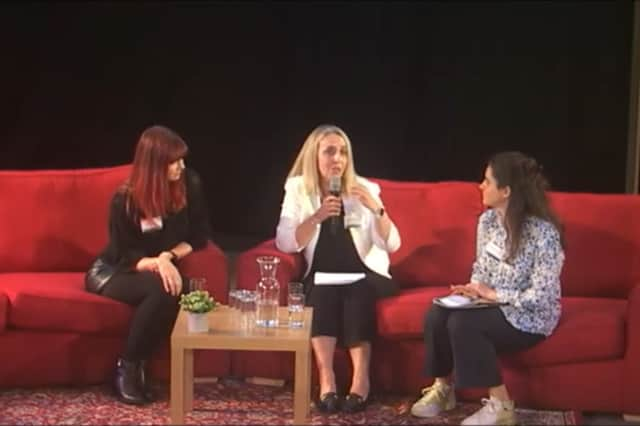

In a discussion with Amy Ellis, head of rights and licensing at Publishers’ Licensing Services, chaired by Dr Clementine Collett, a research fellow at Edinburgh-based Bridging Responsible AI Divides (Braid) and entitled “How publishers can respond responsibly to AI”, Ms Ramsey said she was “excited” about a collective licence for smaller publishers brokered between PLS and the Copyright Licensing Agency, saying it was a “clear route to market”.
“Navigation is the word [when it comes to AI], it’s complex, it’s difficult, it’s huge,” she said. “We’re learning fast and trying to avoid that sense of making it up as we go along.
“It’s complex in that there are real benefits from engaging with AI, but there are also real risks and harms and costs, so we’re having to weigh up those two sides of that picture.”
She added: “We want to engage with the licensing of our content to train generative AI. It’s something we talked about a lot in house over many, many months, because there was a broad range of opinion as to whether we should do it or not, but we’ve decided that we will. So since last summer, we have engaged in author communications, explaining to our authors why we think this is something we ought to do but saying ‘if you do not want to be a part of this, you absolutely don’t have to be’.”
She said other academic publishers had seen a similarly positive response rate from their authors.
She said: “I also think that while some of us may wish none of this were happening at all, the reality is that it is. We also know that a lot of these developers have trained their machines on our content without our permission, so it is happening and it’s about how we engage with that. It is perfectly possible to do this legitimately to pay a fair price for the use of our material, so I think we need to do that.
“I think engaging with this is probably the answer, just wishing it would go away maybe isn’t enough and isn’t the responsible thing to do.”
Ms Ramsey said ”large language model” (LLM) AI was looking for specialist research, having done broader training on a wider range of material.
She said: “It undoubtedly will be an income stream, we don’t know what size that will be, but given the challenge facing the academic publishing industry at the moment, that is going to be welcome. But also, I think if these models are going to be used by everyone, they’re going to be better if they’re trained on really high quality content.
“Everything we publish is peer reviewed, it’s reflecting that research integrity, so the better the content that goes in, the better the output.”
Comments
Want to join the conversation? Please or to comment on this article.