
The Palestinians bringing theatre and comedy to the Edinburgh Fringe 'Art is a way for people to survive'
It has never felt more urgent to platform Palestinian artists at the Edinburgh festivals, says Susan Mansfield
Journeys to the Fringe begin from all over the world and, for most, the biggest hitch will be no worse than a delayed flight. However, performers from inside the Occupied Palestinian Territories face a double barrier: being allowed to leave their country of origin, and being allowed to enter the UK.
Yet hearing Palestinian voices at the Fringe has never felt more urgent. That’s the reason Welcome to the Fringe, Palestine, which ran as a one-day event at Forest Fringe in 2015, is back for a four-day festival-within-a-festival at Portobello Town Hall.

Playwright Sara Shaarawi, born in Egypt and now living in Glasgow, is one of a team of artists giving their time for free to organise the event (others include David Greig and Grid Iron’s Ben Harrison). She says: “We wanted to bring it back in response to the immense violence, to the genocide happening in Gaza, and also in response to the inaction of the UK Government. But also it’s a response to the immense dehumanisation of Palestine in the media. We think it’s urgent now for people to engage with Palestinian art in order to engage with Palestinian narratives, Palestinian struggles. I feel we’re reconnecting with what theatre means — a space to process together, to listen to that which is hard, that which is joyous or that which is complicated.”
After an open call for Palestinian artists from around the world, Welcome to the Fringe will present artists from the UK, Europe, the Middle East and North America in a wide-ranging programme which includes music, comedy, drama, dance, puppetry and musicals. Palestinian artists will attend from the 1948 territories (inside the state of Israel), however organisers could find “no routes open” to bring artists within Gaza, such as rapper Mohammed Lafi, who was initially programmed, or playwright Rafat Al Aydi, whose play Rul Al Ruh (The Soul of My Soul) will be presented as a rehearsed reading.
Also on the way to Edinburgh are the four comedians in Palestine Stands Up: Alaa Shehadeh from Jenin in the West Bank, Diana Sweity from Hebron, Hanna Shammas from Haifa and London-based Sami Abu-Wardeh. The event is organised by Palestine Comedy Club, set up in 2019 by Shehada, British director Sam Beale and film producer Charlotte Knowles to help Palestinian comedians make and tour their work.
“We’re so used to seeing Palestinians as victims or as terrorists,” says Beale. “Being Palestinian is never just one thing, so we’re trying to tell all these different stories.”
While making comedy in the midst of war might seem a strange thing to do, Alaa Shehada says it’s also an important survival strategy. “Of course, you hear about Palestinian comedy and think ‘how can that work?’ But this is part of the reality that people abroad don’t know, that we joke, we make fun of everything, it is a way for us to keep going with our daily life.”
He says the divisions created by the occupation have become a basis for humour. “They have created stereotypes, from Jenin to Nablus, from Nablus to Ramallah. We have a lot of jokes about the people who are living in ’48 territories, and about Palestinians who are living abroad and dreaming about coming back, while I’m living in Palestine and trying to get out. Right now we have 900 checkpoints in the West Bank. All of these things create comedy.”
Then Shehada suddenly becomes very serious, and for a moment the reality of the occupation is right here with us in the room. “It feels like I’m doing a lot of effort to convince you with the idea of ‘Look at me, I’m a human being’. We have, as Palestinians, to find creative ways to reach people abroad, it’s just mad - and sad at the same time - what we need to do to have our freedom, to have some justice.
“I’m educating people, I’m making people laugh, and people are engaging and I’m loving that, but it’s painful when the reality is that nothing on the ground is changing. People are going for their food in Gaza under the bullets. My family are at home in Jenin with no work, no life, no money.”
Meanwhile, Diana Sweity, perhaps the only comedian performing in a hijab at this year’s Fringe, faces not only the usual barriers of travel but specific barriers because she is a woman. She says: “In Palestine, for women it is not easy to be an actress, comedian, dancer, singer. You must fight to make comedy and fight to make art. And if you want to travel, you must suffer to go and you must suffer to come back. Somehow, I don’t know how, we must speak about the situation, about the war in Gaza, we cannot close our eyes. You want to make a comedy show, but you feel broken inside.”
It is not only Palestinian performers who are finding ways to talk about Gaza at the Fringe. A new version of My Name is Rachel Corrie, about a young American activist killed by an Israeli bulldozer while defending Palestinian homes in 2003, is being performed by Jewish actor Sascha Schinder at Zoo Southside. The creative team, who are predominantly Jewish, say they are “adding their voices to the many speaking up for Palestine”. And Jewish writer/performer Sandra Laub explores the issues in her solo play, Picking Up Stones: An American Jew Wakes to a Nightmare at TheSpace @ Surgeons Hall.
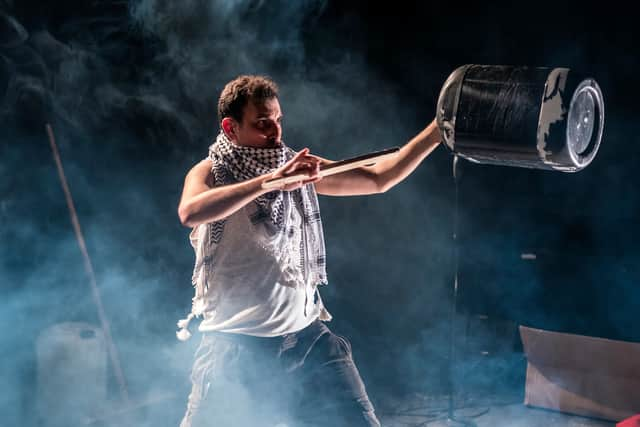
Everyone is agreed on the power of stories to communicate in ways that news bulletin cannot. Alaa Shehada’s one-man play, The Horse of Jenin, developed with Amsterdam-based company Troupe Courage, is about the 16-foot tall horse sculpture built in 2003 by German artist Thomas Kilpper from the wreckage of homes and vehicles. An important symbol of strength and resilience, it was destroyed by the Israeli military in October 2023.
Shehada says: “It became a meeting point in Jenin, we loved it because it expressed who we are. When it was taken away in front of us, it was very painful for everyone. Why is there fear from a statue of a horse made out of rubbish?”
Storytelling has also become central for London-based Palestinian comedian Sami Abu-Wardeh (Channel 4’s The Sheikh) who is presenting his second solo show at the Fringe, Palestine - Peace de Resistance. He says: “I guess it’s very difficult to be a Palestinian creator now and not in some way address what is happening. There was an added layer of difficulty for me because I’m a character comedian and clown by background, and that form doesn’t lend itself to talking about politics. When everything kicked off [in Gaza] I started writing political jokes for the first time in my comedy career. Speaking in my own voice was a big shift for me.”
In the show, he draws on stories of resistance in the Arab world, as well as elements of his own family story. He says that, while he has not yet found a way to make Britain’s supplying Israel with parts for F-35 jets funny, “idiotic physical theatre” will still be part of the show. Comedy, he says, can “galvanise groups of people who have similar ideas”. “But going and seeing comedy and having a laugh at all the things we agree about, in and of itself, is not activism. It is a jumping-off point, I hope.”
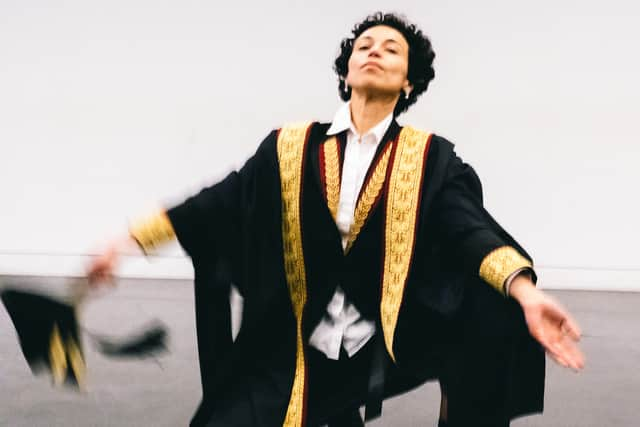
Meanwhile, Scotland-based dancer and performer Farah Saleh explores the colonial roots of the occupation with her solo show, Balfour Reparations. Saleh was a guest at the first Welcome to the Fringe, Palestine in 2015 and is another organiser of this year’s event.
She says: “Arthur Balfour was Prime Minister (1902-1905) and Foreign Secretary (1916-1919). When he was Foreign Secretary, he wrote the Balfour Declaration in which he promised Palestine as a homeland to Jewish people, while denying Palestinians political rights and self-determination. The show is very much about the accountability and responsibility of the UK.”
Set in 2045, it is a performance-lecture, imagining a fictive apology issued by the UK in 2025. Audience members become participants in a “social choreography’ which explores elements of past, present and future. Saleh adds: “Art has always been a way for Palestinians to resist. My friends in Gaza, the West Bank, or in what is now called Israel are using art to survive. When they write poems or when they practice and perform circus tricks to children in the tents in refugee camps, it’s a way for people to survive, to get in touch with their humanity. It is also [a way] for others to share joy again, to feel like humans.”
Welcome to the Fringe, Palestine, is at Portobello Town Hall, 12-15 August, www.fringepalestine.com; Palestine Stands Up, The Stand, 18-20 August, 3.45pm; The Horse of Jenin, Pleasance Dome, 30 July–25 August (not 9, 16, 19, 20), 2:20pm; Sami Abu-Wardeh: Palestine - Peace de Resistance, Pleasance Dome, 30 July - 24 August (not 12, 21), 21:45; Balfour Reparations, Summerhall, 13-25 August (not 19), 16:30pm
Comments
Want to join the conversation? Please or to comment on this article.