
Five Fringe shows about Vincent Van Gogh? We are all ears
The aurally-challenged Dutch Post-Impressionist maestro was much underappreciated in his day, but his legend lives on larger than ever, as Susan Mansfield discovers through a quintet of Fringe theatre and comedy shows by some of the many creatives who keep falling under his spell.

THEATRE
Paint, Vincent, Paint ★★★
Greenside @ George Street (Venue 38) until 29 August
Van Gogh and Me ★★★★
Dovecot Studios (Venue 198) until 30 August
Vincent Van Gogh: Between Worlds ★★★
Assembly George Square Studios (Venue 17) until 30 August
When Vincent Met John ★★★★
C Alto (Venue 40) until 30 August
COMEDY
The Van Gogh Shogh ★★★★
Assembly @ St Andrew Square (Venue 172) until 30 August
IT’S IRONIC that an artist who sold only one painting during his lifetime is now box office gold, whether for exhibitions of his art or theatrical productions which explore aspects of his life. And Van Gogh’s life is such a rich and turbulent story, it’s not surprising that creatives of all kinds keep falling under his spell.
One such is LA-based actor Joe Coffey, who spent two years researching Van Gogh’s early life to write his debut play, Paint, Vincent, Paint. He tells the story from the artist’s childhood in Zundert through failed attempts to be an art dealer and preacher, to the point where he hears - in this case quite literally - his calling to be a painter.
Like many, Coffey is fascinated by what could have caused Van Gogh’s mental illness and looks for answers in his childhood - the strapline for the show is “the pain before the paintbrush” - focusing in on the fact that his parents had a stillborn son, also called Vincent, exactly a year before his birth. Playing in the graveyard near his home, Vincent finds a tombstone bearing his own name.
Coffey interprets Van Gogh’s demons rather literally, with taunting whispers and cackles off stage, but he plays both Vincent and his brother Theo well. The play is particularly strong on Van Gogh’s time as a missionary to the mining communities in the Borinage, when his decision to live a life of radical poverty to help those in need causes consternation in his respectable family.
Enjoying The Scotsman's coverage of the Edinburgh festivals? For just £2 a month you can get unlimited access to scotsman.com plus 2-for-1 Fringe tickets. For details visit www.scotsman.com/subscriptions
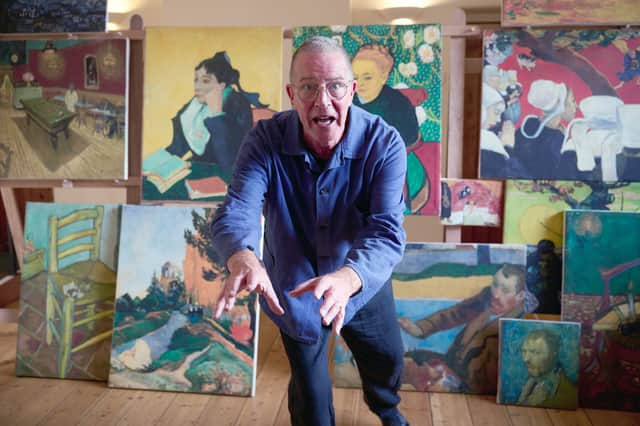
Van Gogh & Me, a solo show written and directed by John Retallack and performed by Jack Ellis, takes up the story a few years later in 1888, when Van Gogh moves to Arles in Provence, with high hopes of forming an artists’ colony. In fact, only one artist ever comes to the Yellow House. Paul Gauguin’s nine weeks in Arles is an intensely productive time for both artists but becomes increasingly fraught, ending in a drunken row in which Van Gogh lashes out at Gauguin, then cuts off part of his own ear.
Ellis, who now lives in Arles, admits to a fascination with Van Gogh since he saw ‘Self Portrait with Bandaged Ear’ in a book in the school library. Retallack’s writing is elegant and clear, and Rachel Marston’s set, in which paintings from the time are gradually revealed, is a joy to look at.
Ellis captures adeptly the contrasting personalities of the artists: Van Gogh generous, impulsive, desperate to learn; Gauguin charming but dogmatic. Gauguin is dismissive of Van Gogh’s practice of painting what he sees, and his insistence that true painting must come from the head causes Van Gogh to doubt himself, both as an artist and as a man.
Although they do learn from one another, a number of factors contribute to Van Gogh’s mounting anxiety and frustration. While it might not entirely explain what happens in the Yellow House, the play sheds valuable light on this important period.
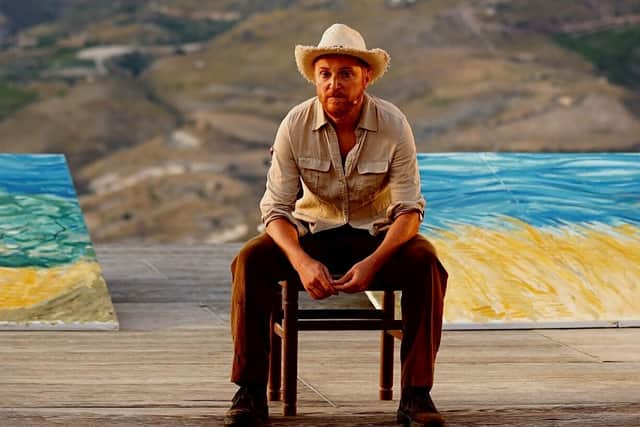
Vincent Van Gogh: Between Worlds by Italian writer and director Paola Veneto, which has been translated into English for the Fringe, is an impressionistic overview of the artist’s life, drawing in particular on an essay by French artist Antonin Artaud (another Van Gogh afficianado) in which he argues that Van Gogh was not insane, he simply felt the world too intensely. His mental breakdown was caused by a society which could not accept his vision.
It’s the most sophisticated production in this group, with live music and animated projections of the paintings, but it often feels static. The cast of five actors tell rather than show in a script which occasionally feels like an essay read aloud. The framing narrative, of a young business student who is inspired by Van Gogh to switch to Fine Art, feels somewhat unnecessary.
Antonio Gargiulo (Van Gogh) conjures up a remarkable physical likeness to the painter, with an intensity which feels appropriate, particularly about the eyes, though his diction in English is occasionally unclear. Pavel Zelinskiy (Artaud) prowls around the ensemble like a provocateur.
Artaud’s theory has the effect of shining a spotlight on Van Gogh’s radical ideas about the beauty of ordinary life and the dignity of the poor. If he made people uncomfortable, it was because he shook them out of their bourgeois comfort zone. While there are elements of the story which don’t fit easily into this model - the ear, for example - it is a reminder that we don’t know for sure.
Nick Wilkes’ two-hander, When Vincent Met John, offers a completely different take by creating a fictional meeting between Van Gogh (Murray Andrews) and John Lennon (Wilkes). Both are in their early thirties. Van Gogh is taking art classes in Antwerp and being ridiculed by the other students for his shabby clothes and strange paintings. Lennon is in LA, estranged from Yoko Ono, drinking and taking drugs, one bad decision away from another rock star death.
Waking up in an art gallery in his vomit-stained jacket, Lennon assumes Van Gogh is yet another fan who wants something from him and puts him on the receiving end of his sardonic sense of humour. However, he is gradually won over by Van Gogh’s intense dedication to drawing, his occasional flashes of clear-eyed wisdom and his insistence that he has never heard of The Beatles. They talk about religion, drinking, relationships, suicide and art.
The script feels a little too long and is occasionally repetitive, and perhaps a little too much effort is put into placing Beatles lyrics in the dialogue, but there are also some beautiful moments: Lennon tries to explain conceptual art to Van Gogh with little success; Van Gogh makes a watercolour sketch of Lennon using spit instead of water, to Lennon’s comical disgust.
Andrews and Wilkes have a clear grasp of their characters and the mood of their interaction is shifting and nuanced. Charlotte Peters’ production keeps everything moving, despite the fact that neither character seems able to leave the space where they’ve met. It’s an ambitious idea, but one which mostly comes off, and it’s often funny as well as insightful.
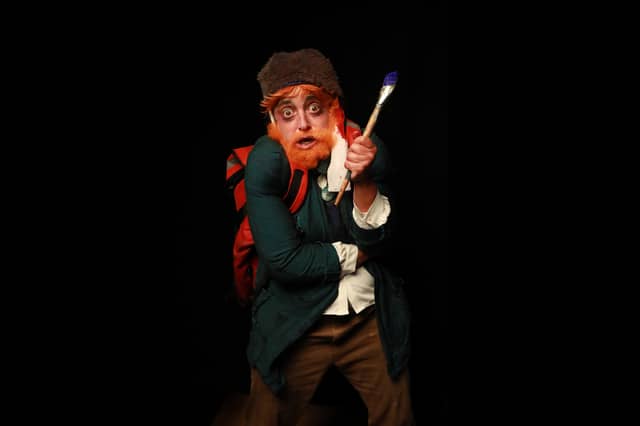
Meanwhile, Donna Oblongata’s The Van Gogh Shogh, directed by Francesca Montanile Lyons, takes the Van Gogh phenomenon and turns it into an anarchic, subversive clown show. “Welcome to the Van Gogh immersive experience,” a recorded voice booms, projections of paintings flicker on the wall and a diminutive Vincent (Oblongata) stumbles in out of the rain, Uber Eats delivery bag still on his back. As members of the audience explain to him how famous he has become, he exhales: “F***ing finally!”
Later, four members of the audience are hauled on stage for a painting class, asked about the personality of blue, and told to “get into the big feelings”. Oblongata, who is a visual artist as well as a performer, works off the energy of the audience with lightning quick responses. The bandaged ear spurts blood, and Meatloaf is on the karaoke in the night cafe in Arles.
In all its madcap absurdity, this should feel like it’s a world away from the historic Van Gogh, yet there is something in the intensity of the performance, and the fact that it clearly comes out of knowledge and respect for the man and the art, which means it touches on something very real. However much of a fantasy it is, it’s a joy to see Van Gogh discover the fame he never knew in life, even if, at the end of it all, he is still - predictably -“f***ing broke”.
The Scotsman’s arts newsletter is now sent twice a week - subscribe today
Enjoying the Arts & Culture journalism on scotsman.com? Make it easier to find by selecting us as a preferred Google source
Want the latest Scottish headlines sent directly to your phone? Sign up to our new WhatsApp channel here
Comments
Want to join the conversation? Please or to comment on this article.