
EIF music reviews: Voices of Canada: Orchestre Symphonique de Montréal | Maxim Emelyanychev | Derya Türkan
Our latest round-up of EIF music reviews includes a magical display of sparkling colours and chattering rhythms, a flawless mini-fest of French chamber music, and a master of the Turkish three-stringed fiddle.
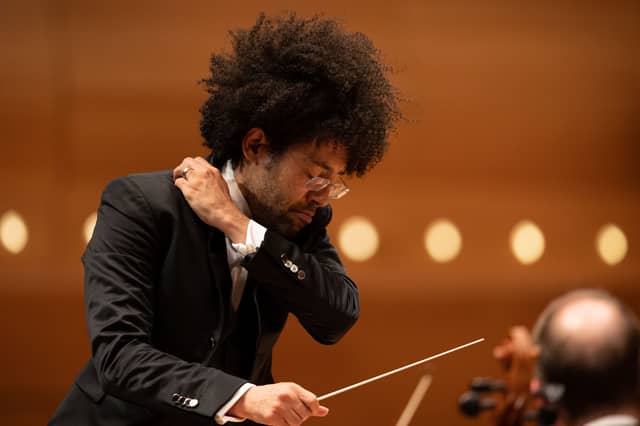

Voices of Canada: Orchestre Symphonique de Montréal ★★★★★
Usher Hall
Brave is probably the word for the Montreal Symphony Orchestra’s second International Festival concert (a bravery that may also have accounted for the rather meagre attendance). That’s brave in going for an all-21st-century opening half, and brave, too, in airing Canada’s dirty laundry to an international audience.
The Orchestra premiered Ana Sokolović’s harrowing You Can Die Peacefully Now in 2025, as a response to historic deaths of indigenous children in the country’s infamous residential schools. It was a sombre way to launch the EIF concert, but soprano Emma Pennell delivered an impassioned account, and conductor Rafael Payare teased apart Sokolović’s intricate orchestral writing, full of striking sounds and unsettling effects, with remarkable power and insight.
Yang to Sokolović’s yin was another of the Orchestra’s commissions, the rapturous Un cri s’élève en moi by Ian Cusson. It was a joyful hymn to womanhood, with more than a nod towards Debussy and John Williams, and sung with poise and elegance by Elisabeth St-Gelais.
But these two short pieces were really just the overture. The first half’s main meat came courtesy of cellist Alisa Weilerstein, the deeply committed soloist in Mexican composer Gabriela Ortiz’s vivid, vivacious Dzonot, full of sparkling colours and chattering rhythms. It drew a performance from Weilerstein that was by turns gritty, declamatory and magical. You could barely imagine a more fiercely committed advocate for the work, and Payare, too, seemed to relish Ortiz’s fresh, vibrant orchestral writing in a thrillingly detailed account.
There were perhaps more familiar sounds after the interval, in the form of Richard Strauss’s expansive musical autobiography Ein Heldenleben. Payare has spoken of building on the Orchestra’s trademark delicacy and colour so embedded by his predecessor Charles Dutoit with bigger, bolder, more muscular statements.
There was no lack of subtlety in his Strauss, and he traced the work’s life-journey with superb clarity, but it was also a magnificently bold, outspoken account, and one in which the composer’s transcendental conclusion felt entirely earnt. David Kettle
Enjoying The Scotsman's coverage of the Edinburgh festivals? For just £2 a month you can get unlimited access to scotsman.com plus 2-for-1 Fringe tickets. For details visit www.scotsman.com/subscriptions
Maxim Emelyanychev & SCO Wind Soloists ★★★★★
Queen’s Hall
In a mini-fest of French chamber music yesterday morning, the Wind Soloists of the Scottish Chamber Orchestra, along with Principal Conductor, Maxim Emelyanychev on piano, played with the distinctive style and finesse that can be regularly heard from their orchestral positions but even more acutely when they’re out front on their own.
In three sonatas by Poulenc, first up was flautist André Cebrián who set the bar high. With Emelyanychev a close-knit collaborator, the music’s shifting moods and spirits shone through in flawlessly elegant phrasing. Likewise with Clara Schweinberger in the Oboe Sonata, where authoritative playing and depth of tone could be both plaintive and lyrical as its three movements led to the surprise, questioning ending.
Convincing in confirming the charm and wit in Poulenc’s writing across all three sonatas, Maximiliano Martin on clarinet completed the set with a particularly beautiful spun out and tender Romanza.
As an ensemble, joined by Cerys Anbrose-Evans on bassoon and Kenneth Henderson on horn, Poulenc’s Sextet for Winds and Piano kept bright and keen pace in a generally well-balanced sound. As piano soloist, Emelyanychev’s Jeux d’eau by Ravel was appropriately limpid and liquid-like with its glistening, graceful cascades. Carol Main
Derya Türkan & Friends ★★★★
The Hub
Derya Türkan, a master of the kemençe, the Turkish three-stringed fiddle, along with most of his group, have given impressive performances at the Hub in previous years, under the auspices of the Agha Khan Master Musicians collective. This time, however, they were completed as a quintet for the first time by a superb singer, Derya’s wife, Dilek Türkan.
The festival programme hinted at “a contemporary twist” to music from 17th-century Constantinople. Türkan’s kemençhe opened the proceedings with that quavering, almost human sounding tone, joined by Yurdal Tockan on oud, Feras Charestan on the qanun or plucked zither and soprano saxophonist Basel Rajoub, also playing hand drums.
This merging of distinct instrumental voices, strings and reed, complemented and responded artfully to Dilek’s singing – velvety, melismatic and accompanied by persuasively expressive hand gestures. At times she might sing, sometimes wordlessly, in dialogue with the kemençhe, with the muted twang of oud or the soft piping of saxophone.
There were no spoken introductions and, as ever, more informative programme notes or other explication would have been welcome. However, Dilek’s entreating vocals and elegantly imploring, almost flamenco-like gesturing seemed to signal across centuries, entreating us to another time and place. Jim Gilchrist
The Scotsman’s arts newsletter is now sent twice a week - subscribe today
Enjoying the Arts & Culture journalism on scotsman.com? Make it easier to find by selecting us as a preferred Google source
Want the latest Scottish headlines sent directly to your phone? Sign up to our new WhatsApp channel here
Comments
Want to join the conversation? Please or to comment on this article.