
Edinburgh International Festival music reviews: Aurora Orchestra + more
A trio of fresh classical music reviews that you can still catch this month at the Edinburgh International Festival.
Aurora Orchestra ★★★★★
What difference does playing a lengthy, complex symphony entirely from memory make? The answer was laid bare in a compelling performance of Shostakovich’s Fifth Symphony by the brave British orchestra that has made a thing out of discarding the printed music. Released from the shackles of music stands and page-turning, the Aurora Orchestra, under founding conductor Nicholas Collon, gave us something that was electrifyingly visceral.
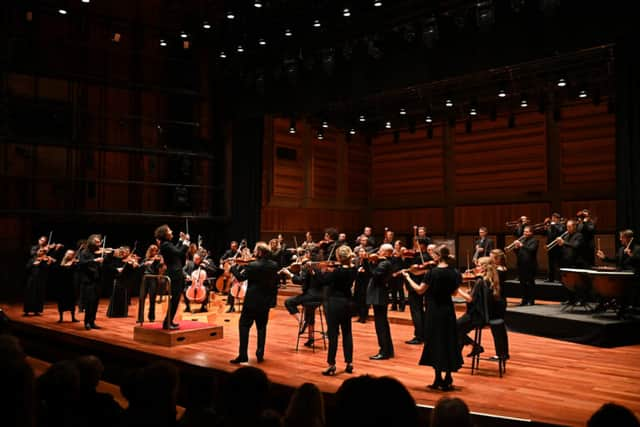

Firstly, it was visually exhilarating. To witness players variously lock eye contact with each other was to be party to the music’s shifting internal dialogues. And with the majority of the orchestra on their feet, the resulting bodily freedom manifested itself in a delivery that was as supple as it was expansive.It was hard-hitting, too. Collon established a chilling tension through the jagged opening rhythms, equally responsive to those unfolding melodies haunted by searing angularity and ironically tart underlay. Fearsome clinical precision amplified the Mahlerian grotesquerie of the Scherzo, before a sumptuous Largo defined by the most magical pianissimos and exquisite sonorities.
The Finale made its ultimate point brutally.Before the Shostakovich, Aurora gave backing - instrumental and vocal - to the idiosyncratic South African cellist Abel Selaocoe in his own composition, Four Spirits. To call it a concerto would misrepresent both its content and presentation, as witnesses to its animated world premiere in Glasgow two years ago will recall.
For this is performance art, in which a traditionally-attired Seleacoe combines his extraordinary talent for native singing - guttural basso profundo to ecstatic chanting - with improvisational cello, a shared front-stage musical discourse with percussionist Bernhard Schimpelsberger, and a restless physical showmanship that had this Festival audience - those in the stalls nestling comfortably in beanbags - singing lustily along.
Just how it will sound on Aurora’s newly-released CD remains to be seen. Live, it is truly memorable.
Ken Walton
Catrin Finch & Aoife Ní Bhriain ★★★★
The Hub
The duo of eclectically minded Welsh harpist Catrin Finch and Irish violinist-fiddler (depends on how she plays it, really) Aoife Ní Bhriain is a richly toned, musically inventive one, both distinguished players straddling classical, folk and world music genres.
The contrasting yet empathetic timbres of violin and harp, the latter’s sonorities tweaked by judicious electronica, make for an often beguiling sound world, evident from their opening piece, Wonder, violin harmonics whistling over booming bass strings. Much of their repertoire was from their album Double You, the titles all beginning with W and relating to bees (it’s a long story).
There was the magical, bell-like riffing of Wings, while Why? saw waspish violin elaborations over booming harp in what became a circling, Breton-sounding folk dance. Ní Bhriain switched to the grainy strains of the Norwegian Hardanger fiddle for a re-imagining of the traditional Eagle’s Whistle.
Their closing Waggle Dance became a darkly impassioned tango, while A brief encore conflated the old Irish air Tabhair Dom Do Lámh – “”Give Me Your Hand” with Wales’s The Ash Grove (Ní Bhriain unfazed by a string break), the piece dedicated to the children of our stricken world.
Jim Gilchrist
Rising Stars of Voice ★★★
Queen's Hall
It’s a tall order for young singers to charm a Festival audience at a morning concert – the demands of a first half with a few minutes’ music for each of the eight voices plus a similarly ingenue accompanist were alarming. In the event, they did well, some more overtly performer than deliverer of startling sound, some beautifully serene, one or two managing both.
The music was a welcome mix to ears a little staved of the tunes of our time, although we did reach back into romance and classics. (Hurrah for the Wind Rising Stars, for their wonderfully wild progrmme). The standout here, however, was vicious Kurt Weill: ‘seething, sexual and cigarette-stained’ as someone once said, through tears.
Brahms´s Liebeslieder Waltzes brought all together in a ringing ensemble: sweet, sophisticated little minatures of longing and politely suppressed lust set to words by Georg Daumer. Brahms´s word painting is ingenious in various combinations of voices with four hands on piano equally expressive and intricate.
The poetry, on paper, hardly flows but his brilliance in musical motion creates tiny opera; Daumer, long married, surely had a flowery imagination. The singers blended beautifully – rehearsals with such a group of individuals must have been heady – and kudos too, to their inspirational mentor James Baillieu for his own star quality.
Mary Miller
Make sure you keep up to date with Arts and Culture news from across Scotland by signing up to our free newsletter here.
Comments
Want to join the conversation? Please or to comment on this article.