
Edinburgh Book Festival Round-Up: Lyse Doucet | Andrey Kurkov

Our latest Edinburgh International Book Festival round-up includes a people’s history of the last 50 years in Afghanistan, an impassioned case for global frontline journalism, and a determined report from Kyiv.
The Book Festival’s event with Lyse Doucet, the BBC’s chief international correspondent, was the first in the festival programme to sell out. Perhaps everyone else knew something I didn’t: that Doucet, whose calm, intelligent voice beams to us from all the most troubled places in the world, is also great company, warm, funny, self-deprecating. It was a joy to listen to her, and an hour was not long enough.
Warmth, charm and quick-thinking have clearly got her out of many a tight corner. At one point, she and interviewer Sally Hayden, another foreign correspondent, were comparing notes about the jokes that have helped them get through checkpoints in, respectively, Afghanistan and Syria.
Doucet grew up in New Brunswick, Eastern Canada, with a single-minded desire to be a foreign reporter. Taking a placement with a Canadian voluntary organisation in Côte d’Ivoire, she was “in the right place” when the BBC set up its West African office, despite have “the wrong accent” and no CV to speak of.
We learn that she travels with a kettle, an iron and tea bags, and lines by Seamus Heaney in her pocket (from his poem Elegy): “The way we are living/ timorous or bold/ will have been our life.”
Enjoying The Scotsman's coverage of the Edinburgh festivals? For just £2 a month you can get unlimited access to scotsman.com plus 2-for-1 Fringe tickets. For details visit www.scotsman.com/subscriptions
Having previously resisted nudges to write a book, she has now published The Finest Hotel in Kabul, a people’s history of the last 50 years in Afghanistan. She went to the country first to report on the Soviet withdrawal in 1988, and is just back from there, five years on from when the Taliban seized power.
While it feels, in many ways, that the country has regressed, she sees signs of hope. The 20-year international presence “helped make Afghan society the most open, most educated it has ever been”, which means that many - parents, teachers, village chiefs, even some within the Taliban - support education for girls, which is happening online and in “secret schools”.
She admitted that even she feels tempted to turn off the news sometimes. “But we have to turn it back on because we’re citizens, we need to know what’s happening.”
In a world of polarised opinions and mistrust of news organisations (including the BBC), that comment was a reminder of a more idealistic view.
“We live in a time when the truth and facts are weaponised. Not only can everyone have their own opinions, they can also have their own facts. Views are polarised. All we can do is try to narrow the gap because nothing less than the future of our society and democracy is at stake.”
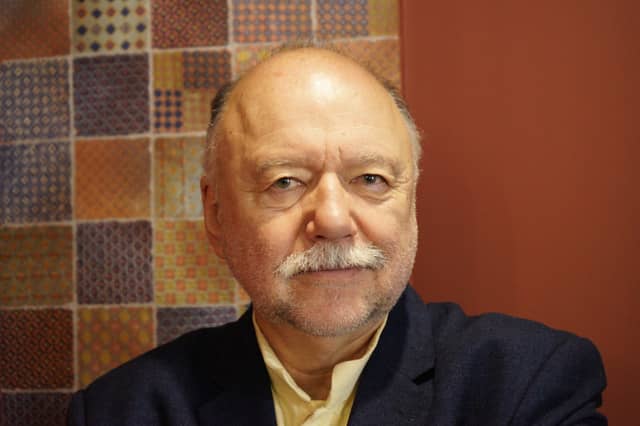
Since Russia’s full-scale invasion of Ukraine, novelist Andrey Kurkov has become a kind of war correspondent, a chronicler of events in his country, travelling around the world to help keep the plight of Ukraine in the public eye. Like Doucet, he’s good company, unflappable and often funny.
There were fewer jokes than in some of his previous appearances, just as there is no denying that life in Kyiv has got harder in recent months. Kurkov says he has deleted the app which many Ukrainians used to warn of drone and missile attacks - now there are simply too many.
He has stopped using bomb shelters too, he simply moves away from the windows of his Kyiv apartment and waits for calm in the hallway. Amid continuing Russian attacks on infrastructure, a record-breaking cold winter is forecast.
But the city remains determined. The theatres have never been so busy. Ukraine is at the forefront of developing drone technology. Kurkov welcomed Andy Burnham’s visit earlier this week to pledge renewed support - and play a song by The Smiths to Ukrainian soldiers.
And he continues to write, not only war diaries (the latest volume is called Three Years on Fire) and crime novels set in Kyiv in 1919. He has finished a short novel about contemporary Ukraine, and is working on a history of the country. Susan Mansfield
The Scotsman’s arts newsletter is now sent twice a week - subscribe today
Enjoying the Arts & Culture journalism on scotsman.com? Make it easier to find by selecting us as a preferred Google source
Want the latest Scottish headlines sent directly to your phone? Sign up to our new WhatsApp channel here
Comments
Want to join the conversation? Please or to comment on this article.