
Edinburgh Art Festival reviews: Del LaGrace Volcano | Emii Alrai | Richard Maguire | Sgàire Wood
The Del LaGrace Volcano exhibition at the EAF hub in Leith makes a fascinating counterpoint to the Catherine Opie exhibition at the RSA, writes Susan Mansfield

The workings of Edinburgh Art Festival are mysterious to some, so here’s the short version. The EAF programme is an umbrella which brings together many (but not all) of the art exhibitions in the city in August. The festival also has a modest budget for programming its own shows and events, and faces the challenge of making its voice heard amid the overwhelming noise of the larger festivals.
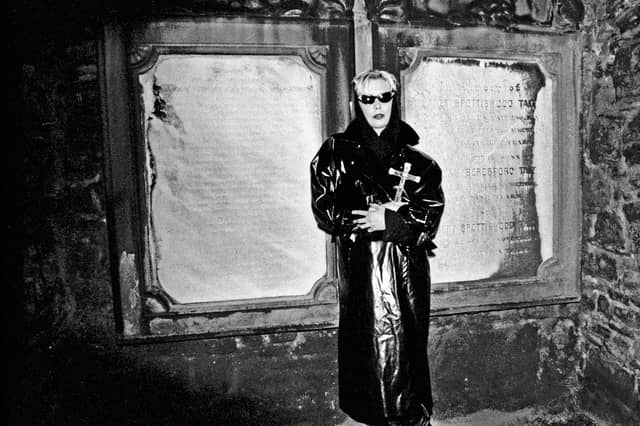
Platforming work by minorities, in particular queer stories, has been a priority in recent years, and that continues. For 2026, in a building currently being renovated to become the festival’s permanent hub at 92 Constitution Street, Leith, EAF hosts pioneering queer artist Del LaGrace Volcano with Love Bites Back (★★★★).
It makes an interesting counterpoint to the National Galleries Scotland Catherine Opie exhibition at the RSA building. The artists are both in their sixties, both American, both committed to recording queer communities in their photographs. Volcano’s work is often more confrontational, documenting leather dyke subculture with candid images which are sometimes explicitly sexual.
Volcano was a frequent visitor to Scotland from 1988-91, and a room of previously unseen images from that period take a gentler, more domestic approach. We see Volcano, their Scottish lover Sylvia MacFarlane, MacFarlane’s family and their friends in Edinburgh and the Highlands. This was a time when queer life - particularly that of queer women and trans people - was all but invisible. Making them visible, recording them for posterity, cannot be other than a political act.

The most public manifestation of EAF to the city as a whole is Guardian, by Scottish-Iraqi artist Emii Alrai (★★★★), a monumental piece of sculpture on Calton Hill. From some angles, it is suggestive of the body of a great horse, its fragmented parts attached to a partially exposed armature. It’s the blue-green colour of oxidised metal, like an ancient thing dug out of the ground.
Commissioned for Bold Tendencies in Peckham in 2025, it has been remade for EAF, and references the Lamassu, divine beings from Sumerian myth. A contemporary work which is deliberately incomplete, it makes a fascinating juxtaposition with the 19th-centry partial replica of the Parthenon nearby, where building halted in 1829 when the project ran out of cash.
Close by, at Collective Gallery, Richard Maguire: There Is No Beginning, As There Is No End (★★★) is the first show in Collective’s new programme for early-career artists, Time + Space. Maguire is a graduate of Glasgow School of Art’s MFA programme, and of the Royal Drawing School. He is interested in imperial power relationships, particularly with reference to South Asia, and the representations of race and sexuality which emerge from them.
To make this work, he has drawn on a complex web of references - so much so that the gallery has printed out a folio of images of his source material with brief explanatory text. The key elements are: photographs from the 1930s by Sri Lankan Lionel Wendt, one of the first People of Colour to make homoerotic images; painted miniatures from Mughal India, in particular referencing the first Mughal emperor, Babur, who was bisexual; and representations of same sex acts from Hindu temples, many of which were destroyed by the British.
He explores and remakes some of this material in detailed, assemblage-style pencil drawings, abstracted silver leaf patterns, pewter reliefs, and limestone sculptures. Recurring barbed wire and chainlink fencing suggest restriction and suppression. He critiques the way certain images have been misused or misunderstood.
However, without the gallery’s folio, we’d be at a loss. It’s one of the challenges of research-based practice: viewers don’t have access to the same research, but the work still needs to come alive for them.

There’s also a great deal of reference material behind Sgàire Wood: In Pride, In Piety, In Vigilance (★★★★) at Jupiter Artland, though it is worn rather more lightly. The Glasgow-based artist, who has been better known as a performer, is fast establishing a studio practice; this is her biggest solo show to date.
The starting point here is heraldry, the language of coats of arms, a system in which animals and objects are given allegorical meanings in what often feels like a fairly random way. Via myths and mistaken anthropomorphic assumptions, the peacock, pelican and crane are assigned the values of pride, piety and vigilance.
Wood has made sculptures of the three birds, and the gallery is hung with shields which play with further layers of referencing. The eyeballs echo the cufflinks worn by the Droogs in Kubrick’s A Clockwork Orange; the eyelashes come from Pascal Laugier’s 2008 horror film, Martyrs. These introduce an undercurrent of violence. Systems such as heraldry are connected to hierarchies and structures, groups and loyalties, them and us. Wood grew up in Northern Ireland, a place with its own intricate system of signs and symbols linked to a legacy of violence. One shield has a wire grille over it like the security cages on the doors of some Belfast pubs.
But that’s not all. One shield is painted in camouflage colours, but the patterns are birds - doves, taken from Disney’s Snow White and the Seven Dwarfs. The small shields which make up the peacock’s tail are decorated with playing cards, Tunnock’s tea cake wrappers, sequins, fur. Heraldry, for those who are commited to it, is a serious business. Wood understands that seriousness, and where it could go, but she also undermines it with glamorous fun.
Edinburgh Art Festival’s Platform exhibition for emerging artists seems to have turned into development funding minus the show, which is sad. However, Blackie House Library and Museum’s Garagespace hosts Off The Charts (★★★★) a show by four artists, selected from this year’s degree shows, who have been invited to respond to a selection of map-based items from the collection.
Eve Giltinan Allais presents a freshly imagined take on maps and navigation in her film This is how we travel, in which a sat-nav gives instructions to a bird in flight. Interested in the “overlooked, sweet absurdity of everyday life”, she reproduces a screen from Google Maps as a meticulous pencil drawing. By making the digital physical, she invites us to slow down and look.
Alyth Krzyzanowska uses absurdity too with her Parking space for a horse, outlined in yellow on the floor of this space which, one guesses, must have once been a stable. Elena Nieva works with shields and insignia to make impressive textile banners, because maps are also about territory and conflict. Milly Toplis’ installation, I cling to you like a limpet to a rock, explores the borders between the human and nature in the landscape.
Richard Maguire: There Is No Beginning, As There Is No End runs until 13 September; Sgàire Wood: In Pride, In Piety, In Vigilance until 18 October; all other shows until 30 August
The Scotsman’s arts newsletter is now sent twice a week - subscribe today
Enjoying the Arts & Culture journalism on scotsman.com? Make it easier to find by selecting us as a preferred Google source
Want the latest Scottish headlines sent directly to your phone? Sign up to our new WhatsApp channel here
Comments
Want to join the conversation? Please or to comment on this article.