
Dunard Centre removed '2,750 grand pianos' of material to create ten metre basement
Work on the Dunard Centre broke ground a year ago

Construction of the Dunard Centre has reached another major milestone, with excavation of the building's 10-metre-deep basement now complete.
A total of 16,000 cubic metres of material has been removed from the site in central Edinburgh - equivalent to around 480 double-decker buses or 2,750 grand pianos. Temporary props supporting the basement walls are now in place, while concrete works are progressing to form the ground and lower basement levels.
Work remains on schedule with the centre due to be completed by 2029. Ground was broken on the centre last December.
The concert hall - which will host music from pop and rock, to classical, folk and jazz as well as providing a permanent home for the Scottish Chamber Orchestra and a new venue for the Edinburgh International Festival - is set to become Edinburgh’s first purpose-built venue of its kind in over 100 years.
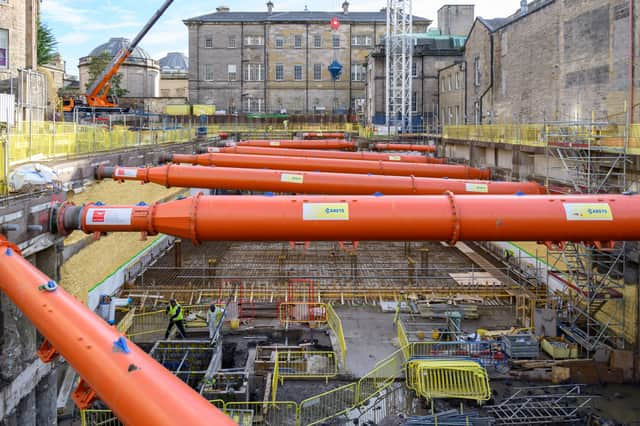

Jo Buckley, chief executive of the Dunard Centre, said: "It's great to be past what can often be a particularly challenging phase in any construction project, digging into volcanic rock laid down thousands of years ago. To be able to see the full shape and outline of our future venue – from the footprint of the box office, to the curve of the auditorium, and even the first hints at stairwells – is really thrilling.
"Not only can we now appreciate the scale and depth of the venue, we can start to picture how it will actually be used: where audiences will arrive, how people will flow through the building, and how the new public pathways that hug our walls will connect our venue with the restaurants, bars, hotels and shops in this vibrant corner of the city. Most importantly, it helps us imagine what this place will become: a venue buzzing with life, people, music and culture.”
The next phase of construction will see the installation of the building's structural cores, which will house staircases and service shafts while providing critical support for the structure above. Steelwork is expected to begin at the start of next year, marking the next visible stage as the venue begins to rise from the ground.
Designed by David Chipperfield Architects with Reiach and Hall Architects, the venue, on a site behind the Royal Bank of Scotland headquarters on St Andrew Square and largely backed by philanthropist Carol Grigor, will be the first Nagata hall in the UK, widely recognised as the world’s leading specialists in concert hall sound.
Martin McGough, project director at Balfour Beatty, said: “Completing the main excavation marks a significant milestone for the Dunard Centre and is testament to the expertise and dedication of our project team and specialist supply chain partners. With works to form the basement structure now well underway, we look forward to building on this progress as the Dunard Centre begins to rise above the ground in the new year.”
Ms Grigor - a former concert pianist and long-term funder of the arts in Scotland, drove the creation of the new concert hall with an initial £35m donation as well as a second £20m cash injection late last year.
Comments
Want to join the conversation? Please or to comment on this article.