
Alexander McCall Smith on the return of 44 Scotland Street: ‘Why would you want Bertie to grow older?’
As 44 Scotland Street returns to The Scotsman, David Robinson talks to its prolific author Sir Alexander McCall Smith about The Prime of Bertie Pollock, the latest edition of the world’s longest-running serial novel
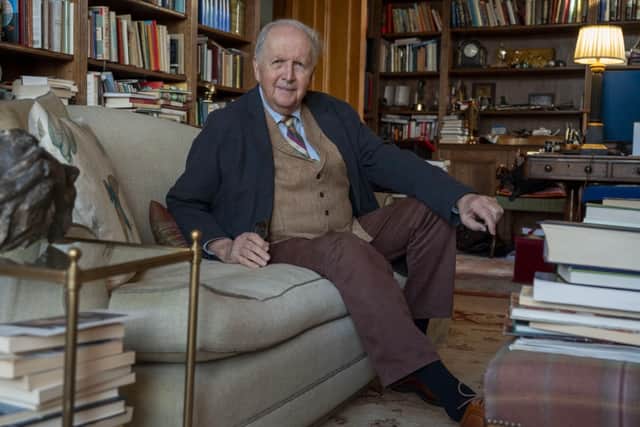
I am sitting in Sir Alexander McCall Smith’s study on the first floor of his house in Merchiston and he is telling me about a story he’s written. I have known him for a quarter of a century, and we are friends: I have never met anybody kinder. So I have heard quite a few of his stories, but I haven’t heard this one, even though it was broadcast last month on Radio 4.


It was called Mary McDonald’s Big Trip, and essentially it is a shaggy dog story in which a Hebridean teacher packs up her job and goes to Nepal. At every stage of the journey, good things happen to her, and at every stage the reader is thinking that surely soon there must be a reversal of fortune, because life’s like that. But no: because Mary McDonald has such good karma, everyone seems to pick up on it – even, when she meets him, the Dalai Lama.
So it’s an outrageously happy story, deliciously unrealistic, and one I can’t imagine anyone else writing other than this genial 77-year-old sitting on my right across an ottoman overflowing with books. On my left, 24 Super Hits for Alto Sax lies unopened on the music stand. When we’ve finished our interview, he plays Mood Indigo’s sax solo. “I’m taking lessons,” he says. “I love learning new things.”
He is telling me about Mary McDonald because he is reworking the story into a standalone novel and I have asked him what books he will be working on in the next three months. What OTHER books I mean, because he has just told me he has written the first 18 chapters of his 19th Scotland Street novel – the longest-running serial novel in the world – which will start appearing in The Scotsman on Monday. And I know all about Scotland Street because I have been editing it in this newspaper ever since the first chapter of the first book 22 years ago.
What differentiates 44 Scotland Street from all his other novels – and almost everyone else’s too – is that they start going into print before he has written the middle, never mind the ending. Those 18 chapters, in other words, won’t even take the story beyond February, much less March or April. Most literary tightrope walkers set off with the other end of the rope firmly fixed. McCall Smith doesn’t.
Naturally, I want to reassure myself that he is not too busy doing too many other things, so I ask him what else he has on the stocks before May. He starts flicking through the six pages of 2026’s to-do list.
He got back earlier this week from the Emirates literary festival in Dubai, but he is not travelling in February, so surely that will be a good month for writing Scotland Street? True, but he also has the last two-thirds of the standalone novel to finish off (and re-title), and he will be launching his first ever podcast of short stories at the end of the month. Also in February, South African theatre star Nicholas Ellenbogen will be coming over for a week to work on a new play after McCall Smith’s play Darwin: A Curious Mind was such a success at Cape Town’s Waterfront Theatre last year. And there is still The Wit and Wisdom of Precious Ramotswe to finish off and at some stage he’ll have to start thinking about what he will want to write about for the Lyceum At Home project announced last week.
READ MORE: The Unfragile Mind: Making Sense of Mental Health by Gavin Francis review: 'sits on the fence'
March isn’t any less busy. On the 3rd, he will fly out to Botswana to lead a two-week readers’ safari visiting many of the places featured in the No.1 Ladies Detective Agency novels. The next book in the series – astonishingly, his 26th – will be published in September, but to finish it, he needs to visit a sanctuary for orphaned elephants near Maun, run by a charity he has supported for a while (elephanthavens.org: it is surely no accident that one of the orphaned pachyderms is a six-year-old bull called Sandy). In the novel, Mma Ramotswe has to battle a campaign waged against the elephant sanctuary. Seeing it again, I suggest, must surely help him finish the novel.
He smiles in agreement. “I finished The Great Hippopotamus Hotel – that’s the one before last in the series – in Botswana. I was in one of the camps, on a river in the Okavango, sitting on the deck, looking out on the water, and as I finished the last sentence, I closed the laptop. At that very moment, a hippo came up in the river in front of me and burped – which is a well-known omen.”
I don’t know where he will be when he finishes writing the new Scotland Street novel or indeed whether there will be any comparable omens when he does. But I do know that he still enjoys writing it.
“Oh yes, very much so. The delightful thing about Scotland Street is that anything can happen. We can write about anything. Do make suggestions, David,” he smiles. “I really value them. If you have any plot suggestions, now is the time...”
I burst out laughing. I have never knowingly written fiction in this newspaper and the plain fact is that I’d be no good at it. Sandy has always welcomed all the minor suggestions I have made in each of the previous 18 novels with equal politeness. But apart from changing the name of a dog in the last one to Ralph (in honour of a friend’s much-missed labrador), not one of them ever made it into print.
The new novel will be called The Prime of Bertie Pollock, after its seven-year-old hero who has entranced readers around the world. “All the usual characters’ lives are progressing apart from Bertie,” says Sandy, “but Bertie’s prime is still seven. Why would you want him to grow older?
“He’s happier now because his mother [hothousing harridan Irene] is up north in Peterhead, where she has taken up with a fisherman who rescued her from the North Sea. She is still a threat, though, because she has taken the view that Edinburgh is irredeemably bourgeois and that Bertie should be in contact with the real people of Scotland and come up to Peterhead where he can, in her words, ‘live with boys who’ve grown up with fish’.”
But because Bertie is phenomenally bright (speaks Italian, plays the saxophone, has probably read half the classics) I have an idea. Not much of one, admittedly. But because I usually go to a pub quiz in Edinburgh’s Barony Bar on a Monday night and this is Monday morning, it seems obvious. Bertie should go to a pub quiz too.
I work out how the other characters could join in – even portrait painter Angus Lordie’s dog – and how Bertie will get all the answers right and win the £50 prize and…
“Yes,” says Sandy, “it could be a good scene. But where does it go? What happens next?” I must admit, I hadn’t thought of that. Still haven’t. That sort of thing is just what Sir Sandy is so good at – which is why, no matter how busy he is in the next few months, I won’t worry about it. Somewhat like Mary McDonald’s life, his writing has got such excellent karma that it always seems to work out perfectly.
44 Scotland Street returns to The Scotsman on Monday, and it will be published as The Prime of Bertie Pollock by Polygon in August, see www.birlinn.co.uk/polygon.
The Scotsman’s arts newsletter is now sent twice a week - subscribe today
Want the latest Scottish headlines sent directly to your phone? Sign up to our new WhatsApp channel here.
Comments
Want to join the conversation? Please or to comment on this article.