
Roman Scotland: Life on the Edge of Empire, Edinburgh review: ‘thrilling’
This complex exhibition writes a whole new chapter in Scotland’s history, writes Duncan Macmillan
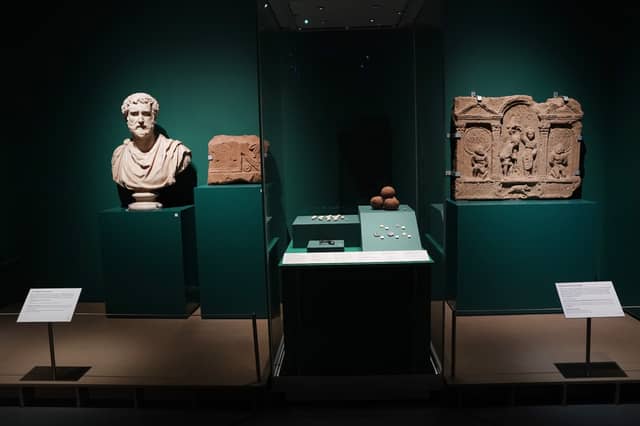

Roman Scotland: Life on the Edge of Empire, National Museum of Scotland, Edinburgh ★★★★★
“O Scotland! that cou’d yence afford / To bang the pith of Roman sword,” wrote the poet Robert Fergusson and he did not exaggerate. The Romans made at least three and possibly more concerted attempts to conquer northern Britain. Eventually they failed, but they certainly left their mark. A major exhibition at the National Museum explores that legacy from military campaigns, premature celebrations of victory to daily life in military camps and related settlements.
We call them Romans, but only the legionaries were Romans. A tombstone shows three of them at ease but with all their arms and armour. The rest of the army was very diverse. Fragments of a tagine, for instance, show North African soldiers home-cooking. Nor were the women just camp followers. A beautiful altar of a goddess called Brigantia was dedicated by a woman from what is now Yorkshire. The people the soldiers encountered and occasionally massacred were not barbarians either, though that is what the Romans called them. Beautiful jewellery and other objects testify to their sophistication. There was also cultural exchange, even in such an uneasy relationship. Some precious objects are a synthesis of Roman and Celtic forms, while an elegantly economical chariot wheel shows the Romans learning from the sophisticated chariots of their enemies.
But why did the Romans bother? Raiding south, the northern tribes were more than just a nuisance, but a bit of conquering on their CV evidently also mattered to the emperors. Claudius had boosted his with the invasion of Britannia in 43 AD. Britain was an island and it would be tidy to conquer all of it, and so 30 years later the Emperor Vespasian, who had been in Britain with Claudius, commanded Agricola, governor of Britannia, to finish the job. Agricola’s son-in-law, Tacitus, wrote his biography. He was scarcely impartial, but his account of Agricola’s campaign is supported by the archaeology. With the fleet in support, he marched up the east and then perhaps as far northwest as the Spey. Finally he met a confederacy of local tribes in a pitched battle at Mons Graupius. Where that was is still a puzzle, but inevitably the lightly armed locals were routed by the unstoppable Roman military machine.
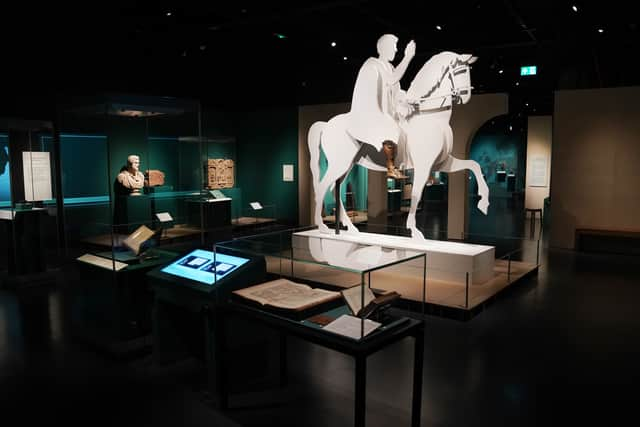
Just how formidable it was is demonstrated by a variety of its fearsome weapons here. At Mons Graupius certainly many northern tribesmen were killed, but to the frustration of the Romans the rest didn’t stand around to be conquered, but vanished into the glens. Agricola nevertheless meant his conquest to be permanent. He built a massive fortress to house five thousand legionaries at Inchtuthil, south of Blairgowrie. But, needed elsewhere, his troops were called away. Still unfinished, the fort was demolished. Here a mass of nails rusted into a block is only a fragment of the ten tons that were found there. With astonishing Roman thoroughness, as they dismantled the fort, the Roman carpenters knocked out and buried a million nails to hide the precious iron from the locals. Here and throughout this exhibition you are constantly reminded of the extraordinary efficiency of the Roman administrative machine. We see, for instance, how the army was supplied from all over Britannia and beyond. Fish sauce and olive oil from Italy, wine from France, in a wooden barrel six feet high for troops, and superior quality for the officers in an amphora.
Agricola’s campaign may have been brutal but it didn’t solve the problem. The Emperor Hadrian visited Britannia in 122 AD and decreed the massive, fortified wall that still bears his name be built to keep out the northern tribes. A bronze cup bearing the names of five forts on the wall was a souvenir to take home for one of the soldiers who built it.
But very soon after it was completed, the emperor Antoninus Pius decreed Hadrian’s Wall should be abandoned and a new wall, the Antonine Wall, built on the Forth-Clyde line. North Britain was apparently the only conquest on his Imperial CV which perhaps explains the existence of the most startling object here. A gilded bronze riding boot, it is a fragment of a life-size, golden, equestrian statue, presumably of the emperor, erected somewhere in the Borders. He wanted his victory to be noticed, but — shades of Shelley’s Ozymandias — it was soon forgotten.
Some of the most dramatic recent archaeology dates from his reign, however, and has been found at Inveresk. The site of an important fort and adjacent town, or vicus, it was probably the administrative base for the renewed Roman presence in Scotland, but it was abandoned within 25 years. The Romans retreated back again to Hadrian’s wall, a border that has hardly changed since. Still the same on the west, it has moved from the Tyne to the Tweed on the east, a distance of just 60 miles.
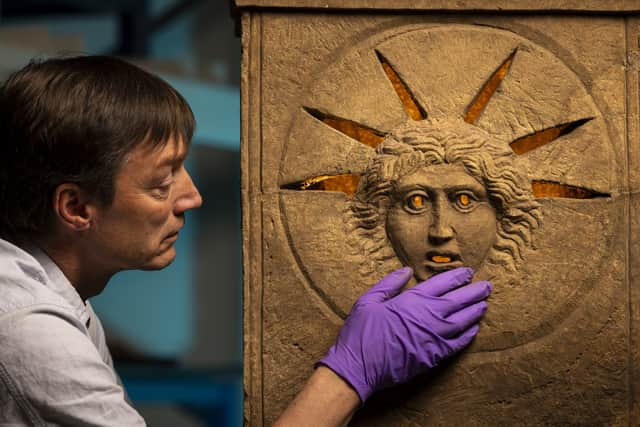
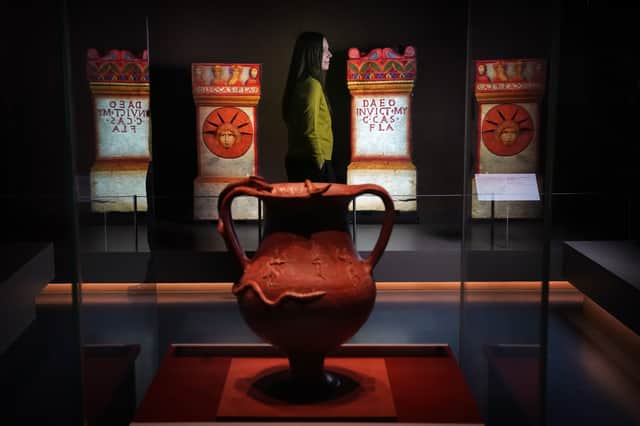
At Inveresk carved columns indicate a grand building and traces of hypocausts, central heating. Combs and instruments used in bathing indicate baths. These were very sophisticated buildings, too. (From Birrens to the south, there is actually a pane of window glass.) Most exciting of all, however, was the discovery of a Mithraic temple. Mithras was popular among soldiers and loans from a Mithraic temple in Germany fill out his story. He has to catch and kill a sacred bull to recover the sun — apt for soldiers on a Scottish positing. The excavation uncovered two Mithraic altars. Carefully buried by the retreating Romans, they are both beautiful, but one is surely unique. It has the face of the sun god surrounded by rays cut through the stone so a lamp behind can shine through them. Something was also hung to flutter in the lamp’s convection. The light would flicker and the face seem alive.
Sixty years after that Roman retreat, in 209, the third major invasion of Scotland was led in person by Emperor Septimius Severus. His son Caracalla led another the following year. Provoked by serious raids across Hadrian’s wall, these two invasions, which may have penetrated as far north as Stonehaven, seem to have been punitive. They were certainly massive, but also inconclusive.
Although his conquests were so short lived, it was Antoninus Pius who left the most substantial traces, not only at Inveresk but elsewhere, too, and especially associated with the wall that bears his name. The soldier-builders marked their achievement with a series of 20 monuments, striking witnesses to the Roman presence. One shows a goddess giving a victory wreath to the eagle standard of the 20th legion with two naked captives at either side. (Elsewhere an iron shackle hints their likely fate as slaves.) A reconstruction of part of another, garishly coloured following traces of colour on the original, shows a triumphant cavalryman leaping over four naked, bleeding natives.
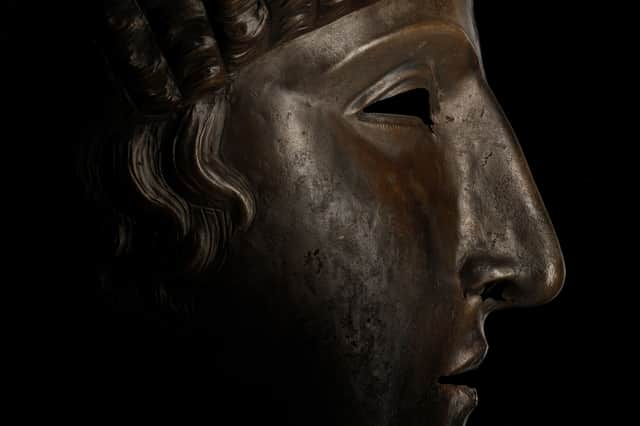
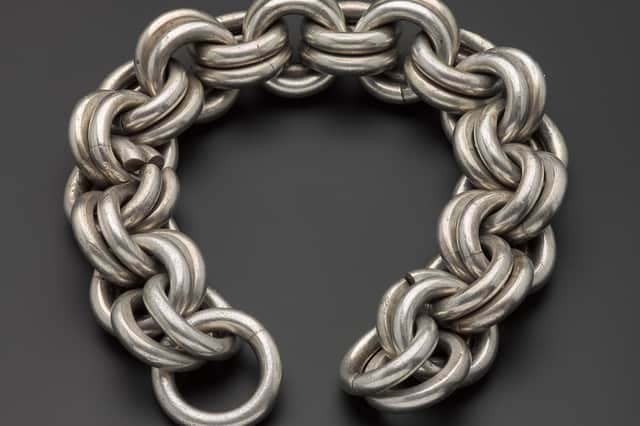
Further south, Newstead, beneath the Eildon Hills, seems to have been one of the most long-established and elaborate Roman forts and associated towns. Finds there range from a beautiful, bronze cavalry mask with the face of a goddess — cross dressing? — an elegant bronze wine jug and also many things reflecting ordinary, settled life, among them leather shoes for a woman and for a child. From here and elsewhere, including sites as far north as Moray, there are also examples of Samian ware, expensive, brilliant red, beautifully decorated pottery from France. Whether through trade, looting, or bribery, a variety of other precious objects with Roman connections have been found throughout Scotland. One striking example is a massive chain made from Roman silver melted down. This and hoards of silver coins and cut up silver objects, mostly in southern Scotland, suggest that after the failure of successive invasions, the Romans resorted to bribery.
One particularly remarkable item is the marble head from a statue of some anonymous Roman dignitary. It was found buried at a nodal and surely sacred spot in southern Scotland, the place where two great rivers, the Clyde and the Tweed, rise very near each other. Evidently decapitated by a raiding Caledonian, it seems the head was then buried as an offering to the gods. Whether in triumph or in thanksgiving, this was not the action of some dim barbarians, but of a self-conscious and spiritually articulate people.
Finally the last object in the show is a Pictish symbol stone. The Picts may have been an identity forged in opposition to Rome. Certainly their typical art form, spectacular carved stones, was inspired directly by the Roman habit of commemorating everything in stone. Shaping the beginnings of modern Scotland, that was certainly an enduring legacy.
This complex but thrilling exhibition writes a whole new chapter in Scotland’s history.
Roman Scotland: Life on the Edge of Empire runs until 18 April 2027
The Scotsman’s arts newsletter is now sent twice a week - subscribe today
Enjoying the Arts & Culture journalism on scotsman.com? Make it easier to find by selecting us as a preferred Google source
Want the latest Scottish headlines sent directly to your phone? Sign up to our new WhatsApp channel here
Comments
Want to join the conversation? Please or to comment on this article.