
Art reviews: Jamie Fitzpatrick | Etchingroom1 | Songs of Innocence & Experience Part II | Lawrence Abu Hamdan
Rather like you would a good sausage, Edinburgh-based sculptor Jamie Fitzpatrick’s new exhibition pricks the ponderousness of statuary with enjoyable results, writes Susan Mansfield.
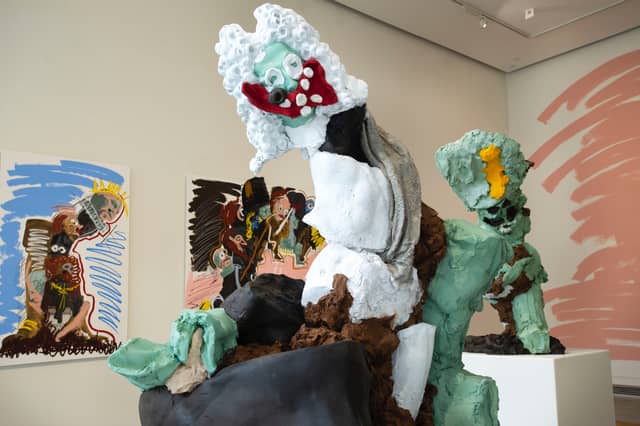

Jamie Fitzpatrick: Memorials to Sausage Politics, Edinburgh Printmakers ★★★★
Etchingroom1: Unexpected Trip, Edinburgh Printmakers ★★★★
Songs of Innocence & Experience Part II, Ingleby Gallery, Edinburgh ★★★★
Lawrence Abu Hamdan: Zifzafa, Leith Theatre, Edinburgh ★★★★
EDINBURGH’S statues commemorate, almost without exception, dead, white males, some of whom have been found to have questionable histories. Nonetheless, they endure, communicating, in their subliminal language of poses, symbols and the way they occupy space, their messages about hierarchy, authority and who is worthy of memorialising.
Edinburgh-based sculptor Jamie Fitzpatrick takes them on in his festival show for Edinburgh Printmakers. German imperial chancellor Otto von Bismarck apparently once said that if you like laws and sausages, you shouldn’t watch either being made. Fitzpatrick invites us to look more closely at the making of social hierarchies, the way a nation - or a city - constructs its own image.
His approach is to undermine them with absurdity. Central to the show are two sculptures on plinths, mimicking statues in their shape, made from a rough-and-ready mix of clay and jesmonite. One has a flowing wig and a clown’s face, the other appears to have no face at all. Their bodies are yellow, green, an excrement shade of brown, the complete opposite of marble and flawlessly cast bronze.
The ideas are expanded in a body of print work: seven print collages, one of which is a monumental 5m square. Elements taken from Edinburgh statues - an outsize hand or foot, a piece of drapery, a kilt and sporran - are collaged with sections of drawing and painting. Lines of sludgy oil paint are added on top. There is speed and spontaneity about the construction; one half-wonders if the paint is still wet.
The method doesn’t lend itself to a thoughtful critique. This is not a reasoned, step-by-step ideological debunking of statuary, it’s a vigorous, slapstick undermining of its ponderousness, an attack on its illusion of permanence. Like sausages, the final result conceals the messiness of its making. Our forebears built for posterity, but they were making it up, just like everyone else.
Meanwhile, the upstairs gallery hosts a body of new work by artist-duo Etchingroom1 (Anna Khodkova and Kristina Yarosh) who hail from Ukraine but are now based in Berlin. Their artistic language is based on drawing and expressed in printmaking, embroidery, textiles and ceramics.
Some of these works remind me of the best kind of children’s book illustrations: ones which give you a cross section of, for example, a cruise ship or airport, and the more you look, the more you see - people, animals, hidden jokes. This might be the grown-up version. Their ‘Airport’ is complete with control tower, departure lounge, security check and diagrams from a plane’s safety instructions, while above it all a plane seems to be exploding.
‘Cosmonaut’ and ‘Let’s Find The Jesus’ look a bit like children’s games or classroom wall charts. Small embroideries: a four-leaf clover, a rainbow, a unicorn, are reminiscent of children’s drawings. A series of ceramic dogs make a kind of autobiography: the childhood dog, the loyal companion, the dog owned by a partner who was lost in the break-up.
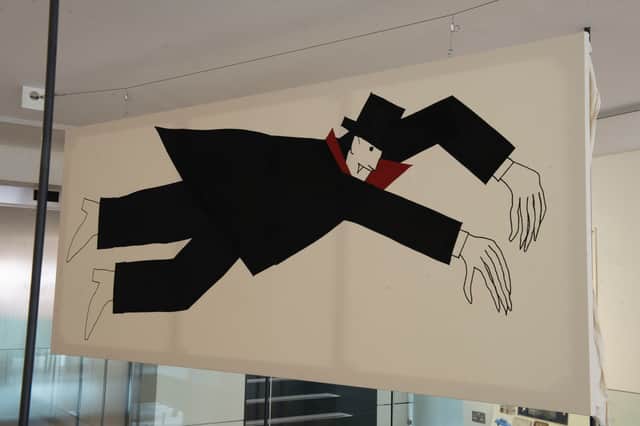
Drawings of cardboard boxes - ‘Important Box’, ‘The Last Box’ - will resonate with anyone who has moved house. There are textile collages of vampires: one hanging upside-down, arms crossed, another flying across the void in the centre of the room, poised to pounce. The work ranges from heartfelt and whimsical to dark and satirical, all produced with care and precision and a knowing wink. It’s a pleasure to look at.
Ingleby Gallery first staged an exhibition, Songs of Innocence & Experience, by Antiguan painter Frank Walter in 2013. At that point, Walter, who died in 2009 leaving a vast, largely unseen body of paintings, drawings and writing, was almost unknown. Since then, he has been the subject of major shows around the world.
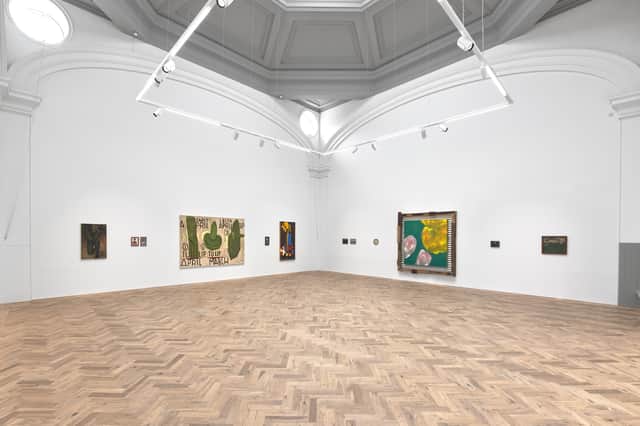
Now, in the year of his centenary, Ingleby revisits his work in Songs of Innocence & Experience II, interweaving his paintings with the work of contemporary painters, some of whom have responded directly to him, others who sit alongside in conversation.
Walter’s work, like Blake’s poetry, is small in scale, cunningly direct, deceptively simple. Few of the others in the show quite match him for directness, but that’s hardly the point. The show is beautifully installed, leading the viewer from one work to the next by the subtlest of threads. Artists who are well known are placed with others who might be new to us.
Most of the paintings are small, with the exception of Alvaro Barrington’s ‘Hibiscus, Tender Touch’, delicate petals in a striking frame made from reclaimed wood and metal, and Hayley Barker’s beautiful sunflower heads. Rose Wylie’s ‘3 Young Tulips’ strikes a wrong note - too big and too crudely painted for this ensemble.
Andrew Cranston is always interesting, always bringing something new to the conversation. Aubrey Levinthal’s gorgeous tin of paintbrushes in a flat, brown landscape with drilling rigs on the horizon, plays with scale. There’s a wonderful figurative piece by Lynette Yiadom-Boakye, and two lovely, small works by Ellen Siebers.
The show spills out of the mail gallery up the stairs, leading to a smaller show in the Instalments series by Chilean artist Sebastián Espejo, which is well worth seeing too.
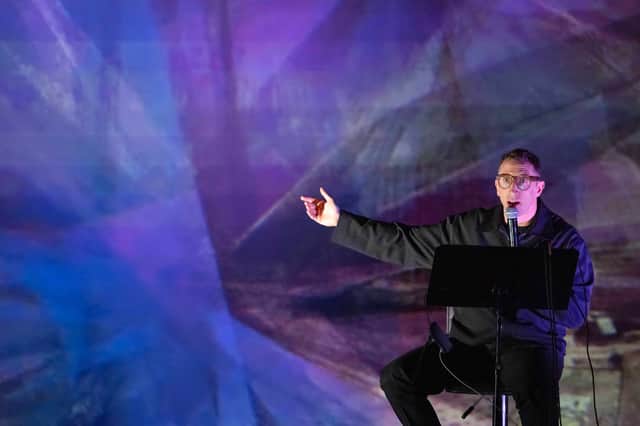
Edinburgh Art Festival drew to a close with a much-anticipated performance of Zifzafa, an audio-essay by Lawrence Abu Hamdan. Hamdan combines his work as a leading contemporary artist with being director of Earshot, an NGO founded in 2023 to investigate human rights abuses using sound evidence.
Zifzafa, an Arabic word for a wind that shakes everything in its path, investigates Israel’s plan to install 31 of the largest land-based wind turbines in the world on the Golan Heights, Syrian land which Israel has occupied since 1967 (in 2019, under the first Trump administration, the US became the first country to recognise the territory as Israeli).
The 250m tall turbines are expected to generate between 70 and 90dB of noise, and could be as little as 35 metres away from homes. They are to take up much of the remaining open space left to the Jawlani Syrians who live in the area, and it is thought would produce just 0.6 per cent of Israel’s energy, leading Hamdan to conclude this is less about green energy than a “sonic annexation”.
The work is scored by Busher Kanj Abu Saleh, and is performed live by saxophonist Amr Mdah and Renate Lurdesa Baumane, all of whom come from the area affected. Hamdan himself provides the narration.
While a big screen shows first abstract patterns, then a simulated landscape of Golan made on video games software, the key element is sound. Saxophone and electronic music is mixed with found sound from the area - bees buzzing, people’s voices, the whirr of waterpumps - occasionally drowned out by the epic thrum of the turbines (recorded at a turbine the same size in Germany).
Earshot is dedicated to evidence gathering, and this work is full of facts. At times there is so much narration, the sound almost becomes secondary. But it is a vital and important work, immaculately put together. The exhibition version of ‘Zifzafa’ runs at the Common Guild in Glasgow until October, please do go and catch it there.
Songs of Innocence & Experience Part II ends 12 September; Jamie Fitzpatrick: Memorials to Sausage Politics and Etchingroom 1: Unexpected Trip end 24 October; Lawrence Abu Hamdan: Zifzafa run ended (Common Guild, Glasgow exhibition runs until 17 October)
The Scotsman’s arts newsletter is now sent twice a week - subscribe today
Enjoying the Arts & Culture journalism on scotsman.com? Make it easier to find by selecting us as a preferred Google source
Want the latest Scottish headlines sent directly to your phone? Sign up to our new WhatsApp channel here
Comments
Want to join the conversation? Please or to comment on this article.