
Art reviews: Ilana Halperin | Rae Yen-Song 宋瑞渊
Both Ilana Halperin and Rae-Yen Song 宋瑞渊 seek to bridge immense gaps of time through their work, writes Susan Mansfield
Ilana Halperin: What Is Us and What Is Earth, Fruitmarket Gallery, Edinburgh ★★★★
Rae-Yen Song 宋瑞渊: •~TUA~• 大眼 •~MAK~•, Tramway, Glasgow ★★★★★
In 2003, the year she turned 30, Ilana Halperin visited Iceland where she discovered that the volcano, Eldfell, on the island of Heimaey, had been “born” in the same year as she was. She celebrated her birthday with the volcano, and has since celebrated her 40th and 50th birthdays there.


Sharing a birthday with a volcano has placed the artist’s human lifespan next to that of a mountain which could “live” for millions of years. Halperin’s strongest work elegantly bridges immense time periods, forging emotional connections across human time and geological deep time. In this the tercentenary of the “father of modern geology” James Hutton, it feels like an appropriate thing to consider.
Having learned stone-carving as a teenager in New York, Halperin studied art then settled in Scotland after coming to study on Glasgow School of Art’s MFA course. Her interest in carving objects from stone morphed into making work which expressed conceptually the closeness between “what is us and what is earth”. This mid-career retrospective at the Fruitmarket is a rare chance to see several significant bodies of work from the last 25 years.
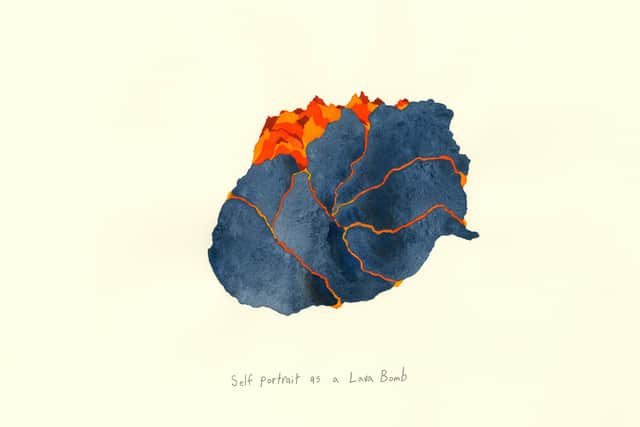
The visitor encounters the Eldfell work first: delicate watercolours of its lava flows, agates and quartz chrystals collected on its slopes on significant birthdays. Small in scale, this work carries overtones of intimacy and emotional charge. A lava bomb from Eldfell, a gift from an Icelander, becomes a “self portrait”, as if the artist herself was a fragment of this greater whole.
The other rooms downstairs expand our sense of her practice by presenting her photographs, which she rarely exhibits, taken with her trusty Holga during 25 years of travel to geological sites and volcanic hotspots: Iceland, Sicily, Japan, Hawaii, Greenland. Another room brings together the handwritten, handdrawn charts on which she plans bodies of work like Towards Heilprin Land and Minerals of New York, mapping the personal and the geological together.
On one wall, unframed photographs are pinned up in ungainly rows. The eye doesn’t know where to look and the quantity dilutes the impact. Some of the individual framed pictures, however, are properly powerful, such as Meeting on the Mid-Atlantic Ridge, in which Halperin and a friend stand barefoot on either side of the fault line under which the tectonic plates of North America and Eurasia are slowly pulling apart. In our ever more divided world, the resonance has grown with time.
Upstairs, a brand new work, The Rock Cycle (from stromatolites to diamonds) plots a kind of evolutionary chain of rocks, from the earliest - fossilised bodies of stromatolites - to limestone, then marble, and to oddities like Herkimer diamonds, perfect 18-facet quartz crystals found in upstate New York.
There is much more science to all this, but the thread which runs through it is calcium carbonate, found in the earliest fossilised life forms, and in human bones and teeth. While we are, as a species, beginning to grasp our kinship with other living creatures, Halperin wants to go a step further and show us our kinship with rocks, with the matter of the earth itself.
Some of this work is also about process, and one can’t blame Halperin for being fascinated by places where processes which would normally take hundreds of years can happen in a few months. She has worked several times at the Fontaines Pétrifiantes de Saint-Nectaire in the Auvergne, calcifying objects like broken bricks and roof tiles and creating delicate limestone “pictures” which look like carved bass reliefs.
A large-scale painting describes the colours of Mars through its various ages. Marble and alabaster surfaces are etched with the patterns inspired by the trails of ancient creatures, tinted with natural ink coloured using earth from James Hutton’s farm. There are etched “books” of Scottish mica, from her series made for Mount Stuart and beautiful, mysterious watercolours of Extremophiles, primitive microscopic creatures which were early life forms on earth and might survive on Mars, if anything does. The series is called We are all Extremophiles.
Halperin’s work is often small in scale, always meticulous and often draws deeply on collaborations with scientists of various kinds. She is wonderful at explaining all this, and writing and performance-lectures are part of her practice. However, many of the objects in this show are presented with a minimum of information, and this feels like something of a loss.
At its most magical, her work tells stories, weaving the threads of her own human story into the weft of deep time. At times, this show is lacking in the connective tissue which shows this warp and weft, but it’s worth seeking out as much information as you can as it will enrich your understanding of how these meticulous, marvellous things came to be.
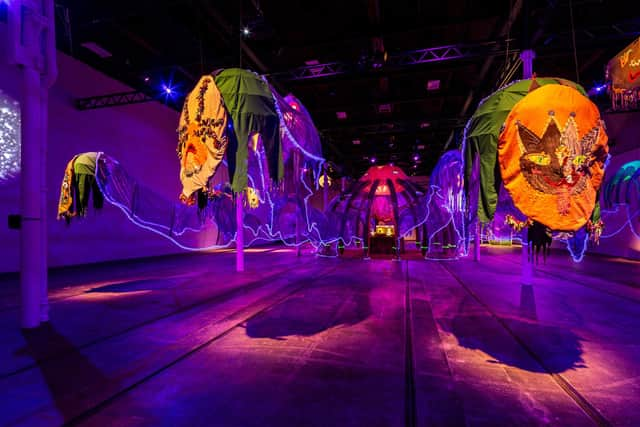
There might appear to be little in common between Halperin’s quiet, precise geology and •~TUA~• 大眼 •~MAK~•, the vast, pulsating installation by Rae-Yen Song 宋瑞渊 currently occupying Tramway 2. However, both artists are engaged with the micro and macro, bridging immense gaps of time, linking us to our ancestors in the broadest sense.
The starting point for Song’s installation is one particular ancestor, Tua Mak, a sibling of the artist’s mother, who drowned at the age of 13 in the ocean off Singapore in the 1950s. Tua Mak died before Song’s mother was born and passed into family mythology, “fabulated” here as a giant sea creature - or a giant representation of a tiny one - which easily occupies the whole cavernous space of Tramway 2.
In the soft, carpeted shrine in the belly of the beast is a tank of water - the pond from Song’s family’s garden in Edinburgh, complete with its micro-critters, invisible to the naked eye but crucial to the ecosystem. Song worked with a microbiologist to visualise their forms and built ceramic models, then worked with animators to make the models move. Meanwhile, the movements of the real critters are livestreamed on to the walls of Tramway and, through specially designed software, partially control the lighting and sound in the space.
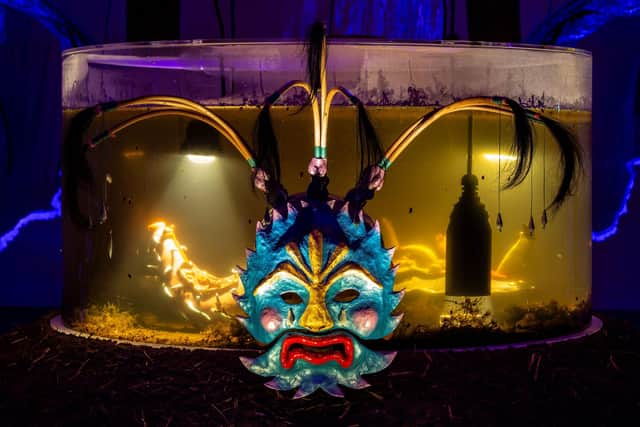
Ancestors and life cycles, Taoism and Chinese mythology, our relationships with other life forms on the planet - all these things feed in to this beautifully crafted construction of stitching and ceramics, blown glass and basket weaving which took about two years to create. Some individual pieces within it are costumes which will be worn in an opera Song is devising, to be performed during the Glasgow International festival in June.
It’s comparatively rare to experience an art work which is the sum of many parts, and of many layers of meaning, yet seems to have taken on its own autonomous existence. That much was clear from the children in the gallery, who hadn’t read the interpretation, revelling in the show’s imaginative environment.
•~TUA~• 大眼 •~MAK~• is the product of the idiosyncratic connections of one creative mind, and Song makes them with such passion, conviction and skill that you gladly go along for the ride. In a world where every second art installation claims to be “immersive”, this one really is: sound, lighting and sculptural forms work together to create something genuinely strange. It transforms the space and invites you to inhabit, albeit briefly, another consciousness. That, surely, is worth anyone’s time.
Ilana Halperin: What Is Us and What Is Earth until 17 May; Rae-Yen Song 宋瑞渊: •~TUA~• 大眼 •~MAK~• until 16 August
The Scotsman’s arts newsletter is now sent twice a week - subscribe today
Want the latest Scottish headlines sent directly to your phone? Sign up to our new WhatsApp channel here.
Comments
Want to join the conversation? Please or to comment on this article.