
Art reviews: Ida Applebroog | France-Lise McGurn
From their striking nudes to the way they both draw inspiration from fashion, advertising and movies, it’s remarkable how much Ida Applebroog and France-Lise McGurn have in common, writes Susan Mansfield

Ida Applebroog: Portraits, Fruitmarket Gallery, Edinburgh ★★★★
France-Lise McGurn: The Charm Offensive, Dundee Contemporary Arts ★★★★
One of the goals of the Fruitmarket Gallery’s programme is to present work by women artists who deserve further attention, from Louise Bourgeois to Lee Lozano to last year’s show on Jaune Quick-to-see Smith. Now it’s the turn of Ida Applebroog, a near contemporary of those women, who died in 2023 aged 93.
The gallery has made the decision to focus on Applebroog’s last two decades and, while this work brims with energy and freshness, it means that the earlier context is missing. We are told she was fiercely feminist, incisive in her approach to gender, politics and power, but the work on show is largely doing something different.
The lower galleries house Angry Birds of America (2018-9), a monumental series made, we’re told, in the context of Trump’s first presidential term. Applebroog collected and photographed dead birds and created large-scale, vividly coloured portraits by manipulating the images electronically, printing them on sheets of mylar (a semi-transparent material used by architects) and working on them by hand with inks and paint.
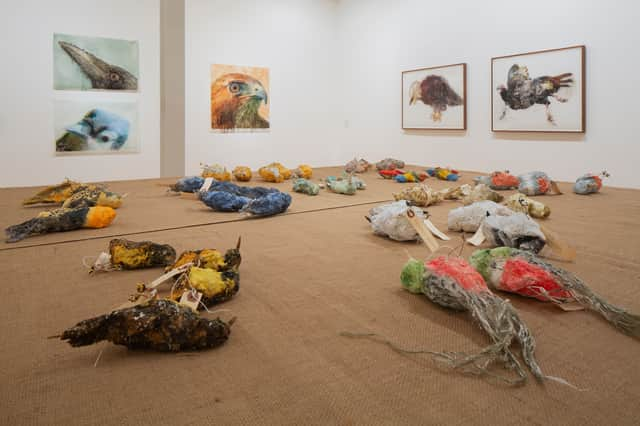
The paintings are bold and striking. Some create an illusion of life. Some have real personality: the turkey and the bald eagle, for example, form a pleasingly odd couple. They are in conversation with John James Audubon’s Birds of America (1838), whose majestic bird portraits were often painted from specimens the artist shot. The unthinking destructiveness is perhaps where the anger comes in. Applebroog has also created life-size “Specimens” from plaster and hessian, and a convincing flock of “White Birds” in flight. They are sad and beautiful all at once.
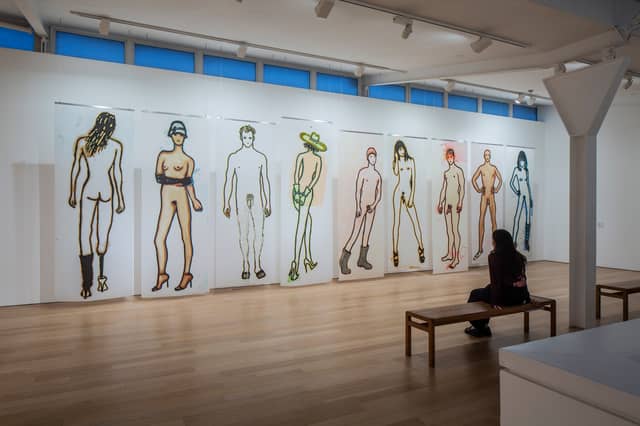
Upstairs, the main work is The Ethics of Desire (2014), a suite of portraits - if one can call them that - inspired by figures in magazines and advertisements. Here, we see Applebroog’s skill with the single, deft line: she trained as a graphic designer, moving into fine art in her thirties and forties after having four children. These figures may have started as models, but she playfully removes their clothes, leaving hats, socks, high heels, provocative poses. They challenge us to look at them, then seem to turn hesitant and vulnerable under our gaze.
The act of looking is even more provocatively explored in Monalisa, a shed-like structure created from more than 150 drawings Applebroog made of her own vagina in 1969. Revisiting them in 2006, she edited them digitally and printed them on semi-translucent materials. The pictures are simultaneously displayed and withheld, partly transparent but also enclosed, in an ambivalent relationship with the audience’s gaze. And, given what you find yourself looking at, the audience is ambivalent about looking.
It’s a pleasure to see such boldness and playfulness in work produced by an artist north of 80. Her last works are here too: an experimental sequence of “palette paintings” from 2021 which seemed to revisit earlier work while doing something entirely new. It’s a enjoyable, accessible show, but the decision to focus on late work means that an audience who is new to Applebroog - my guess is that’s most of us - don’t get to see the work for which she is best known.
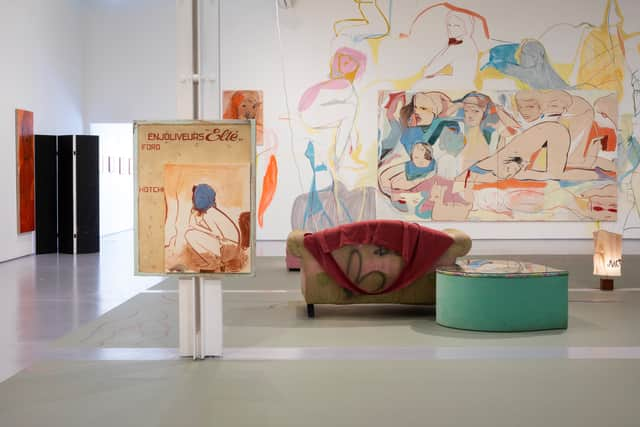
I saw the Applebroog show the day after seeing France-Lise McGurn: The Charm Offensive at DCA and, while I’m not claiming any connection between the two artists, it’s remarkable how much they share: the power of the graphic line, the elegant nude figures, the magpie eye which draws from fashion, advertising, movies, the urban sensibility. They even both paint wet-on-wet (one of the reasons Applebroog loved mylar was that the ink stays wet).
McGurn is some decades younger, and she works with a young, maximalist energy. Her show at DCA is her biggest to date in a UK institution, and she seems to have painted everything she could lay hands on: the walls, the floor, the furniture she has brought in from her studio (nobody told me, but you are allowed to sit on it), a white van parked up in the gallery, an old fridge.
McGurn graduated from Duncan of Jordanstone College of Art and Design in 2005, and her star has risen steadily in the past decade: a commission for Tate Britain as part of Art Now (she also painted the restaurant ceiling), shows at Tramway and Kelvingrove, representation by the Modern Institute, and now a major two-year commission at the Rodin Museum, Philadelphia. She also co-curated a fabulous show for this year’s GI in her Glasgow home.
She works fast and instinctively, her figures seem to whirl in perpetual motion. The show feels more like a performance; nothing is fixed, least of all meaning. Analysing her work feels akin to reviewing the dancing in a night club: for goodness sake, just dance!
At the same time, there are moments where the work earths itself. The title comes from a tongue-in-cheek remark made by her mother, the artist Rita McGurn, a prolifically creative figure who died in 2015. There is loss here: the recurring motif of Bambi is the movie marker of that loss for anyone who grew up in the 1980s. Important, too, is McGurn’s daughter, also called Rita; she collaborates on the painting Camping Together.
For the first time in this show, McGurn is painting on top of found images: family photographs, film posters, video stills. A photograph of What Every Woman Wants, Glasgow’s answer to budget fashion before it was commonplace, conjures the past. The photo of Katy Perry kissing the ground when she returned from a space flight is making a more serious point, as is the still from a video by Italian pop duo FUN FUN: you can’t miss the dancer’s lifeless eyes.
It’s a show which disregards boundaries: between the canvas and the wall, inside and outside, high and low culture, past and present, everyday life and creative life. One of the great strengths of a practice like McGurn’s is that reference points can come from anywhere, they just get seamlessly woven into the mix.
The dance whirls on, which is perhaps how the mind works in any given moment: people, memories, graffiti, product logos, cartoon characters, a beguilingly elegant hand smoking a cigarette. And images inform everything: what we feel, what we buy, what we desire. I’m sorry they won’t ever meet, because I think Ida Applebroog would have some things to say about that.
Ida Applebroog: Portraits runs until 7 February; France-Lise McGurn: The Charm Offensive until 15 November
The Scotsman’s arts newsletter is now sent twice a week - subscribe today
Enjoying the Arts & Culture journalism on scotsman.com? Make it easier to find by selecting us as a preferred Google source
Want the latest Scottish headlines sent directly to your phone? Sign up to our new WhatsApp channel here
Comments
Want to join the conversation? Please or to comment on this article.