
Art review: Gray’s Degree Show, Gray’s School of Art, Aberdeen - 'there’s a strong strand of feminist practice'
Some of the most successful displays of work at this year’s Gray’s Degree Show are those with the clearest focus, writes Susan Mansfield
Gray’s Degree Show, Gray’s School of Art, Aberdeen ****
The smallest of Scotland’s four main art schools is also the last to open its annual degree show, but it remains one of the most enjoyable to visit, in part because of its more manageable size. It also wins (again) the Mansfield Award for the clearest and most readily available artist statements.
Gray’s currently offers two courses within Fine Art: Painting, where many of the students do actually paint, and Contemporary Art Practice, where they do everything else. While some of this year’s work is less resolved, perhaps because this cohort of students spent the first 18 months of their courses in lockdown, the strong work is as vital and accomplished as ever.

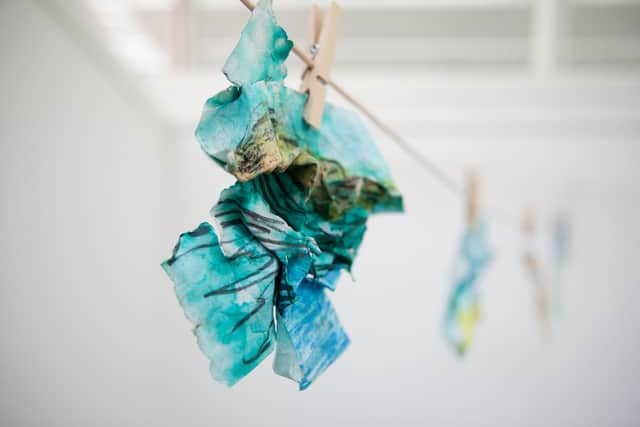
Eco-issues are present in the work of many students, whether as the subject matter or because they have given a lot of thought to developing sustainable practices. Kirsty MacDonald does both, making plant life her subject and creating her paintings and sculptures from recyclable materials and watercolours made from locally sourced natural substances.
Bronwyn Mackenzie takes the term “plant-centric” a step further by putting a plant literally at the centre of her show – a decades-old cheese plant which has lived in the painting department for as long as anyone can remember – and uses biosonification technology to capture its “voice”. She also shows “drawings” made by the trees on campus.
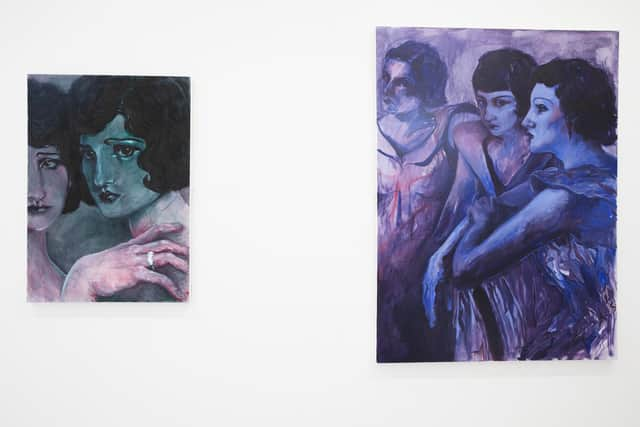
There’s also a strong strand of feminist practice among the women artists. Lisa Ross challenges perceptions with her “No” Manifesto, and has made an impressive series of scold’s bridles designed for women to “wear with pride”. Sonya Binnie is painting in a range of styles, but her work, which explores women’s lives in relation to social structures, shows a lot of skill. Megan Blumski’s atmospheric paintings capture groups of female performers away from the male gaze, recalling the work of the Impressionists painting backstage at the Folies Bergères.
Memory, and the tricky business of capturing what we remember, is a recurring theme. Emily Sutherland paints a picture of the sea capturing a memory from every year for the last 22 years; they become more clear as the years pass. Hannah Mayne looks at the stories attached to possessions, and how they are gradually erased by time. Esme Hoskins’ very good collage-style paintings capture the “jigsaw of personal experience”.
Gray’s has perhaps the highest number of painters per capita of all the four schools, and they work across a range of styles. Some, like Jo Middlethon, have yet to settle on a style, but her deconstructed canvas and powerful abstract diptych are very promising. Millie Farmer’s abstracted landscapes inspired by place and nature have a real flourish.
Kerry Craig’s assemblages explore the failed utopia of modernist social housing, using materials salvaged from developments in Aberdeen’s Balnagask. Lotta Wald’s dreamlike paintings reference the subconscious and nod to surrealism. Ines Maria’s drawings of bathroom objects explore what might be the most intimate of domestic spaces.
Often the most successful shows are those with the clearest focus. Connor McLennaghan’s linocuts are simple in design and clear in their message, recalling the history of printmaking as a political act. Adrienne Murray’s installation of delicate ceramic megaphones and ambient soundtrack is very effective, as is Ionna Papatzanaki’s meditative five-channel film about Islamic prayers. Molly Speir makes us look again at the hyper-controlled nature of museum spaces by reminding us that even our breath is monitored.
Until 15 June